
Introduction: A Nation Transformed by the Beautiful Game
For a country as passionate about football as Spain, the trophy cabinet historically felt strangely empty. The Spain national team, often referred to as La Roja (The Red One), had long been a symbol of talented, yet ultimately frustrated, potential. Moments of brilliance, such as the 1964 European Championship victory, were isolated flashes rather than the sustained dominance expected from a nation that housed behemoths like Real Madrid and Barcelona.
Before 2008, the narrative surrounding the Spain national team was perpetually overshadowed by the “quarter-final curse,” a recurring inability to advance past the last eight in major international tournaments. This history of near-misses made the subsequent four-year reign, a period of unprecedented, suffocating control over global football, all the more remarkable, etching the name of the Spain national team into the history books forever.
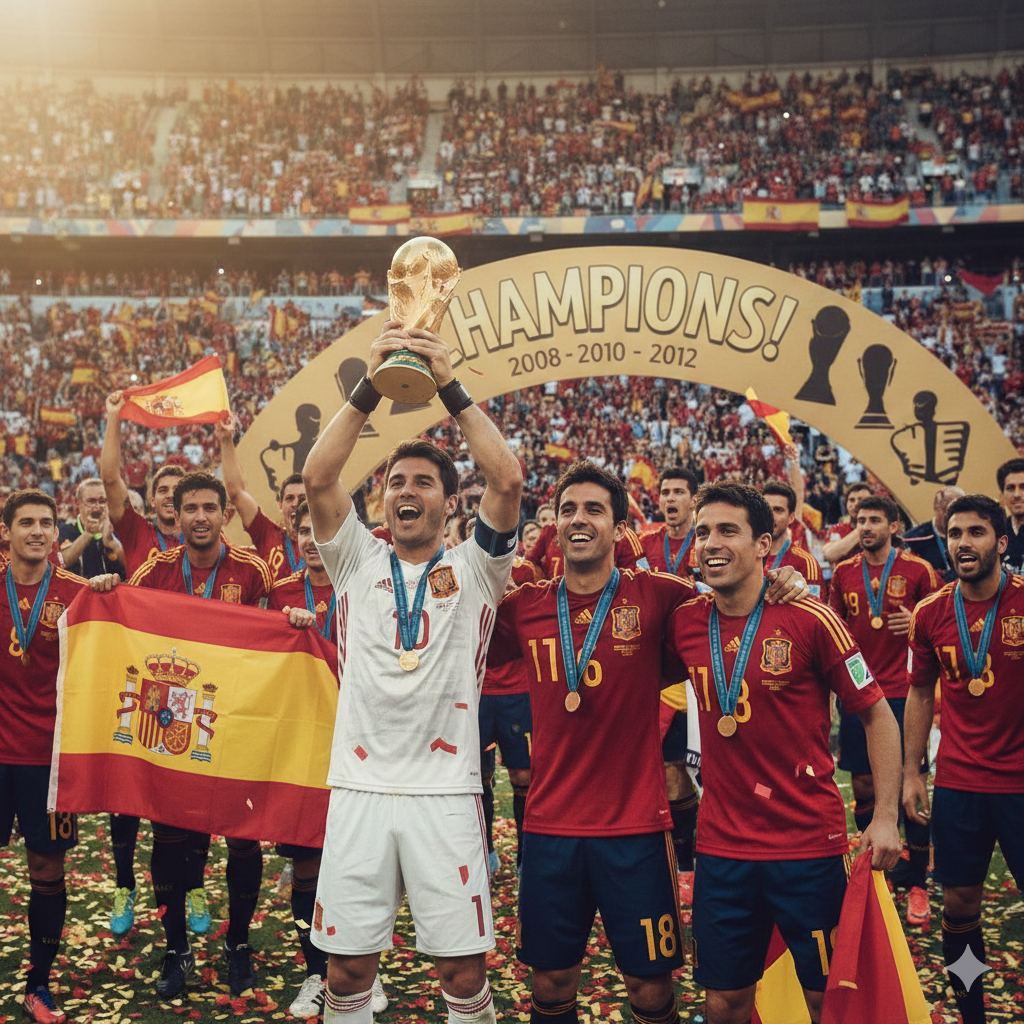
The transition from a team defined by volatile passion (La Furia Roja) to one characterized by meticulous, almost scientific control (Tiki-Taka) was not accidental. It was the result of a calculated cultural and tactical revolution, spearheaded first by Luis Aragonés and perfected by Vicente del Bosque. This period saw the Spain national teamachieve an unmatched treble: consecutive victories at the UEFA European Championship in 2008 and 2012, flanking their historic triumph at the 2010 FIFA World Cup. This article will dissect the making of this dynasty, exploring the tactical genius, the key figures, and the lasting global legacy of the finest iteration of the Spain national team.
Table of Contents
I. The Foundations: Aragonés, the Euro 2008 Breakthrough, and the Birth of Tiki-Taka
The journey of the golden age Spain national team began with a controversial yet crucial decision by coach Luis Aragonés: prioritizing technical skill and midfield control over traditional physical strength and flair. Aragonés realized that for the Spain national team to finally break its psychological barriers, it needed to completely change its identity. The reliance on long passes and aggression was replaced by the philosophy of possession as defense.
The Paradigm Shift: Possession is Protection
The term Tiki-Taka became synonymous with the Spain national team during this era, defining a style built on short, rhythmic passing triangles designed to exhaust the opponent and open up defensive lines. The core principle was simple yet profound: the opponent cannot score if they don’t have the ball. This dedication to ball retention, often pushing possession statistics well above the 65% mark, required players of supreme technical ability who were comfortable operating in tight spaces.
The successful implementation hinged on the exceptional coordination between a core group of midfielders, most notably Xavi Hernández and Andrés Iniesta, who functioned as the primary clockmakers of the team. Their ability to deliver high-volume, high-accuracy passes (Xavi famously completed a tournament-best 544 passes at the 2010 World Cup, as noted by FIFA statistics) meant the Spain national team dictated the tempo of every single match. This intricate passing style required constant movement off the ball, with players ensuring the man in possession always had three or four passing options available, creating an almost unbreachable defensive structure built on superior passing circuits.
Shattering the Curse at Euro 2008
The UEFA European Championship in 2008 was the litmus test for Aragonés’s new approach. The team showed a newfound mental strength, culminating in a tense final against Germany. Fernando Torres’s decisive goal secured the trophy, but the greater victory was psychological. The Spain national team had finally proven that their cultured, controlled style could win a major competition. Crucially, their victory in the quarter-final against Italy, breaking the infamous “quarter-final curse”, was seen by many as the single most important psychological turning point for this generation of players. This triumph confirmed their tactical revolution and marked the Spain national team as a true global contender.
The triumph propelled the Spain national team to the top of the FIFA World Rankings, establishing them as the team to beat heading into the next World Cup cycle.
II. The Apex of Glory: World Champions in South Africa (2010)
Following the Euro 2008 victory, Vicente del Bosque took over, inheriting a talented, cohesive, and psychologically sound squad. Del Bosque’s genius lay not in radical changes, but in subtle refinements and an unwavering trust in the core tactical philosophy. The 2010 FIFA World Cup in South Africa would become the crowning jewel in the history of the Spain national team.
Resilience and Efficiency: The World Cup Narrative
Spain’s campaign was defined by resilience rather than early flamboyance. They suffered a shock defeat in their opening match against Switzerland, a setback that ironically became a hallmark of the tournament, as they became the only team in World Cup history to lose their first match and still go on to win the title. From that point on, the Spain national team tightened their grip, winning every subsequent game 1-0. While critics pointed to their low goal tally (only 8 goals scored in seven games, a record low for a World Cup winner), their defensive and midfield control was unparalleled.
The defensive spine of the team, Iker Casillas (who won the Golden Glove), Carles Puyol, and Gerard Piqué, combined with the protection offered by defensive midfielders Sergio Busquets and Xabi Alonso, made them nearly impossible to break down. This defensive solidity allowed the attacking players, led by the tournament’s joint second-top scorer, David Villa (who scored 75% of Spain’s goals), the freedom to probe and pass until the defense finally cracked.
The Final and the Lasting Image
The final against the Netherlands was a notoriously physical and combative affair. Despite the intense pressure and the sheer volume of yellow cards (a World Cup final record 14), the Spain national team maintained their discipline and adherence to their passing game. The moment of glory arrived in the 116th minute of extra time: a pass from Cesc Fàbregas found Andrés Iniesta, whose powerful right-footed shot found the corner of the net, giving the Spain national team their first-ever World Cup trophy.
The legacy of this victory transcends the trophy itself; it cemented the technical supremacy of the Spanish style and completed the transformation of the Spain national team from eternal underachievers to World Champions.
You can find an in-depth breakdown of the players and tactics in How Spain Became Invincible From 2008 To 2012. This video is relevant because it discusses the key players and their roles in the dominant era of Spanish football from 2008-2012, which is the focus of this blog post.
How Spain Became Invincible From 2008 To 2012 – YouTube
Soccer Stories – Oh My Goal · 59K views


III. Unprecedented History: Retaining the European Crown (2012) and the Global Legacy
The final act of the Spain national team‘s golden era came at the 2012 European Championship in Poland and Ukraine, and it was a masterpiece of tactical adjustment and execution. After struggling through the group stages with performances that seemed less dynamic than in years past, Vicente del Bosque made his most celebrated tactical shift.
The Tactical Evolution: The ‘False Nine’ Experiment
Faced with opponents who were increasingly prepared to defend deep and counter against the Tiki-Taka model, Del Bosque decided to ditch the traditional center-forward altogether for much of the tournament. He often deployed a ‘False Nine’—a flexible attacker like Cesc Fàbregas, who dropped deep into the midfield. This move was revolutionary because it achieved two crucial goals:
- Midfield Overload: It added a sixth, technically gifted player to the already dominant midfield (Xavi, Iniesta, Busquets, Xabi Alonso, and David Silva), making it virtually impossible for opponents to win the ball centrally. This was crucial for the Spain national team to control the flow of the game.
- Defensive Confusion: It dragged the opposing center-backs out of position, creating space for the wide players (Jordi Alba and Álvaro Arbeloa) and the roaming number tens (Iniesta and Silva) to attack the space behind the defense. As analysts noted, Xavi also played further forward in the final, directly pressing Andrea Pirlo and denying Italy’s playmaker the space he needed to start attacks.
This tactical fluidity culminated in the final against Italy, where the Spain national team delivered their most comprehensive and arguably best performance of the dynasty, winning 4-0. The scoreline was a brutal demonstration of their efficiency and control, making them the first national team in history to secure a hat-trick of major tournament victories (Euro 2008, World Cup 2010, Euro 2012). This was a definitive exclamation point, confirming the Spain national team as the most dominant force of the modern era. Across these three tournaments, the Spain national teamnotably did not concede a single goal in any of the knockout stages, a testament to their unparalleled control and defensive mastery achieved through possession.
The Cultural and Global Impact of La Roja
The enduring influence of the golden generation of the Spain national team cannot be overstated. Their success fundamentally altered how football was viewed and taught globally. Academies and clubs across the world, from youth levels to professional leagues, began to prioritize technical proficiency and possession above all else. Coaches were forced to study and counter the Tiki-Taka model, leading to new tactical developments, such as the high-pressing, vertical counter-attacking styles designed specifically to disrupt the rhythmic passing of the Spain national team.
The key players from the Spain national team, particularly Xavi and Iniesta, became the blueprint for the modern central midfielder, a creative orchestrator capable of defending through possession. Their legacy continues through the current generation of players, like Rodri, Pedri, and Gavi, who ensure that the philosophy of the Spain national teamremains technically demanding. You can learn more about the current evolution of the team on their official page: [spain national team] (Internal Link).
IV. The Architects and Icons: The Spine of the Dominance
The success of the Spain national team was not merely a result of a philosophy; it was the result of a uniquely perfect blend of talent executing that philosophy. The team was built around an unshakable spine of players who had matured together through Spain’s highly successful youth system and domestic club rivalries.
The Managers: Visionaries of Change
- Luis Aragonés: The initial architect. He had the courage to break with the tradition of La Furia Roja and instill the Tiki-Taka philosophy. His difficult decision to phase out older stars like Raúl to make way for the midfield technicians was the single bravest and most important move in the history of the modern Spain national team.
- Vicente del Bosque: The maintainer and perfecter. Del Bosque inherited an excellent, mentally-tough squad and, rather than disrupting it, he provided the calm leadership and subtle tactical refinements (like the False Nine) needed to translate continental success into global dominance for the Spain national team. His gentle management style fostered unity between the often-fractious Real Madrid and Barcelona contingents.
The Core Icons
- Iker Casillas (Goalkeeper): Nicknamed San Iker (Saint Iker), he was the undisputed leader and captain. His shot-stopping heroics, especially a crucial save against Arjen Robben in the 2010 World Cup final, were as vital as the goals scored. He won the Golden Glove in 2010.
- Sergio Ramos and Gerard Piqué (Defense): An iconic, if improbable, central defensive partnership. Ramos, the aggressive Real Madrid stalwart, complemented Piqué, the ball-playing Barcelona defender. Their mutual understanding and technical ability were crucial for starting attacks from deep, a non-negotiable requirement for the Spain national team style.
- Xavi Hernández and Andrés Iniesta (Midfield): The technical heartbeat. Xavi, the ‘Metronome,’ dictated the pace and direction of play with inhuman passing accuracy, earning the Euro 2008 Player of the Tournament award. Iniesta, the ‘Illusionist,’ added the vital verticality, dribbling brilliance, and the flair to break down defenses, culminating in the winning goal of the World Cup final. Sergio Busquets served as the indispensable anchor, recycling possession and providing defensive intelligence that allowed Xavi and Iniesta their freedom.
- David Villa (Attack): Spain’s all-time top scorer. Villa provided the ruthless finishing edge, particularly at the 2010 World Cup where he scored five of the team’s eight goals, ensuring the Spain national team had enough cutting edge to capitalize on their midfield dominance.
V. The Post-Dominance Era and Future of the Spain National Team
Inevitably, the golden age of the Spain national team came to an end. The 2014 World Cup marked a harsh reality check, with the reigning champions crashing out in the group stage, signaling the difficulty of maintaining such a demanding style of play once the core players aged. Successive tournaments saw the Spain national team struggle to evolve, relying too heavily on the Tiki-Taka philosophy without the genius of its originators. They fell to the Round of 16 in the 2018 World Cup and the 2022 World Cup, demonstrating the challenge of replacement.
The New Dawn and the 2024 European Triumph
The period of relative disappointment proved to be a necessary transition. Spain has since rebuilt around a new crop of outstanding young talent, proving that the nation’s commitment to technically-gifted players remains strong. The current generation features exceptional young stars like Pedri, Gavi, and Lamine Yamal, players who, crucially, still adhere to a philosophy of technical superiority and high intelligence.
This renewed focus led to a significant return to glory, confirming a new era for the Spain national team. Under coach Luis de la Fuente, they secured victory in the 2023 UEFA Nations League, marking their first major international trophy since 2012. More impressively, the Spain national team went on to win Euro 2024, showcasing a refined tactical approach that blends the old possession control with more direct, aggressive wing play, capitalizing on the speed of players like Nico Williams and Lamine Yamal. This victory marked a record-breaking fourth European title for the Spain national team and demonstrated a successful evolution of their identity.
A Lasting Legacy and the Path Ahead
The story of the Spain national team from 2008 to 2012 is a foundational chapter in modern football history. It proved that a national team could achieve prolonged success by adopting a complex, cohesive, club-like tactical identity, relying on intelligence and skill over raw physicality. While the faces and specific tactics have changed, the current team is more pragmatic and vertical, the commitment to technical excellence and positional play instilled by Aragonés and perfected by Del Bosque remains the indelible hallmark of the Spain national team.
With a wealth of young talent ready to lead the charge into the 2026 World Cup and beyond, the history of the Spain national team suggests that their current success is not an anomaly, but the start of another sustained challenge for global dominance.
This video explores the tactics of the Spanish team during their Golden Era. For a more visual breakdown of the famous “False 9” tactical formation, you can watch False 9 Tactical Formation Made Famous by the Spain National Team.
False 9 Tactical Formation Made Famous by the Spain National Team – YouTube

Take Your Game Knowledge to the Next Level!
The golden era of the Spain National Team taught us that success isn’t built on luck, but on precise strategy, deep analysis, and vision. Just as Luis Aragonés and Vicente del Bosque dissected opponents to build their dominant dynasty, we dedicate ourselves to dissecting the world of football to bring you the sharpest insights.
You’ve just read an in-depth analysis of one of football’s greatest stories, now, apply that knowledge by staying ahead of the curve!
Don’t Just Watch the Game, Predict It!
Are you tired of relying on gut feeling? Do you want to receive predictions that are grounded in the same level of tactical and historical analysis you just absorbed?
Subscribe to our exclusive newsletter today and get the best predictions delivered straight to your inbox. We cover major tournaments, league matches, and provide in-depth analysis on the teams most likely to dominate the modern era, including the latest form and tactical shifts for the current Spain National Team!
What You Get When You Subscribe:
- Exclusive Predictions: Early access to our expert forecasts for all major upcoming matches involving top teams.
- In-Depth Tactical Breakdowns: Understand why we pick a certain result with analysis mirroring the detail of this article.
- Weekly News & Stats Digest: Stay informed on injuries, form, and tactical changes before they hit the headlines.
Ready to turn your passion into precision?
Click here to subscribe now and join our community of informed fans!