
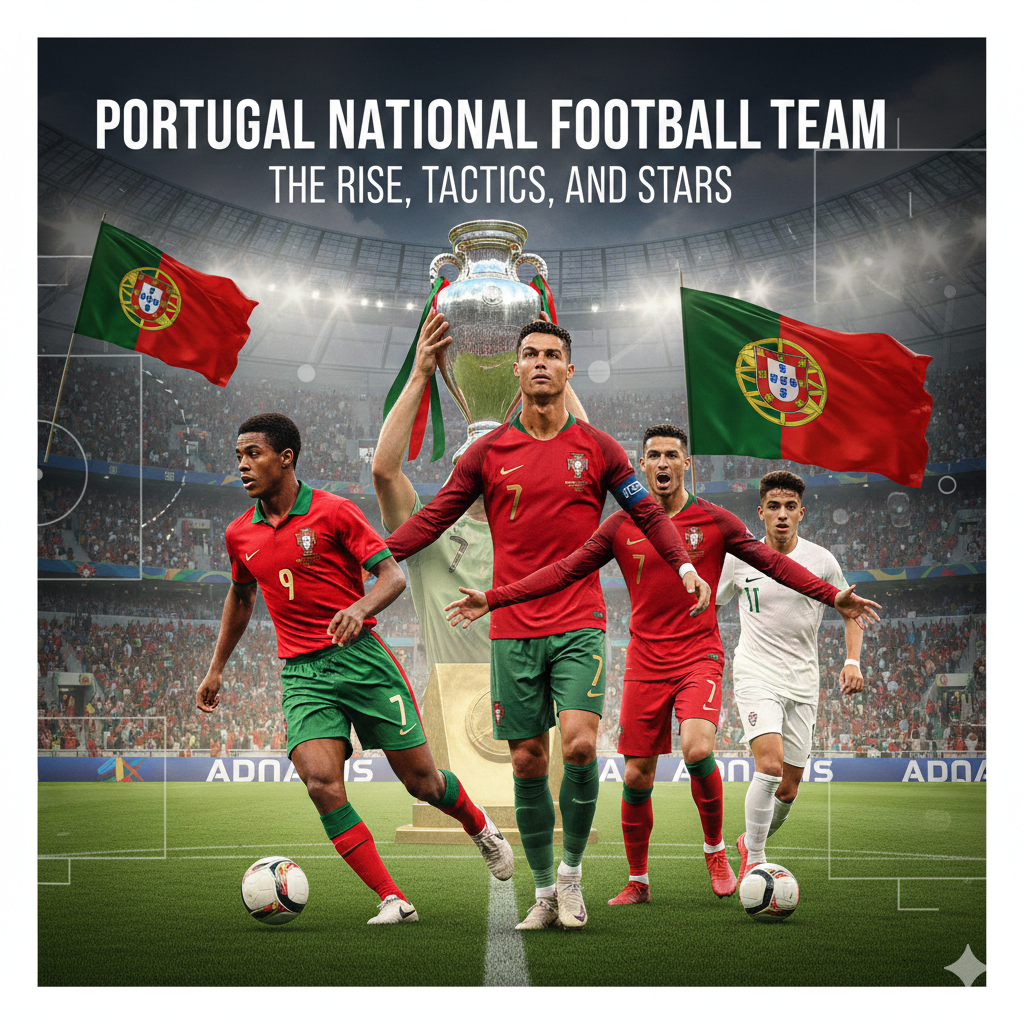
Introduction: The Phoenix of the Iberian Peninsula
The story of the Portugal national football team is one of brilliant peaks, frustrating valleys, and a constant, beautiful evolution. For decades, the Seleção das Quinas were considered the eternal dark horse, a team of stunning individual talent, from Eusébio to the Golden Generation of Figo, who often fell short of the ultimate prize.
That narrative was shattered in 2016.
The victory at UEFA Euro 2016, followed by the inaugural UEFA Nations League title in 2019, marked a seismic shift.Portugal transformed from a team reliant solely on flashes of genius into a European footballing power with a winning mentality. Today, under the guidance of Roberto Martínez, a new era is dawning. It is a period defined by a blend of tactical flexibility, high-pressing aggression, and a phenomenal depth of talent that seamlessly mixes legendary experience with youthful exuberance.
This post delves deep into the mechanisms of this modern footballing giant. We will trace the historical roots of the national team’s identity, dissect the sophisticated, dynamic tactics of the current coaching regime, and shine a spotlight on the phenomenal athletes, both established stars and burgeoning prodigies, who are positioning the Portugal national football team to challenge for every major honor on the global stage. This is more than just a squad; it is a meticulously crafted machine ready to define the next decade of international football.
Table of Contents
I. From Os Magriços to the Golden Generation: The Historical Foundation
The modern dominance of the Portugal national football team is not an overnight success but the culmination of nearly sixty years of evolving footballing identity. It is a history punctuated by three distinct eras: the initial burst of the Black Panther, the dazzling but trophy-less promise of the Golden Generation, and the ultimate arrival of a global icon.
1.1 Eusébio and the 1966 World Cup: The First Great Peak
The world first took serious notice of Portuguese football at the 1966 FIFA World Cup in England. The squad, affectionately nicknamed Os Magriços, captivated fans with their attacking flair and introduced the legendary Eusébio da Silva Ferreira to the global stage. Eusébio, the “Black Panther,” delivered a phenomenal individual performance, scoring nine goals, securing the tournament’s Golden Boot, and almost single-handedly driving Portugal to an improbable third-place finish, still the nation’s best World Cup result.
His quarter-final performance against North Korea remains one of the most remarkable comebacks in tournament history: trailing 0–3 after 25 minutes, Eusébio scored four consecutive goals to secure a sensational 5–3 victory. The emotional semi-final loss to the eventual hosts, England, known in Portugal as the Jogo das Lágrimas (Game of Tears), cemented the 1966 team as national heroes and established a high-water mark of achievement that would take decades to approach again. For a deeper look at the lasting legacy of Eusébio, check out this excellent piece on his impact: The Legacy of the Black Panther.
1.2 The Golden Generation: Promise Unfulfilled
Following a long period of inconsistency, a new wave of generational talent emerged in the late 1980s. This Golden Generation, a moniker earned after winning the FIFA U-20 World Cup in both 1989 and 1991, featured a dazzling collection of players: Luís Figo, Rui Costa, João Pinto, and Vítor Baía. These players were not just individually gifted; they were the embodiment of Portuguese flair and technical artistry.
Their collective presence propelled the national team back into relevance, consistently reaching the knockout stages of major tournaments (Euro 2000 semi-finals, Euro 2004 runners-up, 2006 World Cup fourth place). While their beautiful, attack-minded football won admirers, the ultimate prize, a major trophy, eluded them. Their defeat in the final of Euro 2004, hosted on home soil, remains a painful footnote, highlighting the lingering gap between immense talent and championship pedigree that the Portugal national football team struggled to bridge.
1.3 The Ronaldo Factor: Shifting the Paradigm
The emergence of Cristiano Ronaldo in the early 2000s initially coincided with the final years of the Golden Generation, providing a spectacular bridge between eras. He quickly evolved from a raw, flashy winger into the most prolific goalscorer in the sport’s history. His arrival didn’t just add world-class quality; it fundamentally altered the mentality of the squad.
Ronaldo’s relentless drive, record-breaking ambition, and singular focus on victory instilled a new level of professionalism and self-belief into the national team setup. By the time the Golden Generation retired, Portugal was no longer just a team of hopeful talent; they were a serious, competitive force designed around their talisman to contend on every international stage. This transition, fueled by Ronaldo’s unparalleled commitment, laid the groundwork for the ultimate successes that would follow a decade later.
You can watch a tribute to the legendary Eusébio and his goals from the 1966 World Cup here: Eusébio – England 1966 – 9 goals.
Eusébio – England 1966 – 9 goals – YouTube
Barbosa Fútbol Videos · 55K views

II. The Triumphant Era: Euro 2016 and Nations League Victories of the Portugal national football team
The years 2016 and 2019 irrevocably redefined the legacy of the Portugal national football team. These were the years when the team shed its reputation as the “eternal dark horse” and finally claimed two major international titles, fundamentally shifting the country’s footballing narrative from one of flair and frustration to one of grit, pragmatism, and ultimate success.
2.1 The Defensive Masterclass of Fernando Santos (2014-2022)
The architect of this transformation was manager Fernando Santos, who took the reins in 2014. Santos, an engineer by trade, instilled a pragmatic, defense-first philosophy, prioritizing structure and resilience over the free-flowing attacking style often associated with Portuguese football.
The journey through UEFA Euro 2016 perfectly exemplified this approach. The team progressed from the group stage with three draws, winning only one match in 90 minutes throughout the entire tournament (the semi-final against Wales). Key to their success was defensive solidity. Centre-backs Pepe and José Fonte formed an unyielding partnership, while goalkeeper Rui Patrício delivered several man-of-the-match performances. This tactical shift marked a significant departure from the ‘Golden Generation’ era, proving that a disciplined, cohesive unit could overcome superior technical adversaries.
The final against host nation France encapsulated this defensive masterclass. When captain Cristiano Ronaldo was forced off early due to injury, the Seleção did not crumble. Instead, they dug in, maintained their shape, and frustrated the French attack for 109 minutes. The unlikely hero, substitute striker Éder, then struck a powerful, long-range goal in extra time, sealing a 1-0 victory and the country’s first-ever major trophy. The win was a triumph of tactical discipline and mental fortitude.
2.2 The Inaugural UEFA Nations League (2019)
The Euro 2016 victory was crucial, but it was sometimes criticized as a fluke due to the team’s drawing of matches and a fortunate tournament bracket. The success in the inaugural UEFA Nations League three years later firmly cemented Portugal’s new status as a major European power.
Hosting the tournament finals in 2019, the Portugal national football team demonstrated a more mature, slightly more expansive brand of football, integrated with the solid defense Santos had built. The semi-final saw a vintage performance from Cristiano Ronaldo, who scored a sensational hat-trick against Switzerland to secure a 3-1 win.
The final pitted Portugal against a resurgent Netherlands team featuring Virgil van Dijk and Frenkie de Jong. The 1-0 victory at the Estádio do Dragão in Porto was secured by a brilliant strike from forward Gonçalo Guedes. This tournament proved that the 2016 success was not an anomaly; it demonstrated the depth and consistency of the squad, earning a second major title in just three years and further justifying the shift in national footballing identity.
2.3 The Shift in Mentality: The Winning Habit
Perhaps the most enduring legacy of this triumphant era is the profound shift in the team’s mentality. The pain of the past, the Euro 2004 final defeat and the repeated near-misses of the Golden Generation, was replaced by an unshakable confidence. The Portugal national football team learned how to navigate tournament football, not just by playing attractive football, but by knowing how to win.
This period nurtured new leaders, notably Pepe, who delivered a monumental performance at Euro 2016, and established a foundation for future stars like Bernardo Silva, who was named Player of the Tournament in the Nations League. Winning bred the expectation of winning, which is now the defining characteristic of the modern Portuguese squad.
This video shows the highlights from the inaugural UEFA Nations League final against the Netherlands: Portugal 1 x 0 Netherlands | 2019 Nations League Final Extended Highlights & All Goals HD.
Portugal 1 × 0 Netherlands | 2019 Nations League Final Extended Highlights & All Goals HD

III. The Tactical Evolution under Roberto Martínez of the Portugal national football team
The appointment of Roberto Martínez in January 2023 signaled a definitive break from the pragmatic, low-block defensive style championed by his predecessor, Fernando Santos. Martínez, known for his high-possession and attacking football with Belgium, has swiftly initiated a sweeping tactical evolution for the Portugal national football team. The goal is clear: to leverage the immense technical talent available across the pitch and transition into a truly dominant, possession-based European powerhouse.
3.1 The Fluid Formation: 4-3-3/3-4-3 Hybrid
Martínez’s philosophy centers not on a rigid system, but on tactical flexibility and utilizing the players’ strengths. While the primary base formation often appears as a 4-3-3 in the mid-block, it transforms dramatically during the build-up phase.
In possession, the formation often morphs into a dynamic 3-2-5 or 3-4-3 structure. This is achieved through the movements of the fullbacks and the defensive midfielder. Typically, one full-back (often the left-sided player) pushes high to become a genuine winger/wing-back, while the other full-back or a defensive midfielder (like João Palhinha) drops into the backline, creating a stable back three with the two centre-backs. This manipulation creates overloads in central midfield and allows for safer, shorter passes out from the defense, effectively bypassing the opponent’s initial press.
3.2 High Press and Fluidity in Possession
Martínez places immense value on being aggressive without the ball. In contrast to the deep, passive defensive strategy of the past, the Portugal national football team now employs an intense, high press in a middle-high block, often utilizing a man-to-man marking scheme in the opposition’s half. This is essentially using defense as an attacking threat, aiming to win the ball back high up the pitch to create immediate goal-scoring opportunities before the opponent can reset.
When in possession, fluidity and rotation are paramount. Midfielders and attackers constantly interchange positions to disrupt the opposition’s defensive structure. Fullbacks frequently push high, while the central midfielders, particularly Bruno Fernandes and Bernardo Silva, drop deep or move wide to link play. This versatility is designed to stretch opponents and create passing lanes through the middle. Portugal’s ability to maintain a high backline aids in this counter-pressing, ensuring the team stays compact and close to the action when possession is lost.
3.3 Exploiting the Half-Spaces with Creative Maestros
The tactical centerpiece of Martínez’s attack is the exploitation of the half-spaces, the dangerous channels between the opponent’s center-back and full-back. This is where the world-class talent of Bruno Fernandes and Bernardo Silva truly shines.
- Bruno Fernandes: Operating primarily as an attacking midfielder or an “advanced playmaker,” Fernandes serves as the team’s creative conductor. His exceptional vision and passing range allow him to play defense-splitting through-balls into the half-spaces for running forwards or wingers. He is constantly looking to receive the ball behind the opponent’s midfield line to turn and drive at the defense.
- Bernardo Silva: The technical maestro often operates on the right wing but has the freedom to drift centrally, acting as an inverted winger or a shadow striker. His close control and low center of gravity make him invaluable in tight spaces. When the winger (e.g., Rafael Leão on the left) draws the opposing full-back, Silva can make a diagonal run into the half-space, or receive the ball centrally and combine perfectly with Fernandes to unlock the defense. This symbiotic relationship provides the cutting edge for the modern, dynamic attack of the Portugal national football team.
This tactical shift has been decisive, transforming the team into one of the highest-scoring international sides in qualification campaigns, blending defensive structure with scintillating, high-tempo attack.
This video provides a detailed breakdown of Roberto Martínez’s tactical approach with Portugal in a 4-2-3-1 formation. Roberto Martinez’s 4-2-3-1 Formation: The Key to Portugal’s EURO 2024 Success | EA FC 24 – YouTube
Roberto Martinez’s 4-2-3-1 Formation: The Key to Portugal’s EURO 2024 Success | EA FC 24 – YouTube
Brom Squad Gaming · 1.3K views

IV. The Defensive Vanguard: Pillars of the Backline of the Portugal national football team
Under Roberto Martínez, the defensive unit of the Portugal national football team has evolved beyond mere resilience into a critical component of the team’s offensive strategy. The modern backline is built on a foundation of ball-playing ability, tactical intelligence, and world-class individual talent, ensuring that the team can defend securely while initiating sophisticated attacks from the deepest areas of the pitch.
4.1 Rúben Dias: The Modern Defensive Leader
The bedrock of this defensive structure is Rúben Dias. The Manchester City centre-back is the quintessential modern defensive leader: physically imposing, tactically astute, and exceptional in possession. Dias doesn’t just win tackles and aerial duels; he organizes the entire defensive line, ensuring high levels of communication and coordination, especially when the team presses high.
His importance in ball progression is paramount. Martínez demands that his centre-backs act as the first playmakers. Dias possesses a reliable short passing range necessary for intricate build-up plays within the defensive third. Furthermore, his ability to step out of the defense with the ball and break the first line of an opponent’s press is essential to the fast, vertical nature of Portugal’s current tactical setup. His consistency and leadership have made him the undisputed successor to the legendary Pepe as the commanding voice at the heart of the defense.
4.2 The Full-back Overload: Attack and Transition
The role of the full-backs is arguably the most tactically demanding position in the current Portuguese setup, as they are crucial for providing attacking width and numerical advantages. Players like João Cancelo and Nuno Mendes are less traditional defenders and more wing-backs who operate high up the pitch.
- Cancelo’s Versatility: Cancelo is an exceptional two-sided full-back who often operates as an inverted full-back when deployed on the right. In this role, he drifts into the central midfield to help create overloads in the middle of the park, essentially acting as a fourth central midfielder during possession phases. This movement frees up wingers and allows for complex midfield rotations.
- Mendes’s Pace: On the opposite flank, Nuno Mendes provides explosive pace and directness. He typically holds the wide channel, stretching the opposition defense and providing the overlapping runs necessary to deliver crosses or cut-backs.
Their coordinated movements, one often inverting while the other holds the width, are vital to Martínez’s approach, ensuring that the defense is constantly challenged both centrally and wide, creating space for the technical midfielders to operate.
4.3 Goalkeeping Excellence: Diogo Costa
In goal, the emergence of Diogo Costa has provided the team with stability and a contemporary skill set. Costa is highly rated for his shot-stopping ability and commanding presence. Crucially, in Martínez’s system, he is an effective sweeper-keeper.
Costa is comfortable receiving the ball under pressure from his defenders, executing short passes, and acting as the final outlet in the build-up phase. His ability to launch accurate long passes also offers Portugal the option to quickly switch the play or bypass the opposition’s press when necessary. His blend of traditional goalkeeping solidity with modern ball-playing skills makes him an indispensable part of the defensive vanguard, ensuring that the Portugal national football team possesses technical quality and calmness from back to front.
V. The Midfield Engine: Creativity and Control of the Portugal national football team
The midfield is the beating heart of the modern Portugal national football team, acting as the essential link between the solid defensive base and the explosive attacking unit. Under Roberto Martínez, this area is characterized by a potent mix of creative genius, positional control, and tireless industry. Portugal is blessed with an abundance of world-class options, allowing them to dictate the tempo of matches and consistently unlock disciplined defenses.
5.1 Bruno Fernandes: The Creative Conductor
Bruno Fernandes is arguably the most critical component in Portugal’s creative machinery. Operating predominantly as a high-volume attacking midfielder, Fernandes is the side’s primary creative conductor and risk-taker. His role is to bridge the gap between midfield and attack, often making late runs into the box or spraying incisive passes from deep.
His key attributes include:
- Vision and Range: Fernandes possesses an exceptional passing range, capable of executing laser-guided through-balls to exploit the channels and the half-spaces, often turning defense into attack instantly.
- Goal Contribution: He doesn’t just create; he scores. His high volume of shots and penalty box presence ensures he is a consistent goal threat, contributing not only to assists but also delivering crucial goals in tight matches.
- Pressing Intensity: He embodies the modern requirement for an attacking player, working relentlessly in the high press to quickly recover possession, making him vital to Martínez’s counter-pressing philosophy.
5.2 Bernardo Silva: The Technical Maestro
If Fernandes is the conductor, Bernardo Silva is the technical maestro who sets the rhythm and provides the intricate solutions in tight areas. Silva’s versatility allows him to operate effectively across the midfield and attack, be it as an inverted winger, a central midfielder, or a false nine.
His contribution is founded on technical perfection:
- Close Control: Silva’s control in crowded central areas is virtually unmatched, allowing him to maintain possession under intense pressure and draw fouls, relieving pressure on the defense.
- Decision-Making: He consistently makes the correct decision, opting for the simple, high-percentage pass that keeps the attack flowing, often providing the “pass before the assist.”
- Tactical Intelligence: His innate understanding of space and movement allows him to drift into unexpected positions, creating overloads and passing triangles that destabilize the opponent’s defensive structure. He is the glue that ensures the team’s intricate possession sequences remain fluid and effective.
5.3 The Future of the Pivot: Stability and Potential
The foundation that supports the attacking talents of Fernandes and Silva is the stability provided by the defensive pivot. The current core is anchored by João Palhinha, whose presence is a throwback to a more traditional defensive midfielder.
- João Palhinha’s Defensive Stability: Palhinha is essential for his ball-winning ability, aerial presence, and positional discipline. He screens the back four, provides reliable cover when the fullbacks push forward, and acts as the crucial anchor in transitions. His presence allows the more creative players to operate with confidence further up the field.
- The Exciting Potential of João Neves: Waiting in the wings is the highly-rated teenage prodigy João Neves. Neves represents the new era of Portuguese midfielders: technically refined, tenacious in the tackle, and adept at progressing the ball through short, sharp passes. He offers a more dynamic, deep-lying playmaker option for the future, ensuring the Portugal national football team has a sustained pipeline of excellence in the crucial midfield engine room.
VI. The Attacking Force: Pace, Power, and the Legend
The attacking third of the Portugal national football team is a compelling blend of generational experience and raw, explosive talent. It is an area defined by tactical variety, high-volume goal-scoring, and the enduring presence of the most iconic player in the nation’s history. Under Roberto Martínez, the focus is on maximizing the output of these diverse forwards, using their unique strengths to create both wide threats and central finishes.
6.1 Cristiano Ronaldo: The Enduring Icon
The narrative of the Portuguese attack remains intrinsically linked to Cristiano Ronaldo. Now in the twilight of his career, the team’s all-time leading goalscorer and captain has transitioned from the electric, wide forward of his youth into a highly efficient, central goal-poacher.
His evolving role is critical:
- Central Focal Point: Ronaldo primarily operates as a traditional number nine, relying on his movement in the box, aerial prowess, and elite finishing instincts. His world-class positioning ensures he is often in the right place to convert the chances created by the creative midfield.
- Leadership and Influence: Beyond the goals, his presence provides invaluable leadership and a championship mindset, inspiring younger players and demanding the highest standards in training and matches. His sheer global status also brings an elevated sense of occasion to every game the Portugal national football team plays.
- Goal-Scoring Efficiency: Despite his age, his output remains phenomenal, particularly in qualifying tournaments, proving he is still a decisive figure whose experience is leveraged to secure victories.
6.2 Rafael Leão: The Explosive Winger
Providing the crucial asymmetric threat, particularly on the left flank, is Rafael Leão. Known for his blistering pace, strength, and exceptional dribbling ability, the AC Milan star is the perfect modern winger to exploit the spaces created by Portugal’s congested midfield build-up.
Leão’s role is to disrupt and create chaos:
- The Wide Threat: He holds the width on the left, forcing the opposition full-back deep, which creates critical space for the inverted movements of midfielders like Bruno Fernandes and Bernardo Silva.
- Solo Runs and Creativity: He is one of the team’s best players in one-on-one situations, often embarking on explosive, long carries of the ball that turn defense into attack in seconds. His final delivery, whether a sharp cut-back or a driven pass, provides a constant stream of opportunities for the central attackers.
- Pace in Transition: Leão is devastating on the counter-attack, using his speed to punish high defensive lines, making him a central pillar of Martínez’s preference for fast, vertical football.
6.3 The Center-Forward Options: Tactical Flexibility
While Ronaldo remains the primary central figure, the squad depth allows Martínez to deploy high-quality alternatives, offering different tactical profiles depending on the opponent.
- Gonçalo Ramos: The younger, versatile striker offers excellent pressing ability and a high work rate, which fits perfectly with the aggressive defensive block. Ramos is renowned for his clinical finishing inside the box and provides an energetic foil to Ronaldo’s more positional style.
- Diogo Jota: Jota is perhaps the most tactically flexible option. He can play across the front three, offering intelligence in his movement and an innate ability to score scrappy, crucial goals. His tireless running and off-the-ball movements are invaluable for creating space for others.
This trio, the enduring power of Ronaldo, the blistering pace of Leão, and the interchangeable talent of the other central options, gives the Portugal national football team a multidimensional attacking threat that few international rivals can match.
VII. The Youth Revolution: Portugal’s Next Golden Crop of the Portugal national football team
The sustained success of the Portugal national football team is guaranteed not just by the current generation of stars but by an assembly line of world-class talent continuously rolling off the nation’s top academy floors. This “Youth Revolution” ensures longevity and constant competition for places, preventing complacency and securing Portugal’s status as a formidable footballing nation well into the future. The country’s commitment to youth development is among the best in the world, fostering players who are technically gifted, tactically aware, and mentally prepared for the highest level.
7.1 Scouting the Academies: The Prolific Trio
The continuous influx of high-quality players is a direct result of the meticulous and world-renowned youth development systems of Portugal’s Os Três Grandes (The Big Three): Sporting CP, S.L. Benfica, and FC Porto.These academies have consistently proven their ability to nurture talent that defines eras:
- Sporting CP (Academia Cristiano Ronaldo): The birthplace of Cristiano Ronaldo, Luís Figo, and Bruno Fernandes, Sporting focuses heavily on technical fundamentals, discipline, and building a professional mindset from a young age. Their development system instills an attacking flair often seen in their graduates.
- S.L. Benfica (Benfica Campus): Widely recognized as a leading global talent factory, Benfica integrates sports science and a competitive environment, producing stars like Rúben Dias, Bernardo Silva, and João Félix. Their methodical approach focuses on creating well-rounded, adaptive players.
- FC Porto: The northern giant instills grit, resilience, and tactical discipline, preparing players like Diogo Costa and Vitinha for high-pressure situations, creating individuals who are mentally tough and quick thinkers.
These institutions provide structured development pathways, competitive B-team environments (like those in the second division), and a clear route to first-team football, which is crucial for player maturation.
7.2 Rising Stars to Watch: António Silva and João Neves
Two players, both products of the Benfica Campus, have rapidly emerged as the central pillars of Portugal’s future, embodying the technical and psychological strength of the current youth revolution:
- António Silva (Defender): Despite his young age, Silva has already established himself as a mature, first-team regular. He is a commanding centre-back who is comfortable on the ball, possessing the high level of passing quality and reading of the game required by Roberto Martínez’s system. He is calm under pressure and has the positional intelligence to maintain a high defensive line, making him a long-term heir to the defensive leadership role.
- João Neves (Midfielder): A diminutive, tenacious central midfielder, Neves has been lauded for his technical ability, low centre of gravity, and relentless work rate. He is a press-resistant player who excels at breaking the opponent’s first line of pressure through his quick dribbling and sharp passing. He provides a more dynamic, ball-progressing option in the defensive midfield pivot, complementing the more combative style of João Palhinha. Both Silva and Neves have been recognized as nominees for the prestigious Golden Boy award, underscoring their world-class potential.
Other high-potential talents, such as Sporting CP’s Geovany Quenda and FC Porto’s Rodrigo Mora, are also making waves, demonstrating that the future depth of the Portugal national football team is secure across all positions.
7.3 Ensuring Longevity: A Sustainable Model
The continuous pipeline of talent is not accidental; it is a sustainable model of elite player production. Portugal benefits from a culture that values technical ability and a domestic league that provides young players with significant playing time before their inevitable moves to larger European leagues.
This model ensures that the senior squad is constantly refreshed with technically proficient, battle-tested players, eliminating the feast-or-famine cycle that plagues many other national teams. The successful integration of young players alongside veterans like Ronaldo and Pepe ensures that the hard-won experience and winning culture of the triumphant era are passed down, maintaining the competitive edge that defines the current Portugal national football team.
VIII. Key Rivalries and Iconic Matches of the Portugal national football team
The history of the Portugal national football team is enriched by defining rivalries and legendary matches that have shaped the team’s identity and tournament mentality. These contests, often steeped in geographical proximity, historical tensions, or repeated knockout stage clashes, are more than just games; they are emotional flashpoints that showcase the Seleção’s grit, brilliance, and occasional heartbreak on the grandest stages.
8.1 The Iberian Derby (vs. Spain)
The rivalry with neighboring Spain, popularly known as The Iberian Derby, is one of the oldest in international football, dating back to 1921. While Spain historically holds the advantage in the head-to-head record, the competitive matches in the 21st century have been fiercely contested battles of attrition and spectacle.
Key moments in this rivalry include:
- Euro 2004 Group Stage: Playing on home soil, Portugal secured a crucial 1-0 victory against the Spanish side, knocking them out of the tournament and fueling the belief that propelled Portugal to the final.
- 2010 World Cup Round of 16: Spain, on their path to lifting the trophy, edged Portugal 1-0 in a tense, tightly-fought affair, underscoring the difficulties Portugal faced against the dominant La Roja era.
- 2018 World Cup Group Stage: This match is perhaps the most iconic recent encounter, a pulsating 3-3 drawwhere Cristiano Ronaldo produced a mesmerizing performance, completing a magnificent hat-trick, capped by a stunning late free-kick to secure the draw. This match perfectly encapsulated the individual brilliance that the Portugal national football team has often relied upon against their more consistent neighbors.
These matches transcend the scoreboard, drawing passion from the deep, shared history of the Iberian Peninsula.
8.2 The French Hurdle: Redemption and History
The rivalry with France is defined by a consistent narrative of psychological dominance by Les Bleus in major tournament knockouts, only to be spectacularly reversed in the most important fixture of all. Before 2016, France had eliminated Portugal from three consecutive major tournament semi-finals:
- Euro 1984 Semi-Final: A classic, high-scoring contest in Marseille saw France win 3-2 after extra time, ending the dreams of a promising Portuguese side.
- Euro 2000 Semi-Final: A controversial Golden Goal penalty by Zinédine Zidane in extra time secured a painful 2-1 victory for France, denying the Golden Generation a shot at the final.
- 2006 World Cup Semi-Final: Once again, Zidane delivered the decisive blow with a penalty, securing a 1-0 win for France and eliminating Portugal from a World Cup semi-final spot.
This agonizing run created a massive psychological hurdle that the Portugal national football team finally smashed in the Euro 2016 Final. Playing in Paris, despite losing Ronaldo to injury early, Portugal produced a heroic defensive performance. The 109th-minute strike by substitute Éder secured a gritty 1-0 extra-time victory. This win was not just a trophy; it was an act of national redemption, shattering the French curse and completing the team’s shift in mentality from hopeful contenders to proven champions.
8.3 The Underdog Story: 1966 and the Great Comeback
While not a rivalry, the quarter-final match against North Korea at the 1966 FIFA World Cup stands as a testament to the never-say-die spirit that often surfaces in Portuguese teams. Trailing an astonishing 3–0 after just 25 minutes, the newly introduced Os Magriços stared down humiliation.
Led by the incomparable Eusébio, the team mounted one of the most famous comebacks in World Cup history. Eusébio scored four consecutive goals, including two penalties, to turn the deficit into a 4-3 lead. Portugal went on to win the game 5-3, securing their place in the semi-finals. This match is an enduring symbol of the explosive individual talent and resilience that remains a core element of the Seleção’s footballing DNA, often recalled when the team faces seemingly insurmountable odds.
IX. The Role of Portuguese Football Culture
Football in Portugal is far more than a sport; it is a profound element of the national identity, woven into the cultural fabric of the nation. The passion, the heartache, and the ultimate triumph of the Portugal national football team are all intrinsically linked to unique cultural concepts, a passionate fan base, and the unifying force of the global Portuguese diaspora.
9.1 Saudade and the Spirit of the Seleção
Perhaps the most unique cultural concept influencing Portuguese football is Saudade. This untranslatable Portuguese term signifies a deep emotional state of melancholic longing, profound nostalgia, or yearning for something absent that one loves. It is a feeling of incompleteness, often associated with a sense of loss or a bittersweet memory of a joy that may never return.
In the context of the Portugal national football team, Saudade has historically been a powerful, yet painful, motivator:
- The Ache of “Almost”: For decades, Portugal carried the Saudade of the Golden Generation’s near-misses and Eusébio’s tears in 1966. This collective longing for a major trophy fueled the passion of the fans and became the emotional backdrop to every tournament challenge.
- The Exorcism of 2016: The Euro 2016 victory was often viewed not just as a sporting win, but as an exorcism of Saudade. The collective achievement finally filled the long-empty space where the major trophy should have been, turning generations of longing into ultimate joy.
- A Continuous Resource: As football writers have noted, Saudade does not disappear with victory; it is a resource. It is the bittersweet memory that makes glory sweeter, ensuring the team plays with a persistent fire, a refusal to settle for less than they know they are capable of achieving.
For a deep dive into the meaning and cultural significance of Saudade, particularly in connection with Portuguese art and identity, check out this informative article. Cultural Insights: Understanding Saudade
9.2 The Fandom and Stadium Atmosphere
The support for the Seleção is famously vocal and atmospheric. Whether playing at the Estádio da Luz (Lisbon) or the Estádio do Dragão (Porto), match days are communal festivals. The stadium atmosphere is characterized by:
- Unwavering Passion: The adeptos (fans) are known for their unwavering loyalty, turning up in massive numbers for both competitive and friendly matches, regardless of form.
- National Unity: Unlike the intense and often fractured loyalties to domestic clubs (Benfica, Sporting, Porto), the national team acts as a singular unifying force, bringing together Portuguese people from all regions and social backgrounds under one flag.
- The Roar of the Seleção: The collective cheers, chants, and visual displays of the national colors (red, green, and gold) create an intimidating and inspiring environment for the players, driving them forward in tight contests.
9.3 Global Impact: The Strength of the Diaspora
One of the most defining aspects of support for the Portugal national football team is the immense and passionate backing from the Portuguese diaspora. Millions of people of Portuguese heritage live across the globe, in France, Switzerland, the United States, Canada, Brazil, and former colonies in Africa.
- “Home” Games Abroad: When Portugal plays a major tournament match in places like Paris, Toronto, or New York, the crowd is often dominated by fervent Portuguese fans, effectively turning the stadium into a ‘home’ environment. This widespread, global support is a massive psychological boost for the players, reminding them they are representing a nation that stretches far beyond its physical borders.
- A Cultural Bridge: Football serves as a crucial cultural bridge, linking generations of Portuguese immigrants and their descendants back to their heritage. A victory for the Seleção is a moment of shared national pride that transcends geographical distance.
- Talent Integration: The diaspora also contributes to the team’s talent pool. Historically, many top players, including the iconic Eusébio (born in Mozambique) and more recent players of colonial or international descent (like Deco, Pepe, and Éder), have worn the Portuguese shirt, symbolizing the integration and diversity that enriches the Portugal national football team.
X. Conclusion: The Road Ahead to the World Stage
The Portugal national football team stands today at a historical inflection point. Having successfully navigated the transitional phase following the triumphant era of Fernando Santos, the Seleção das Quinas is now a force redefined by tactical sophistication, generational depth, and a relentless pursuit of excellence under Roberto Martínez. The foundational work, from Eusébio’s pioneering spirit to the Golden Generation’s technical artistry, and the disciplined victories of 2016 and 2019, has culminated in the creation of a squad uniquely positioned to dominate the global stage.
10.1 A New Era of Expectation: From Dark Horse to Favorite
The most significant change in the Portuguese footballing identity is the shift in expectation. No longer content with merely being the “dark horse” capable of an upset, Portugal now enters every major tournament, whether the European Championship or the FIFA World Cup, as a genuine, primary favorite. This status is earned through a combination of factors:
- Tactical Dominance: The transition to a high-possession, attacking system under Martínez maximizes the team’s technical superiority in midfield.
- Consistent Quality: The seamless integration of youth ensures that there are world-class options in every position, providing depth that few international teams can match.
- Tournament Pedigree: Having demonstrated the ability to win knockout football, most notably by shattering the French curse, the squad possesses the mental fortitude necessary to close out major finals.
10.2 The Balance of Experience and Youth: The Ultimate Strength
The current squad’s ultimate strength lies in its meticulous balance. It is a harmonious blend of seasoned champions who have won every major trophy in club football, and exuberant young prodigies eager to make their mark.
- The Core of Experience: Veterans like Cristiano Ronaldo and Pepe provide crucial dressing-room leadership, competitive fire, and tactical know-how, ensuring the high standards of the championship-winning years are upheld.
- The Injection of Talent: The exciting dynamism provided by players such as Rafael Leão, João Neves, and António Silva injects pace, unpredictability, and energy, securing the team’s long-term competitive health.
This strategic mix ensures the team is both mature enough to handle knockout pressure and young enough to execute the high-tempo, demanding tactics of the modern game.
10.3 Final Verdict: Poised for Global Glory
From the individual heroics of Eusébio to the collective achievement in Paris, the journey of the Portugal national football team has always been captivating. Today, the Seleção possesses the highest level of technical talent and tactical flexibility in its history. The team’s ability to dominate possession, press intensely, and unlock defenses through the genius of players like Bruno Fernandes and Bernardo Silva positions them perfectly.
The road ahead is clear: the focus is on achieving the ultimate prize, the World Cup. With an established winning culture, a continuous supply of elite talent, and a tactical system designed for domination, the current Portugal national football team is not just competing; it is actively defining a new, golden chapter in international football, ready to cement its place among the greatest national sides in history.
Thank you for reading this comprehensive analysis of the Portugal National Football Team!
If you would like to delve deeper into the specific statistics, player profiles, or match histories mentioned in this post, please let me know.
Join the Seleção Community: Get the Best Predictions!
You’ve explored the history, analyzed the tactics of Roberto Martínez, and met the stars, from the enduring power of Cristiano Ronaldo to the blazing speed of Rafael Leão, that define the modern Portugal national football team. You understand the depth of talent, the shift in mentality, and the strategic planning that makes Portugal a favorite in every major tournament.
But tactical analysis only gets you halfway there. To truly stay ahead of the game, you need the inside track on team form, key injuries, predicted lineups, and head-to-head performance statistics before every international window.
Don’t Just Follow the Game, Predict It!
We provide the most informed, researched, and accurate predictions, taking into account:
- Martínez’s Evolving Formations: How the 4-3-3 hybrid will look against specific opponents.
- Player Rotations: Who rests and who starts in crucial qualification matches.
- Statistical Deep Dives: Historical data and recent player performance metrics.
Ready to elevate your football knowledge and impress your friends?
👉 Subscribe Now for Exclusive Insights!
Be the first to know the predicted starting XI, the tactical breakdown, and the final score prediction for every game the Portugal national football team plays.
Click Here to Subscribe to Our Exclusive Prediction Newsletter Today!
- ✅ Weekly Deep Dives: Detailed analysis sent straight to your inbox.
- ✅ Matchday Predictions: Pre-game previews with our best bets.
- ✅ Zero Cost: Absolutely free, delivered directly to you.
Join our community of informed fans and never miss a beat on the road to global glory!