

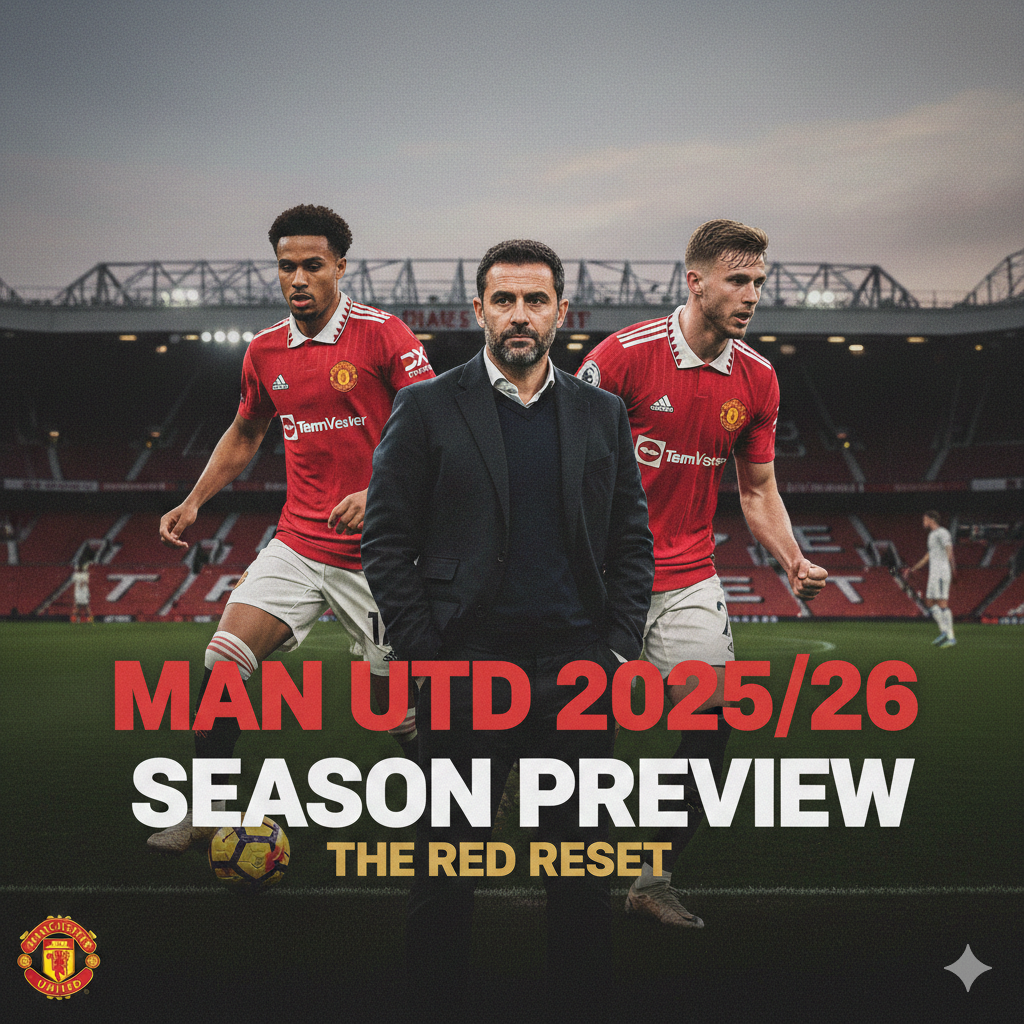
Introduction: The Year of Reckoning
The summer of 2025 was defined by a single, inescapable truth: the 2024/25 season was one of the worst in the modern history of man utd. Finishing 15th in the Premier League, a historically low ebb, meant the club was starting the new campaign with no European football for the first time in over a decade. This reality, however stark, has created a rare and vital opportunity: a clean slate. Under the continued, yet now fully empowered, leadership of Head Coach Rúben Amorim and the new INEOS sporting structure, the 2025/26 campaign is not about silverware; it is about building a sustainable foundation, instilling a non-negotiable tactical identity, and resetting the culture at Old Trafford.
The key question for the faithful is whether the substantial summer overhaul, particularly in the attacking third, can translate into the immediate, massive improvement required to lift the club back into the European places. This season preview will delve into the critical areas of change, analyze the key personnel tasked with driving the recovery, and set realistic expectations for a turbulent, yet potentially transformative, year for man utd.
Table of Contents
The Ghosts of Seasons Past (A Brief Review)
The 2024/25 campaign was defined by inconsistency, managerial change, and a staggering lack of goals, scoring a paltry 44 league goals across 38 games. The mid-season arrival of Rúben Amorim, succeeding Erik ten Hag, initially failed to spark the desired bounce, culminating in a 15th-place finish and an unfortunate Europa League Final loss to rivals Tottenham Hotspur. The statistics under Amorim, including a win rate of only 25.9% in the Premier League, highlighted a squad that was fundamentally ill-equipped to execute his demanding 3-4-3 system. The final league position and the meek exit from European competition provided a harsh, yet necessary, dose of reality, setting the stage for the dramatic summer of restructuring that followed.
The Summer Overhaul: Amorim’s Attack Rebuild
The primary failure of the previous season was a disjointed and often wasteful attack. The new management identified this as the priority, spending heavily and decisively to bring in players perfectly tailored to Amorim’s aggressive, vertical system. The summer saw significant departures, including Antony, Rasmus Højlund, and the high-profile loan of Marcus Rashford to Barcelona, making space for three major attacking additions.
The New Attacking Core: Matheus Cunha, Bryan Mbeumo, and Benjamin Šeško
The recruitment strategy was clear: buy proven Premier League quality combined with high-potential Bundesliga finishing.
Matheus Cunha (Signed from Wolves)
Cunha is the archetypal player for the fluid forward line in a 3-4-3. Capable of operating as a deep-lying striker or a narrow number ten, his relentless pressing, technical link-up play, and capacity to draw defenders will be vital. At Wolves, Cunha excelled in transitional play and provided significant creative output, qualities man utd desperately lacked. His arrival, alongside Mbeumo, is intended to relieve the playmaking burden that has overwhelmingly fallen on Bruno Fernandes for several seasons. He arrives with the expectation of being a central creative and goal-scoring hub.
Bryan Mbeumo (Signed from Brentford)
Mbeumo represents the direct, goal-scoring threat from the wide-forward positions that Amorim’s system relies on. A player who consistently delivered goals and assists for a mid-table side, Mbeumo’s xG over-performance suggests an elite level of composure and finishing instinct. His move to Old Trafford offers him the biggest stage of his career, and his proven Premier League output, specifically his ability to convert chances, makes him perhaps the most crucial acquisition. If Mbeumo can translate his form into a high-pressure environment, he will be central to the team’s resurgence.
Manchester United Summer Transfer Window Round-Up! – YouTube
Stretford Paddock · 36K views

Benjamin Šeško (Signed from RB Leipzig)
The signing of Benjamin Šeško addresses the long-term need for a commanding, clinical centre-forward. While Rasmus Højlund showed flashes, the new management clearly opted for a more traditional yet modern Number 9. Šeško, arriving for a significant fee from the German league, is less of a gamble than some critics suggest. His move from Austria to the Bundesliga was seamless, and he possesses the physical profile and aerial presence to lead the line, benefiting immensely from the creativity of Cunha and Mbeumo playing just behind him.
However, the pressure on a young player to perform immediately will be immense, especially following an early-season injury. The latest updates, such as those reported by Sky Sports on his return from a knee injury, will be closely monitored by the fan base as the fixture list becomes congested.
The Tactical Blueprint: Ruben Amorim’s Unwavering 3-4-3
The defining feature of Rúben Amorim’s tenure has been his rigid commitment to the 3−4−3 formation. While it was often unsuccessful last season due to a lack of personnel fitting the roles, he now has the components to make it functional.
3-4-3 / 3-4-2-1
The formation relies heavily on the wing-backs to provide the team’s width and crossing threat, as the wide attackers (Mbeumo and Cunha) operate in narrow, ‘half-space’ positions closer to Bruno Fernandes.
- Defence: The back-three, likely anchored by an experienced figure, requires highly mobile and ball-playing outside centre-backs (Leny Yoro, Matthijs de Ligt, or Luke Shaw).
- Midfield: The midfield pivot, where Kobbie Mainoo’s energy and technical composure will be vital, must be dominant both defensively and in initiating play. The rumored January interest in midfielders like Carlos Baleba highlights the continuous need for quality in this area.
- Attack: The front three is now built for pressing and verticality. The two attacking midfielders/narrow forwards (Cunha and Mbeumo) will create overloads, while the central striker (Šeško/Zirkzee) provides the finishing touch.
For a deeper dive into Amorim’s tactical philosophy and its successes at Sporting CP, you can read the analysis on the Tifo Football YouTube channel.
Key Players: The Spine of the Recovery
The success of the 2025/26 season hinges not just on the new signings, but on the ability of several key, established figures to lead the recovery on the pitch. These players form the core of the man utd spine.
1. Bruno Fernandes: The Captain, The Catalyst
Bruno Fernandes remains the undisputed heartbeat of the team. Last season, despite the chaos around him, he was often the sole reliable source of creativity and goals, scoring 19 in all competitions. The additions of Cunha and Mbeumo are designed specifically to improve his game. With more quality runners ahead of him, Fernandes can revert to his most natural and dangerous position, the true Number 10, focusing less on carrying the ball from deep and more on the final, killer pass. If man utd are to succeed, Fernandes must once again be their Player of the Season. The club’s desire to fend off lucrative offers from Saudi Arabia highlights his indispensable status.
2. Kobbie Mainoo: The Midfield Maestro
Kobbie Mainoo’s rise has been one of the few genuine positives of recent years. His composure under pressure, intelligence in possession, and defensive awareness at such a young age make him a foundational player for the new era. In Amorim’s system, the central midfield pairing is tasked with controlling tempo, shielding the back three, and linking defense to attack. Mainoo is uniquely suited to this role. However, the transfer speculation surrounding him (with interest reported from clubs like Bayern Munich) underscores the pressure on man utd to prove they are the right place for his development. Maintaining his fitness and managing his workload will be crucial, especially without European fixtures.
3. Leny Yoro: The Defensive Rock
The acquisition of Leny Yoro in the previous season, while currently developing, is expected to come into his own this term. As the young centre-back matures, he offers the perfect blend of physical dominance and technical ability required to operate on the right side of the back three. His performances in pre-season and early competitive games have been encouraging, showing the ability to step into midfield with the ball, a key characteristic for a team looking to build from the back. The defence needs to shed its reputation for conceding ‘soft goals’, and Yoro’s development will be a major factor in achieving defensive stability.
4. Diogo Dalot: The Wing-Back Engine
Diogo Dalot is a player who has thrived under multiple managers, and his profile perfectly fits the wing-back role in Amorim’s system. Unlike the previous structure, where he had to balance defensive stability with overlapping runs, the 3-4-3 grants him the license to operate as a genuine wide attacker, with the back three providing cover. His energy, crossing ability, and versatility will be essential for stretching opposing defences and delivering quality service to the new attacking trio.
Benjamin Sesko is Just Getting Started (2025/26) – YouTube
KaiiZoFilms · 58K views

Season Expectations and The Road Ahead
Predicting the outcome for man utd is fraught with difficulty, given the magnitude of the recent upheaval. The absence of European football is a double-edged sword: it reduces fixture congestion, giving Amorim precious time on the training pitch to instill his complex tactical patterns, but it also means fewer opportunities for squad rotation and income.
The Target: A Return to the Elite
The absolute minimum requirement for this season is a significant improvement in the league table. While a title challenge is unrealistic, the target must be an immediate return to European competition. A top-six finish, ideally 5th place, is the consensus expectation among pundits and should be the internal goal.
“A top-half finish would feel like a failure given the investment and the tactical expertise Amorim brings. The new attack has the quality to compete for the Champions League spots, but the depth and consistency in midfield and defence remain questions. man utd must aim for 5th place.”
Potential Pitfalls
- Midfield Balance: The central midfield, particularly if Casemiro’s influence wanes, could still be overrun. The reliance on Mainoo and a potentially fragile Manuel Ugarte pairing is a risk.
- Managerial Pressure: The fanbase is patient, but the opening fixtures are brutal (e.g., Arsenal, Manchester City, Liverpool early on). A poor start could quickly erode confidence and place Rúben Amorim under intense scrutiny.
- Defensive Depth: While Yoro is promising, the defensive unit lacks the world-class depth of their top-four rivals. An injury to a key centre-back could quickly derail their progress.
The Optimistic View
The club’s new lack of European football is a huge advantage over rivals like Tottenham and Newcastle, who will be juggling demanding schedules. The focus on league form, coupled with a full pre-season under a tactically astute coach and an attack built to score goals, provides a genuine platform for a significant points haul.
If the new front three clicks early, and Bruno Fernandes thrives with his new support network, man utd could surprise many and genuinely push for a return to the Champions League spots (Top 4). The new era, under the scrutiny of Sir Jim Ratcliffe and INEOS, demands a shift from celebrity signings to cohesive team building. This is the year where the club truly begins to live up to its history.
The Academy Path: Breakout Stars and Youth Prospects
While the high-profile signings of Cunha and Šeško command the headlines, the sustainability of the new era at man utd rests heavily on the success of its famous youth academy. The shift in club philosophy under the new sporting structure emphasizes nurturing elite talent from within, especially during a period without European distractions. The 2025/26 season offers a unique chance for several young players to cement their place in the first team squad and reduce the need for further expensive transfers.
The Next Generation: Four to Watch Closely
1. Shola Shoretire (Forward/Attacking Midfield)
Shoretire, now 21, has long been tipped as a future star. After a successful loan spell in the Championship where he demonstrated his versatility and technical close control, he returns to Old Trafford physically and mentally ready for the Premier League grind. Amorim’s system, which utilizes narrow attacking players who excel in tight spaces, is perfect for Shoretire’s profile.
He competes directly with Cunha and Mbeumo for minutes, but his ability to rotate and maintain high-level pressing makes him an invaluable asset off the bench. His integration into the first-team rotation will be critical, especially during cup runs. The club views Shoretire not just as a prospect, but as a genuine option who understands the ethos of man utd.
2. Willy Kambwala (Centre-Back)
Willy Kambwala showed flashes of maturity and athleticism last season, often stepping in during the defensive injury crisis. At 6’4″, he possesses the physical presence required in the Premier League, and crucially for Amorim, he is comfortable carrying the ball out of the back.
In the 3-4-3 formation, Kambwala is an ideal understudy to Leny Yoro or Lisandro Martínez on the sides of the back three. His pace helps compensate for a higher defensive line, a necessary component of the aggressive pressing system. If man utd face fixture congestion or minor defensive injuries, Kambwala could quickly become a regular feature, providing crucial depth and high potential.
3. Dan Gore (Central Midfield)
The central midfield remains the area of most significant tactical complexity for Rúben Amorim. Dan Gore, a tenacious and technically sound midfielder, offers a different profile than the current starting options. While Mainoo excels in control, Gore is a dynamic, box-to-box presence, often drawing comparisons to past midfield engines.
Gore’s primary challenge will be adapting to the specific defensive requirements of the double pivot. However, his high work rate and ability to switch play quickly make him an ideal option for maintaining intensity when the starting duo needs rest. He is expected to feature heavily in the domestic cup competitions (FA Cup and League Cup), providing a clear pathway to earning league minutes.
4. Omari Forson (Winger/Wide Forward)
Forson is perhaps the most exciting unknown quantity. With the departures of several established wide players, there is a clear pathway for Forson to stake his claim on the bench. He offers genuine width and traditional wing play, which can be utilized as a tactical alternative when Amorim wants to stretch the opposition defense, particularly when chasing a goal late in games.
His direct style is a contrast to the narrow attackers favored by the system, giving the manager a valuable alternative strategy. Forson’s performances will be key indicators of the depth and flexibility available to man utd in the wide areas.
The Academy Advantage in the Modern Game
The reliance on homegrown talent is not just romantic; it’s a financial necessity and a cultural imperative for man utd. In a footballing landscape increasingly governed by Financial Fair Play (FFP) regulations, academy graduates represent pure profit on the club’s balance sheet.
This financial reality is perhaps best explained by recent findings from organizations like KPMG Football Benchmark, which consistently show the monetary value and cost-effectiveness of integrating youth players into high-level squads (DoFollow Link). For a club like man utd that has endured massive transfer expenditure, nurturing players like Mainoo, Gore, and Kambwala provides breathing room to invest strategically in only the most necessary positions. It also ensures the squad retains a core of players who truly understand the club’s history and pressure, which is vital for team cohesion during difficult periods.
The coaching staff, supported by the new INEOS structure, has dedicated significant resources this year to bridging the gap between the U21s and the first team. The lack of Thursday night European fixtures means these young players will train more frequently with the senior squad, accelerating their development. Their growth is perhaps the most important long-term project for the resurgence of man utd.
The Manager’s Challenge: Rúben Amorim’s Defining Season
The fate of the 2025/26 season, more than any individual signing, rests squarely on the shoulders of Rúben Amorim. His mid-season arrival in 2024/25 was difficult, characterized by poor results and an inability to instantly impose his complex tactical demands on a fatigued and mismatched squad. The historical 15th-place finish left him with the lowest points-per-game record of any permanent manager in the club’s Premier League history, a statistic that would have meant instant dismissal at almost any other club. However, the new INEOS hierarchy views last season as an evaluation period rather than a failure period, defined by the management at man utd.
This campaign, therefore, is Amorim’s true debut. He has been backed with targeted, high-cost recruitment that fits his preferred 3-4-3 system, and he has enjoyed a full pre-season to conduct intensive training sessions without the distraction of European fixtures. There are now zero excuses, and the stakes for the Portuguese coach could not be higher.
The Full Pre-Season: The Tactical Incubator
The lack of European football is, paradoxically, the biggest asset afforded to Amorim. For a coach whose system relies on intricate, positional play, pattern recognition, and aggressive counter-pressing, time on the training pitch is gold. Previous managers at man utd have often lamented the lack of time to implement deep tactical changes due to the relentless schedule. Amorim now has blocks of full weeks to refine the roles of his wing-backs (Dalot, Dorgu), coordinate the midfield press (Mainoo, Ugarte), and embed the movement patterns of the new-look front three (Cunha, Mbeumo, Šeško).
The key tactical challenge will be transitioning from defense to attack. In the 3−4−3, the central defender must be brave enough to step into midfield, and the wing-backs must be precise in their final-third delivery. Getting this level of cohesion takes weeks of repetitive drilling, and the empty calendar allows him to achieve this. If the team starts the season looking disjointed, the blame will fall firmly on the tactical preparation, not the workload.
INEOS and the Culture of Accountability
Amorim operates under a level of scrutiny that is fundamentally different from previous regimes. The new sporting structure at man utd, led by Sir Jim Ratcliffe’s INEOS group, demands efficiency, clear strategy, and long-term planning, not quick fixes. This environment requires Amorim to not just win games, but to articulate a coherent football philosophy that aligns with the club’s institutional goals. The decision to remove several long-serving players over the summer, notably Marcus Rashford, was a powerful statement that the club is prioritizing attitude and suitability to the system above historic reputation.
The pressure cooker at man utd is known for melting even the most seasoned managers. Amorim’s challenge is to ensure the new signings quickly assimilate, while simultaneously raising the performance of established players like Bruno Fernandes and Casemiro.
To maintain success at a big club, a manager must be a master of rotation and motivation. Amorim’s tenure at Sporting CP showcased his ability to develop talent and win major honors, achieving some of the most impressive success stories in the recent history of man utd‘s former rivals. His track record of developing young stars like Matheus Nunes and João Palhinha offers fans hope that the current crop of players at man utd will similarly thrive. For a detailed breakdown of Amorim’s managerial philosophy, particularly his utilization of the 3-4-3, read this excellent historical piece on his methods.
The Defining Outcome
While the club’s long-term ambition of man utd is the title, the immediate metric for Amorim’s success this season is simple: Top Four. Failing to qualify for the Champions League for a second consecutive year, especially with a squad tailored to his specifications and no European distraction, would be a catastrophic outcome that the new structure at man utd is unlikely to tolerate. He has been given the tools and the time; now, he must deliver the results to ensure his long-term future at Old Trafford.
Position-by-Position Analysis: Midfield Balance and Defensive Depth
While the focus during the summer transfer window was overwhelmingly on fixing the goalscoring crisis, a deeper look at the 2025/26 squad for man utd reveals significant challenges in the spine of the team, specifically the central midfield and defensive unit. Amorim’s 3−4−3 system is only as strong as its central base, and any weakness here can expose the wide centre-backs and leave the wing-backs stranded high up the pitch.
The Goalkeeping Conundrum
The goalkeeper position remains a point of contention and instability. André Onana’s first two seasons at Old Trafford were marred by costly errors, and his poor form carried over into the last campaign before he was loaned out to Trabzonspor. The club invested in Senne Lammens from Royal Antwerp to compete with Altay Bayındır, but neither has fully convinced the faithful.
The ideal goalkeeper in Amorim’s system needs to be excellent with the ball at his feet, acting as a fourth centre-back to recycle possession under pressure. If the current options fail to instill confidence early on, the January window could see man utd heavily linked with a move for an established figure, such as the persistent rumours involving Gianluigi Donnarumma. Until stability is found here, the defense will constantly be under needless pressure.
The Defensive Line: Quality over Quantity
The back three, likely comprising a rotation of Leny Yoro, Matthijs de Ligt, Lisandro Martínez, and Luke Shaw, is formidable when fit. De Ligt, in particular, has adapted well to the central “sweeper” role, while Yoro and Martínez offer aggressive, front-foot defending on the sides.
However, the depth is concerning.
- Centre-Back Coverage: Injuries to two of the starting trio would require relying on players like Jonny Evans (now retired but involved in the club’s loans department) or using players out of position. The club desperately needs a reliable, experienced fifth-choice centre-back.
- Wing-Back Risk: The wing-backs are engines. Diogo Dalot and Patrick Dorgu on the left, and Amad Diallo and potentially Aaron Wan-Bissaka (if he is retained and retooled) on the right, must sustain high energy levels for an entire season. Any dip in form or fitness in these crucial positions directly compromises both the attack (lack of width) and the defense (vulnerability to counter-attacks). The club’s pursuit of a specialized full-back/wing-back in the next transfer window, perhaps someone like Tiago Santos or Arnau Martínez, is a clear tactical necessity.
The Central Midfield Minefield
This is where the tactical blueprint of man utd faces its sternest test. The double pivot needs defensive solidity, press resistance, and the ability to launch attacks.
- The Casemiro Question: Casemiro, at 33, showed clear signs of slowing down last season. His ability to cover ground and track runners in the high-tempo Premier League remains a question mark. While his experience is invaluable, Amorim needs a more dynamic option.
- The Ugarte/Mainoo Partnership: A partnership between Manuel Ugarte and Kobbie Mainoo is the likely long-term goal. Ugarte is a dedicated defensive disruptor, while Mainoo offers control. However, Ugarte still has to convince the Old Trafford faithful that he can transition effectively from defense to attack, a crucial responsibility in the absence of a dedicated Number 8.
- The Need for Depth: Beyond this trio, the options are limited to youngsters like Dan Gore or players like Scott McTominay, whose dynamic style may not perfectly fit the intricate possession-based demands of Amorim. This weakness has led to consistent speculation around mid-season acquisitions. Names like Carlos Baleba and Elliot Anderson have been repeatedly linked with the club, reflecting the internal recognition that another elite, press-resistant central midfielder is required to truly challenge for the top four. For an expert analysis on why Amorim’s system demands an elite number six, see this insightful report by The Analyst.
If an injury hits either Mainoo or Ugarte, the tactical stability of man utd could collapse, making January midfield recruitment almost non-negotiable.
The Attacking Depth: A High-Risk Strategy
The first-choice front three is exciting, but the risk lies in their backups. The reliance on Benjamin Šeško, despite his obvious quality, is high, and his early-season knee injury proved how thin the cover is.
- The Striker Role: Joshua Zirkzee has seen his opportunities increase following the Šeško injury, and his performances in recent games against Palace and West Ham have been promising, showcasing his versatility as a foil for the number 10s. However, the long-term plan is unclear, with rumours of a potential move to Roma in January.
- Wide Options: The loans of Marcus Rashford and Rasmus Højlund, along with the permanent sale of Alejandro Garnacho, mean the supporting cast consists mostly of untested youngsters like Omari Forson and Amad Diallo. While these players are promising, they lack the proven consistency needed to carry the goalscoring burden should one of the new main signings falter.
The overall squad at man utd shows a clear pattern: world-class talent in the starting eleven, but a distinct lack of proven depth in key defensive and midfield areas.
Fixture Analysis, Season Prediction, and The Red Reset Conclusion
The fate of the 2025/26 season for man utd will be defined not just by the quality of the new signings, but by how they navigate the critical early-season run-in. With Rúben Amorim implementing a complex, demanding tactical system, a fast start is absolutely essential to build confidence and buy time for the inevitable mid-season dips.
The Early Gauntlet: August and September
The initial fixture list is exceptionally challenging for a team undergoing a deep tactical overhaul. The season kicks off with a blockbuster home game against Arsenal (H), followed by a trip to Fulham, before the true tests begin: Manchester City (A) and Chelsea (H) follow in September.
This opening period will be the ultimate acid test of the Red Reset:
- Tactical Readiness: Can the new back-three and midfield pivot cope with the technical complexity and high press of Arsenal and Manchester City?
- Mental Fortitude: Can the squad, still scarred by the 15th-place finish, avoid an early crisis of confidence if they drop points against rivals?
Success in this period is not necessarily defined by wins against the traditional “Big Six,” but by performances. If man utd can demonstrate clear tactical cohesion, relentless pressing, and resilience, even in defeat, the fan base will retain patience. Collecting a minimum of nine points from the opening six league games would be a highly positive return.
The Mid-Season Battleground (October – January)
The pivotal run of the season comes between October and January, featuring three crucial matchups: Liverpool (A), Tottenham Hotspur (A), and a home derby against Manchester City (H) in January.
The lack of European travel during these congested months is a massive comparative advantage for man utd over their Champions League rivals. While Arsenal, Chelsea, and Liverpool are rotating players for mid-week European fixtures, Amorim will be able to field his strongest starting eleven week in and week out in the Premier League. This tactical edge must be exploited through superior fitness, rest, and consistency in team selection.
If the team is to meet the minimum goal of a Top 6 finish, they must dominate the middle-tier teams during this phase. Dropping points against teams like Nottingham Forest, Bournemouth, and Crystal Palace, as they did consistently last season, would immediately jeopardize their European aspirations.
The Wider Context: Record Spending and FFP
The summer of 2025 saw unprecedented financial activity across the Premier League. The league surpassed the £3 billion spending mark for the first time, with rivals like Liverpool and Arsenal leading the way with colossal outlays, as reported by financial analysts. While man utd spent significantly, their focus was on targeted tactical fixes rather than broad squad overhauls.
This financial arms race creates a double pressure:
- Performance Pressure: The spending by rivals raises the bar for European qualification.
- FFP Pressure: The club’s substantial net spend, coupled with previous years of high expenditure, means future spending is dependent on performance (i.e., qualifying for the Champions League) and player sales. The club’s future financial flexibility hinges on the success of this 2025/26 season.
The Final Verdict: Season Prediction
The 2025/26 campaign for man utd is best viewed as a marathon of reconstruction rather than a sprint for silverware. Rúben Amorim has been given the tools he requested, particularly in the attacking department (Cunha, Mbeumo, Šeško), and the crucial time on the training pitch is invaluable for embedding his tactical philosophy.
However, the squad still carries question marks, especially in central midfield depth and the consistency of the goalkeeping position. The psychological weight of overcoming the previous season’s collapse is also a factor. The projections from various statistical models are highly pessimistic, often placing man utd as low as 10th or 12th in the table. While this seems unduly harsh given the clear influx of quality, it reflects the skepticism surrounding the club’s stability.
Prediction: The quality of the new attacking spine will prove transformative, leading to a much-needed increase in goal output. The lack of European football will be utilized effectively to build cohesion. While the club may fall short of the Champions League spots due to the continued strength of Arsenal, Liverpool, and Manchester City, they will significantly improve their league standing.
Final League Position: 5th Place
This outcome would represent a colossal 10-place leap, securing an immediate return to the Europa League and providing the necessary platform and stability for Amorim and the new INEOS structure to build upon in the subsequent season. The Red Reset begins now, and it will be a fascinating, if occasionally frustrating, season to watch.
Don’t Miss the Next Prediction: Join the Red Insider!
Did you agree with our Top 5 prediction for man utd? Do you think Rúben Amorim can truly unlock the potential of the new attack?
The 2025/26 season is set to be one of the most unpredictable in recent memory. If you want exclusive, in-depth analysis on every tactical shift, transfer rumour, and post-match breakdown, plus our weekly betting tips and bold predictions, you need to join the Red Insider community.
🚨 Subscribe now to get the best pre-game insights and expert post-match verdicts delivered directly to your inbox. Be the first to know what to expect from the Red Devils!
Click here to subscribe for all future analysis and predictions!















Comments 8