

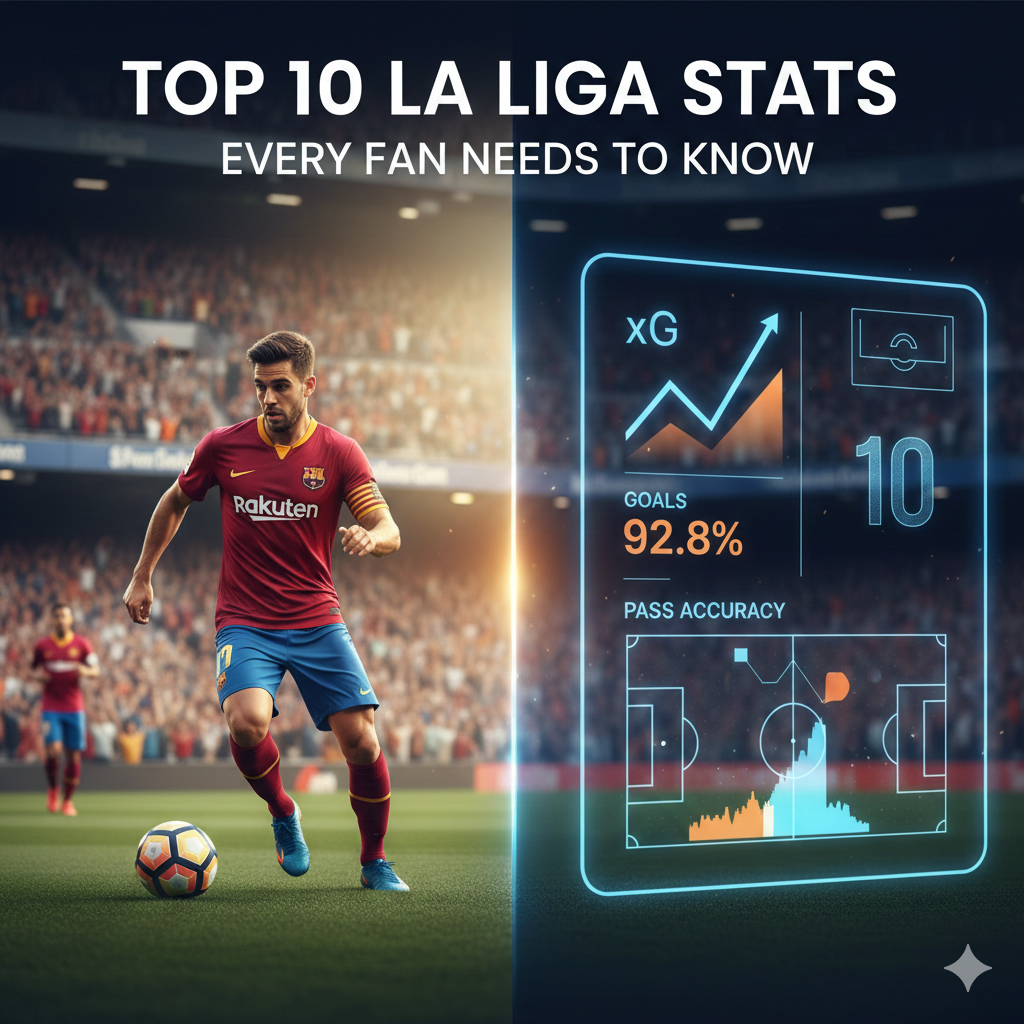
The sound of the final whistle no longer marks the end of the analysis. In the modern era of Spanish football, the drama of a La Liga season is written not just in goals and spectacular saves, but in the columns of complex data sheets. The 2024/2025 campaign has been a prime example, delivering one of the most compelling and statistically dense races in recent memory. From the moment Kylian Mbappé officially arrived at Real Madrid, setting the stage for a new era of Galácticos, to the seamless transition of Hansi Flick at defending champions Barcelona, the narrative has been defined by high-stakes performance and groundbreaking numbers.
Table of Contents
The New Language of La Liga
Forget relying solely on goal difference. Today, understanding La Liga stats means speaking the language of Expected Goals (xG), Possession Value (PV), and Successful Pressures. Teams are no longer built simply on instinct; they are meticulously constructed and coached using algorithms that analyze every blade of grass covered. Clubs like Sevilla and even Barcelona have openly embraced data science, turning mathematical engineers and performance analysts into key figures on their coaching staff, proving that advanced La Liga stats are now essential for gaining a competitive edge. The league itself, through its Mediacoach platform, shares tracking and event data with every club, democratizing performance analysis and raising the tactical ceiling across the board.
This season has presented a unique statistical puzzle. The title race has been an exhilarating fight, defined by thin margins that only granular data can fully explain. For instance, is Barcelona’s high goal tally a sign of superior creation, or simply clinical finishing that might regress? Is Real Madrid’s defensive resilience due to a world-class goalkeeper, or an elite low-block structure that suppresses high-quality chances? These are questions that require diving deeper than the basic league table.
Separating the Fan from the Expert
To truly understand why one team is lifting the trophy and another is battling for a European spot, you must look beyond the highlight reels. The most informed fans, the true connoisseurs of the Spanish game, use the power of La Liga stats to predict slumps, identify hidden gems, and understand the tactical intent behind every managerial decision.
This analysis is your definitive guide to becoming one of those experts. We have broken down the 2024/2025 campaign into the ten most critical La Liga stats every enthusiast needs to know. From the individual brilliance of the Pichichi frontrunners, whose goal totals must be viewed through the lens of Expected Goals, to the youth index that reveals the future health of Spain’s academies, these figures tell the complete story of a spectacular season. Prepare to see the Spanish game in a new light, where every pass, tackle, and shot is quantified, weighted, and used to reveal the deep tactical truth of La Liga.
Goal-Scoring & Attacking Metrics
The attack is the spectacle of La Liga, and nothing defines the success of a season more clearly than goals scored. However, to truly appreciate the genius behind the finishing, we must employ the advanced La Liga stats that reveal why the ball hit the back of the net, not just that it did. This section breaks down the three most vital attacking metrics, proving that the 2024/2025 season is one of supreme individual dominance coupled with elite team efficiency.
Stat 1: The Golden Boot Race – Total Goals and xG Outliers
The pursuit of the Pichichi award, La Liga’s Golden Boot, is always captivating, but the introduction of Expected Goals (xG) has given this traditional metric a crucial analytic dimension. xG measures the probability of a shot resulting in a goal based on factors like shot location, body part used, and play type. The difference between a player’s actual goals and their total xG is called the xG Overperformance, the ultimate indicator of world-class finishing.
The Reign of Mbappé and Elite Overperformance
The story of the 2024/2025 attack is the arrival and immediate dominance of Kylian Mbappé. The Real Madrid forward did not just top the scoring charts; he redefined the meaning of an outlier.

- Kylian Mbappé finished the full 2024/2025 La Liga season with an astonishing 31 goals. While his xG was a league-leading 27.00, the difference of +4 demonstrates a consistently elite level of finishing quality. This substantial overperformance proves that he is not just benefiting from a high volume of chances, but is clinically converting shots that other players would be expected to miss. This is the hallmark of a generational talent.
- In contrast, a high-volume striker like Robert Lewandowski of Barcelona, who scored 27 goals with an xG of 26.87, shows incredible efficiency, nearly meeting his expected output, but without the same degree of otherworldly finishing magic.
Analyzing this pivotal La Liga stat (Actual Goals vs. xG) reveals a team’s true efficiency. When a striker consistently overperforms their xG, they are papering over potential cracks in chance quality. When a team’s collective goals align perfectly with their xG, it shows a sustainable, quality attack, but one that is perhaps less reliant on individual moments of genius. To see the full standings and comparative data that defines this Golden Boot race, fans should consult up-to-date league statistics.
Stat 2: Expected Goals Chain (xGC) – The Creative Engine
While goals are the output, they are only made possible by the creation, and modern analytics allows us to track offensive contribution from start to finish. The metric of “Big Chances Created” (BCC) is a simplified version of the Expected Goals Chain (xGC) and is one of the most useful La Liga stats for identifying true playmakers. A “Big Chance” is defined as a situation where a player should reasonably be expected to score, typically in a one-on-one scenario or a wide-open shot.
The Rise of the Young Playmaker
This season has been defined by the breathtaking creative volume from Barcelona’s young phenom, Lamine Yamal.
- Lamine Yamal led La Liga in Big Chances Created with a remarkable 28. This incredible number is a powerful demonstration of his vision, technical ability to execute difficult passes, and his central role in the Catalan attack. This La Liga stat confirms he isn’t just a winger who takes on his man, but a genuine, elite-level primary chance creator.
- Another key indicator is total chances created. While Mbappé also features highly (43 chances created), players who operate slightly deeper, such as Real Madrid’s emerging star Arda Güler (34 chances created) and the consistent talent of Pedri (32 chances created), highlight the midfield artists whose passes, dribbles, and movements unlock the defense.
This La Liga stat of Big Chances Created forces the fan to recognize the full scope of offensive contribution. An attacker might have few goals, but if they are constantly topping the Big Chances Created list, their value to the team’s offense is arguably just as high as the striker who finishes the chance. This sophisticated view of attacking output illustrates why the league’s most successful teams are those that possess multiple creative threats who rank highly in this critical area.
For an even more granular breakdown of passing metrics, you can check out this deep-dive on a specific la liga stat.
Stat 3: Team Offensive Efficiency – Goals Per Shot on Target (G/SOT)
Individual talent can win a few matches, but team efficiency wins titles. Goal-Scored-per-Shot-on-Target (G/SOT) is the quintessential team-based attacking La Liga stat. It measures the percentage of shots that force the goalkeeper into action and then bypass him. A high G/SOT ratio indicates a team that is not wasting their best opportunities, they are clinical, strategic, and their shots are placed with malice.
The Clinical Nature of the Title Race
In the 2024/2025 season, the top two title challengers, Barcelona and Real Madrid, showed slightly different but equally successful approaches to offensive efficiency.
- Barcelona was the league’s overall top-scoring team, prioritizing sheer volume and quality of chances. Their team xG (Expected Goals) was the highest in the division (around 92.4), and they successfully maximized their shots, indicating a sustained, overwhelming attacking pressure.
- However, the truest measure of finishing proficiency often comes from the efficiency ratio. A team that scores, for example, 30% of their shots on target is performing better than a team that scores 25%, regardless of total goals. Teams that are ruthless in the box, taking fewer but higher-quality shots, will post a superior G/SOT. The teams that consistently convert their shots on target at the highest rate (typically around 30−35%) are those who benefit from precise attacking coaching and a cool collective temperament in the final moments.
This collective attacking La Liga stat is the most powerful tool for predicting future success. While a goal count can be skewed by penalties or one lucky hot streak, a high G/SOT percentage reflects a reliable, institutionalized clinical edge that sustains over a full season. It proves that the entire attacking structure, from the midfield’s final pass to the forward’s body shape, is operating at an elite level.
Defensive Fortresses and Tactical Indicators (Stats 4-6)
If the attacking end of the pitch provides the drama, the defensive end provides the structure, discipline, and foundation upon which every successful season is built. To truly understand tactical supremacy in Spanish football, we must look at the La Liga stats that quantify prevention, pressing, and temperament. The 2024/2025 season highlighted which teams excelled at controlling chaos and which managers have created truly impenetrable systems.
Stat 4: Defensive Solidity – Expected Goals Conceded (xGA)
Goals Conceded (GC) is the traditional measure of defensive performance, but it is heavily susceptible to luck, a wonder strike, a missed penalty, or a goalkeeping error can skew the entire metric. Expected Goals Against (xGA) strips away this luck, measuring the quality and volume of shots a team allows their opponent to take. It is the purest La Liga stat for evaluating defensive structure.
Structure vs. Shot Stopping
The key to analyzing xGA is to compare it directly to actual Goals Conceded (GC).
- Teams Overperforming xGA: If a team’s GC is significantly lower than their xGA, it means their defense (and especially their goalkeeper) is performing heroically. They are facing high-quality chances but finding ways to prevent them from hitting the net.
- For example, Real Madrid finished the season conceding 38 goals but had an xGA of 45.48. This substantial difference of 7.48 “Goals Prevented” is a massive indicator of elite shot-stopping from their goalkeepers (Thibaut Courtois/Andriy Lunin) and phenomenal goal-line defending.
- Athletic Club also showed elite numbers, conceding just 29 goals for the entire season. Their low GC (0.76 per match) often aligns closely with their structural brilliance, making them one of the league’s most difficult puzzles to solve.
- Teams Underperforming xGA: Conversely, a team like Real Valladolid conceded a league-high 90 goalsagainst an xGA of 69.81. This massive disparity shows that while their defense was statistically expected to leak goals, the situation was compounded by poor goalkeeping, bad luck, or low morale, leading to a catastrophic underperformance of over 20 goals.
This distinction between GC and xGA is arguably the most enlightening defensive La Liga stat. It tells the story of the best defenses: teams like Athletic Club and Atlético Madrid build impenetrable structures, while teams like Real Madrid rely on world-class individuals to save what the structure allows.
The Goalkeeping Heroics
The single most critical player in the xGA conversation is the goalkeeper. When a keeper consistently saves shots that are high-probability goals, they are said to be leading the “Goals Prevented” metric.
- In the 2024/2025 season, the veteran Jan Oblak (Atlético Madrid) still led the league with 15 clean sheets, a traditional La Liga stat demonstrating his consistent dominance.
- However, other keepers like Joan García (Espanyol), who led the league with 145 total saves, prove that volume matters for lower-table teams, while others demonstrate elite efficiency. The average goalkeeper Save Percentage in the league hovers around 70%; any player significantly above this rate is a certified shot-stopping hero.
Stat 5: The Midfield Battle – Possession Won in Final Third
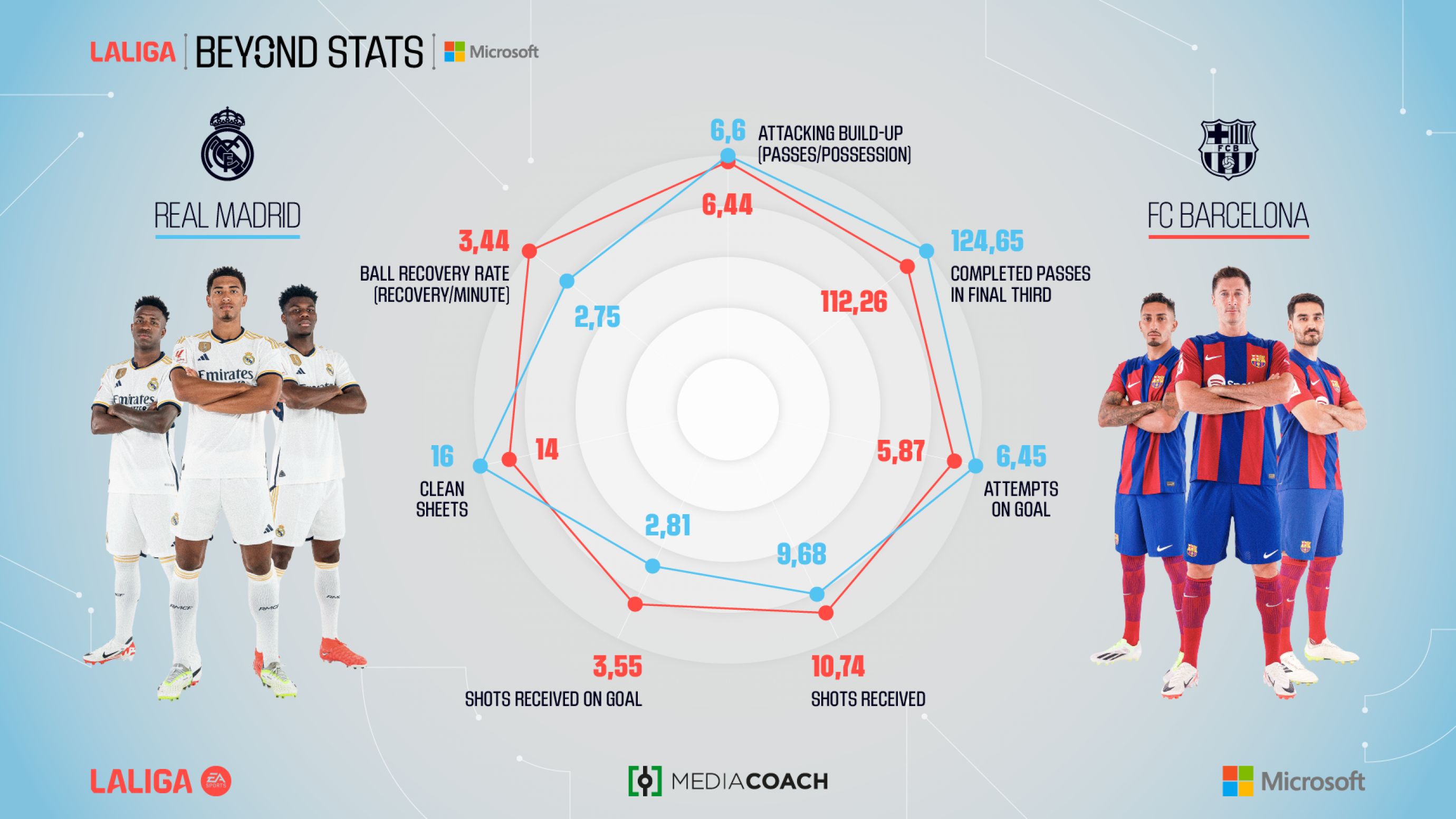
Defense in modern La Liga is an aggressive, high-pressing effort led by the midfield and forwards. The key metric here is Possession Won in Final Third (PWF3), which quantifies the volume and effectiveness of a team’s high press. Winning the ball back close to the opponent’s goal is a tactical dream: it prevents a counter-attack and immediately launches a high-danger opportunity.
The High-Press Revolution
This La Liga stat separates the aggressive, proactive coaches from the reactive, deep-lying defensive units.
- Barcelona led the league in this critical metric, with an average of 5.4 possessions won in the final third per match. This is a testament to the tactical demands of their manager, who requires midfielders like Pedri and Gavi (and even their forwards) to engage in intense, coordinated counter-pressing. This statistic is central to understanding the modern tiki-taka philosophy: use possession, but if you lose it, win it back instantly and dangerously.
- Challengers like Athletic Club (4.7) and Real Betis (4.6) also feature highly, reflecting their commitment to high-intensity, vertical football. These numbers are a powerful indicator of fitness, tactical cohesion, and the team’s ability to maintain high energy levels late into matches.
Successful La Liga stats in this area indicate a high-risk, high-reward strategy. While it can lead to quick goals, a failed press can leave huge space behind the midfielders, making this metric a double-edged sword. This number, more than any other defensive La Liga stat, defines the high-octane spectacle that Spanish football has become.
Stat 6: Discipline and Temperament – Total Red and Yellow Cards
While the focus often remains on technical and physical metrics, the simpler, non-technical data can derail a season just as quickly. The Disciplinary Table, tracking the total accumulation of Yellow and Red Cards, is a crucial indicator of temperament, managerial control, and tactical fouling strategy.
The Cost of Chaos
Suspensions caused by accumulated yellow cards, or the loss of a player mid-match from a red card, can cost critical points in a tight title race. This La Liga stat is a tangible measure of the cost of a team’s aggression.
- Las Palmas led the league in total Yellow Cards (107), suggesting a highly physical, perhaps sometimes desperate, tactical approach that often led to bookings.
- Sevilla led the league in Red Cards (8). This is a staggering number that points to either poor discipline, a highly stressed squad, or a manager employing a calculated, cynical fouling strategy to break up opponent attacks. The fact that the league’s most carded individuals, like Yvan Neyou (14 yellow cards) or Mario Martín (3 red cards), can miss significant time underscores the importance of this simple metric.
In the context of the title race, the most disciplined teams often maintain better squad rotation and availability. The Champions, typically Real Madrid or Barcelona, are generally disciplined because they dominate possession and rarely have to resort to cynical fouling to stop opponents. This La Liga stat proves that sometimes, control and composure are the most valuable defensive assets of all.
Possession, Performance, and Popularity
The true measure of a club’s success is not just determined by the current season’s wins and losses, but by the philosophy that underpins its play, the consistent quality of its best performers, and the long-term health of its brand. This final set of La Liga stats shifts focus from the tactical battle to the broader narrative: the style, the star quality, and the fan engagement that collectively make the Spanish top flight one of the world’s most compelling leagues.
Stat 7: The Possession Paradigm – Pass Completion Percentage
La Liga has long been synonymous with the philosophy of possession and short passing, a tactical doctrine often perfected by Barcelona but practiced to varying degrees by nearly every team. High Pass Completion Percentage (PCP) reflects control, patience, and a technical proficiency that few other leagues can match. It is the signature stylistic La Liga stat.
Real Madrid, Barcelona, and the Art of Control
While Barcelona traditionally sets the benchmark for this metric, the 2024/2025 season showed that high pass accuracy is now an expectation for any club with European aspirations.
- Individual Precision: Players like Real Madrid’s Dani Ceballos (95.5%) and Barcelona’s breakout center-back Pau Cubarsí (93.3%) finished among the individual leaders in pass completion. The dominance of center-backs and defensive midfielders in this list highlights their crucial role as the starting point of every successful possession sequence, demonstrating supreme calmness and technique under pressure.
- Team Philosophy: While Real Madrid often plays a more vertical, direct style than their rivals, their key playmakers, including Tchouaméni and Valverde, still hover above the 91% mark. This confirms that while their intent may be to break quickly, their technical foundation is still rooted in Spanish football’s reliance on accurate passing.
The high pass completion rate across the top of the table reinforces the notion that sustained pressure through control remains a core tenet of winning in La Liga. The teams that struggle most are often those whose Pass Completion Percentage drops significantly under pressure, reflecting a technical fragility that their opponents consistently exploit.
Stat 8: The MVP Metric – Average Player Rating (Aggregate)
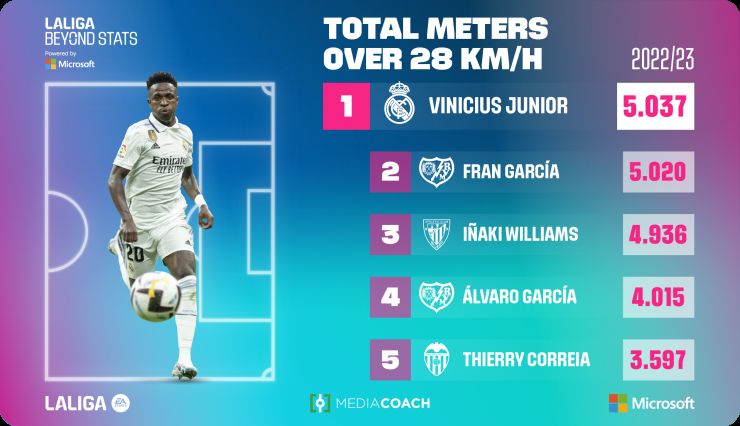
While goal tallies and clean sheets grab headlines, the Average Player Rating, compiled by leading statistics providers, is arguably the fairest holistic La Liga stat for consistent individual brilliance. It aggregates a player’s performance across a multitude of metrics, passes, dribbles, tackles, chances created, and goals, to provide a single, objective score.
Beyond the Goal Scorers
The 2024/2025 season’s ratings table highlighted two key trends: the enduring quality of seasoned playmakers and the explosive impact of youth.
- Midfield Mastery: Players whose primary role isn’t scoring goals often top this list due to their all-around contribution. Pedri (Barcelona) finished the season as one of the highest-rated players in the league (8.00), demonstrating that his control, tactical awareness, and defensive work rate, not just his assists, make him the ultimate midfield engine.
- The Teen Titans: Teenagers like Lamine Yamal (7.66) and Real Madrid’s Arda Güler (7.35) featured prominently among the league’s best. This is a powerful La Liga stat confirming that they weren’t just flashes in the pan; they maintained an elite level of performance over the course of a gruelling 38-match season, consistently grading out as Man of the Match contenders.
The Average Player Rating proves that a player does not need to be the league’s top scorer to be its most valuable asset. It rewards the defensive full-back who never loses a duel, the midfielder who maintains possession with supreme accuracy, and the playmaker who consistently unlocks defenses, the hidden architects of team success.
Stat 9: Stadium Atmosphere – Average Attendance/Occupancy Rate
Away from the pitch, the financial health and cultural passion of La Liga are best measured by the crowd figures. The Average Attendance and Stadium Occupancy Rate are critical business La Liga stats that reflect brand appeal, local community connection, and the value of matchday revenue.
Record Crowds and Shifting Capacities
The 2024/2025 season was notable for breaking attendance records and managing stadium transitions.
- Overall Health: The league’s overall average attendance surpassed 30,000 fans per match, reflecting a global resurgence of interest in Spanish football and an improvement in the league’s competitive balance.
- The Attendance King: Real Madrid’s Santiago Bernabéu commanded the highest absolute average attendance at 72,692 per game.
- The Occupancy Battle: However, a more insightful metric is the Occupancy Rate, which measures the percentage of seats filled. Despite playing in their temporary home, the Estadi Olímpic Lluís Companys, FC Barcelona led this chart with a remarkable 92.9% occupancy rate, narrowly edging out Real Madrid’s 92.8%. This indicates that the demand for the Blaugrana brand remains incredibly high, even when playing in a smaller, less familiar venue.
These commercial La Liga stats illustrate the league’s economic vitality. High attendance drives revenue, allowing clubs to afford top talent and maintain competitiveness with the rest of Europe. To see the full impact of these figures on the league’s finances, you can explore the official reports linked here.
Stat 10: Youth Movement Index – Minutes Played by U-21 Players
The final, and most forward-looking, La Liga stat is the Youth Movement Index: the total minutes given to players aged 21 or younger. This metric assesses a club’s commitment to its academy and provides a strong indicator of its long-term sustainability and talent pipeline.
The Future is Now
La Liga’s strength has always been its Cantera (academy) system, and the 2024/2025 season saw an explosion of youth integration.
- La Liga’s Commitment: The league collectively gave over 88,000 minutes to U-21 players, placing it second only to France’s Ligue 1 among the top European leagues.
- The Youth Hotbeds: Clubs like Barcelona and Real Madrid, with their integrated youth stars like Yamal, Cubarsí, Güler, and Bellingham, dominated the individual minutes played by U-21 players. However, other clubs renowned for their academy work, such as Valencia and Athletic Club, consistently feature among the teams giving the most collective minutes to young talent.
This La Liga stat guarantees the long-term health of the Spanish game. It is a powerful statement that clubs trust their young talent on the biggest stage. The minutes played by a 17-year-old center-back today are minutes of experience that will translate into a club legend tomorrow, securing La Liga’s reputation as the global factory of football’s next generation of superstars.
Conclusion
The 2024/2025 La Liga season will be remembered not only for the thrilling title race but for the sheer depth and quality of the data that documented it. From the moment Kylian Mbappé redefined the meaning of xG Overperformance (Stat 1), to the defensive structure championed by the low xGA figures (Stat 4) of clubs like Athletic Club, the campaign proved that true understanding of Spanish football requires a deeper look beneath the surface.
If one La Liga stat defined the future, it was the explosive performance of the Youth Movement (Stat 10), with players like Lamine Yamal and Arda Güler commanding elite Average Player Ratings (Stat 8) and demonstrating that the Canterasystem remains the heartbeat of the league. If one la liga stat defined the present, it was the sheer efficiency of the league’s top-scoring teams (Stat 3), whose high Goals-per-Shot-on-Target ratios showcased ruthless clinical finishing.
Ultimately, these ten critical La Liga stats separate the casual observer from the knowledgeable analyst. They provide the necessary context to appreciate the aggressive tactical press (Stat 5) and the strategic discipline (Stat 6) required to navigate a 38-match season. By mastering this data, you gain a panoramic view of the technical brilliance, financial health, and star power that continues to make La Liga one of the most compelling competitions on the planet.
Which of these surprising statistics do you think will have the biggest impact on the final standings? Share your thoughts below and continue to follow the data!
🎁 Don’t Just Watch the Game, Predict It!
You’ve just absorbed the ten most critical La Liga stats that define the 2024/2025 season. You know the true meaning of xG overperformance, the importance of Possession Won in the Final Third, and which young stars are dominating the Youth Movement Index.
But knowing the data is only half the battle.
To consistently beat your friends in fantasy leagues, dominate office pools, and make the most accurate match predictions, you need the analysis delivered straight to your inbox.
Ready to Level Up Your La Liga Knowledge?
Subscribe to our exclusive newsletter, “The Data Decoded, ” and receive:
- Weekly Stat Reports: Fresh, curated La Liga stats and rankings (xG, xGA, and more) before every match week.
- Expert Predictions: Our top 3 weekly match predictions, powered by proprietary algorithms that use the very statistics discussed in this post.
- Deep Dives: Detailed breakdowns of breaking news, tactical shifts, and emerging talent using advanced metrics.
Stop reacting to the results and start predicting them. Join thousands of dedicated fans who rely on data, not just luck.
➡️ Click Here to Subscribe and Get Your First Prediction Guide Instantly! ⬅️















Comments 3