
The story of the Los Angeles Football Club (LA FC) is not just a tale of a soccer team; it’s a blueprint for modern sports franchise success. From the moment their inception was announced, the club set out to be different, a reflection of the vibrant, diverse, and dynamic city they call home. While many expansion teams face a difficult climb, LA FC burst onto the Major League Soccer (MLS) scene with an immediate impact, challenging established norms both on and off the pitch.
Understanding the LA FC history is to understand a modern phenomenon in North American football, a journey marked by stunning victories, record-breaking seasons, and a dedicated, passionate fanbase that has redefined the matchday experience. This post will explore the foundational years, the key figures who shaped the club’s identity, the architectural marvel of their home stadium, and the enduring connection they have forged with the community.
Table of Contents
The Black & Gold Blueprint
The story of the Los Angeles Football Club (LA FC) is not simply the addition of another team to Major League Soccer (MLS); it is a blueprint for modern sports franchise success in North America. Announced in 2014 and taking the pitch for the first time in 2018, LA FC did not creep into existence, it arrived with a seismic cultural and competitive impact. Founded upon the dissolution of Chivas USA, the club was built with a distinctly ambitious, forward-thinking philosophy that set new standards for MLS expansion teams.
This vision, driven by a diverse and influential ownership group (which included figures like Will Ferrell and Magic Johnson), centered on three key pillars: building a state-of-the-art soccer-specific stadium in the heart of Los Angeles, assembling a dynamic roster capable of immediate contention, and, most crucially, fostering an authentic, grassroots connection with the city’s vast and diverse soccer community.
Within just two seasons, LA FC had shattered league records, winning the 2019 Supporters’ Shield with the highest points total in MLS history at the time. Their commitment to attacking, high-tempo football, coupled with star power like Mexican international Carlos Vela, quickly established a dominant presence. This rapid ascent culminated in the team securing the MLS Cup and a second Supporters’ Shield in 2022, solidifying their status as a league powerhouse. This journey from conceptual placeholder to championship caliber is what makes the rise of la fc one of the most compelling narratives in contemporary American sports.
The Foundational Years: From Announcement to Inaugural Kickoff
The genesis of LA FC was rooted in a necessary renewal. Following the folding of Chivas USA in 2014, MLS was determined to maintain two vibrant franchises in the massive Los Angeles market. The announcement of the new club, initially referred to as LA FC, signaled a commitment to building a brand that was authentically Angelenos, a stark contrast to the previous franchise.
The Ownership Group and Vision
The ownership collective assembled for LA FC was unprecedented in its breadth and influence, drawing from sports, business, and entertainment. Figures like Henry Nguyen, Larry Berg, and Tom Penn led the charge, with high-profile minority owners including Mia Hamm, Nomar Garciaparra, and entertainment mogul Will Ferrell. Their unified vision was to create a global soccer brand rooted locally, emphasizing a modern, attacking style of play and a community-first approach. They didn’t just want a team; they wanted an institution.
The Stadium Decision: A Home in the Heart of LA
Perhaps the most critical foundational decision was the choice of location for their home stadium. Rejecting proposals for distant suburban sites, the ownership group insisted on building in Exposition Park, adjacent to the historic Los Angeles Memorial Coliseum. This decision was pivotal, placing the club geographically and symbolically near the city’s core.
The resulting stadium, initially known as Banc of California Stadium (now BMO Stadium), was an architectural marvel, a $350 million investment designed specifically to maximize atmosphere. Completed for the 2018 inaugural season, its steep, 33-degree seating pitch and proximity to the field were engineered to create an overwhelming wall of sound, fulfilling the promise to deliver a European-style matchday experience. This commitment to an in-city, soccer-specific venue was a powerful statement of intent.
Assembling the Leadership
The next crucial step was hiring the right personnel. John Thorrington, a former MLS player and executive, was appointed General Manager. Thorrington prioritized building a roster with defined traits: technical skill, high work rate, and strong character. This philosophy was encapsulated by the appointment of Bob Bradley as the first head coach. A veteran coach with international experience, Bradley was tasked with implementing a demanding, possession-based, attacking system that would define the club’s play from the first whistle.
From the official crest reveal, featuring the iconic winged shield, to the choice of Black and Gold as primary colors, every foundational decision was meticulous and strategic. By the time they kicked off the 2018 season, la fc had established not just a team, but a dynamic and cohesive identity, ready to explode onto the MLS landscape. This strategic planning set the stage for one of the most successful inaugural seasons in league history.
Building the Roster: Identity and Strategy
The success of LA FC was not accidental; it was the result of a meticulously planned roster strategy executed by General Manager John Thorrington and Head Coach Bob Bradley. Their philosophy was simple but demanding: build a team committed to a specific, attacking identity, blending global star power with high-potential young talent.
The Designated Player (DP) Strategy: The Star Anchor
The Designated Player rule in MLS allows teams to sign a few high-salary players whose wages exceed the salary cap, and LA FC used these slots with surgical precision. The club’s very first signing, announced in August 2017 before the team even had a field to play on, was foundational: Carlos Vela.
Vela, a Mexican international and star attacker coming from La Liga’s Real Sociedad, represented the ideal DP profile: a player in his prime (28 years old at the time) with global recognition, technical brilliance, and a connection to the massive Hispanic population of Los Angeles. Vela was not just a goalscorer; he was the attacking fulcrum around which the entire system would revolve. His signing immediately lent credibility to the expansion side.
LA FC subsequently used its remaining DP slots strategically, often targeting young players who offered significant re-sale value, demonstrating a clever balancing of immediate competitiveness with long-term financial health. The acquisition of 19-year-old Uruguayan international Diego Rossi as a Young Designated Player exemplified this approach, pairing youth with the established star power of Vela to create a dynamic, fluid attack.
The Style of Play: High Press and High Tempo
Under Bob Bradley, the team’s identity became a commitment to fast, vertical, and aggressive football. This style, often referred to as a high press, required players who were technically clean on the ball but also possessed exceptional fitness and work ethic. General Manager Thorrington specifically targeted players who fit this demanding profile, filling out the roster with shrewd signings from North America, South America, and Europe.
Key to this identity were players like:
- Midfield Engine: Eduard Atuesta (Colombia), who served as the deep-lying playmaker, linking defense to the high-flying attack.
- Defensive Core: Strong domestic and international center-backs who could play out of the back.
- Fast Wingers: Players like Rossi and others who could rapidly transition defense into attack and capitalize on the space created by Vela’s movement.
The Inaugural Season: Exceeding Expectations
The roster building culminated in a stunning debut. In their inaugural 2018 season, la fc did not play like an expansion team. They finished third in the Western Conference and secured a playoff spot, a feat rarely achieved by a first-year club. This immediate success was a testament to the club’s philosophy that culture and identity matter as much as individual talent. Every player was bought into Bradley’s high-intensity system, establishing a winning standard that quickly became synonymous with the Black & Gold.
The constant push for technical and physical excellence, coupled with the star production from their DP, set the stage for the record-breaking achievements that would follow in their sophomore season.
The Golden Age: Records, Trophies, and Supporters
The foundational years of LA FC quickly matured into an era of dominance, characterized by record-breaking regular seasons and, eventually, the attainment of the league’s ultimate prize. This period showcased the tactical brilliance of the club’s leadership and the unparalleled devotion of its fanbase.
The 2019 Supporters’ Shield: Breaking the Mold
LA FC’s sophomore season in 2019 was arguably one of the most statistically dominant campaigns in MLS history.Under Bob Bradley, the high-octane offense reached peak efficiency, scoring a then-record 85 goals and achieving a goal differential of +48, also a league record. The team’s relentless pursuit of goals led them to clinch the Supporters’ Shield—awarded to the team with the best regular-season record, with an astonishing 72 points, surpassing the previous record.
The season was defined by the phenomenal performance of captain Carlos Vela, who delivered a historic MVP year.Vela set a new MLS single-season goal record with 34 goals, cementing his status not just as the club’s centerpiece, but as one of the most productive players the league had ever seen. The Black & Gold played a style of football that was exhilarating to watch, transforming every home game into a showcase of attacking dynamism.
The Heartbeat of the Club: The 3252
Crucially, the success on the field was amplified by the atmosphere off it, generated by the club’s independent supporters union, The 3252. Named for the approximate number of seats in the dedicated standing area behind the North Goal at BMO Stadium, the 3252 serves as the team’s 12th man. This collective of diverse supporter groups is known for its non-stop chanting, elaborate visual displays (Tifos), drums, and smoke flares (known as “smoke” in the section) that turn the North End into a kinetic, intimidating spectacle.
The 3252’s culture is one of undying passion and loyalty, traveling en masse for away games and making the BMO Stadium experience a genuine point of difference in MLS. Their commitment to inclusive and intense support has been pivotal in forging the club’s identity as a vibrant reflection of Los Angeles’s multifaceted communities.
The Ultimate Prize: The 2022 MLS Cup Double
After falling short in the MLS Cup Playoffs in previous years, the 2022 season proved to be the golden crescendo. Under new Head Coach Steve Cherundolo, LA FC once again won the Supporters’ Shield, setting up a dramatic run through the playoffs.
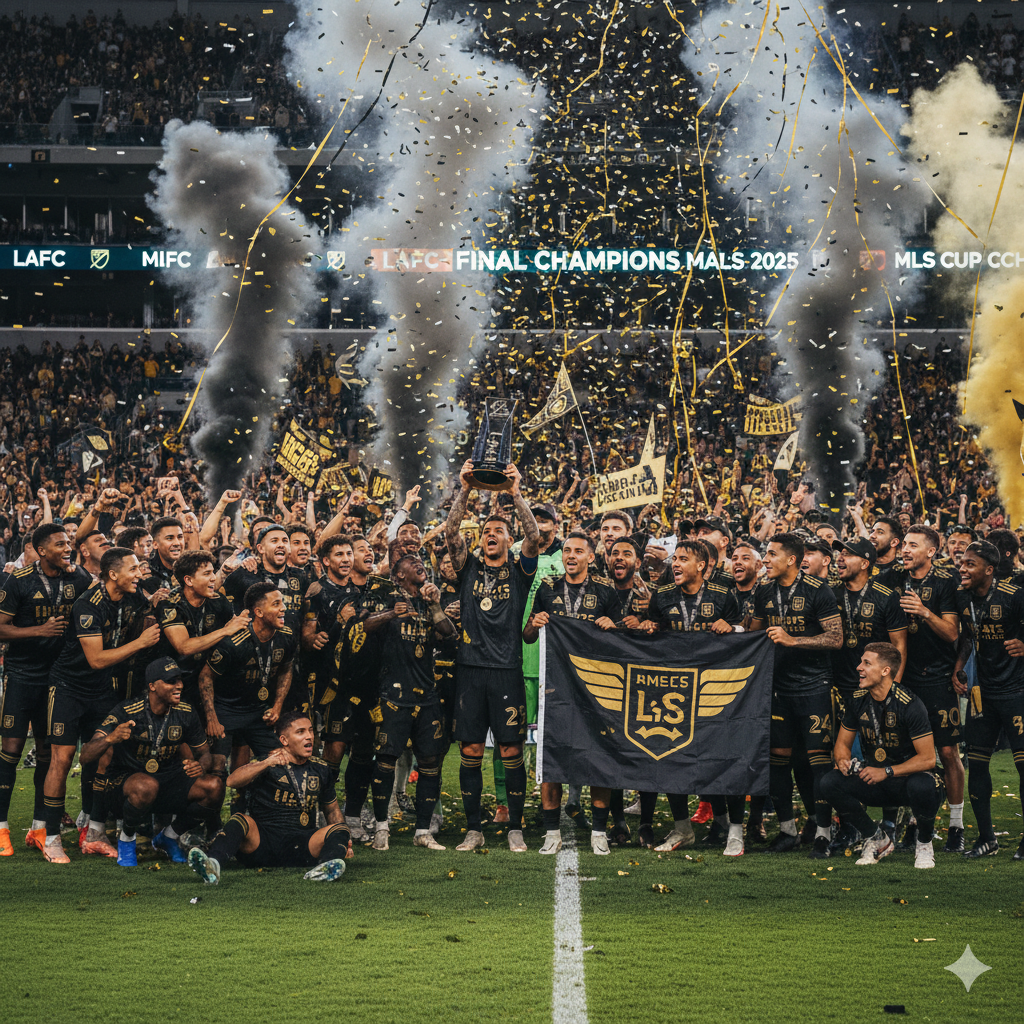
The 2022 MLS Cup Final against the Philadelphia Union was an instant classic, widely regarded as one of the most thrilling championship games in North American soccer history. The match, played at a raucous BMO Stadium, went to extra time tied 2-2. In a sequence of events straight out of a Hollywood script, the Union took the lead in the 124th minute, seemingly sealing the victory. However, in the 128th minute, club legend Gareth Bale, signed earlier that year, rose to head home a dramatic equalizer, sending the game to a penalty shootout.
Substitute goalkeeper John McCarthy, who entered the game late in extra time due to an injury and ejection, became the hero of the shootout, making two key saves as la fc won 3-0 on penalties. The victory secured the club’s first-ever MLS Cup and completed the rare league “Double” (Supporters’ Shield and MLS Cup) in a year that solidified the club’s standing at the very top of MLS.
The BMO Stadium Experience
The BMO Stadium (formerly Banc of California Stadium) is not merely a venue; it is the physical manifestation of the LA FC ethos and a fundamental pillar of the club’s identity. From the moment it opened in 2018, the stadium was engineered to be a catalyst for atmosphere, setting a new benchmark for soccer-specific venues in North America.
Architecture and Location: An Urban Icon
The decision to locate the stadium in Exposition Park, adjacent to the Los Angeles Memorial Coliseum and USC, was a critical strategic choice. By choosing a prime urban site, LAFC positioned itself at the heart of the city’s rich sporting and cultural landscape, ensuring accessibility and visibility.
Designed by Gensler, the stadium’s architecture emphasizes intimacy and noise maximization. The structure features the steepest seating rake (33 degrees) allowed by code in MLS, ensuring that every one of the roughly 22,000 seats feels close to the pitch. This design philosophy compresses the sound generated by the crowd, transforming the roar into a visceral experience for both players and opponents. The stadium also boasts a stunning canopy roof, which further traps and amplifies the noise.
The Matchday Rituals
An LA FC matchday is a total cultural immersion that begins long before the opening whistle. The grounds surrounding the stadium become a hub of activity, with tailgate parties and organized marches involving thousands of supporters. The procession of the 3252 supporter groups marching into the North End is a key ritual, building anticipation and volume as they fill their steep, standing-only section.
Once inside, the fan experience is seamless and premium, featuring diverse food and beverage options that reflect the global cuisine of Los Angeles. However, the focus always remains on the pitch. The stadium’s design eliminates corner flags from the field of vision for a large portion of the seating, forcing all attention toward the immediate action, creating a tunnel-vision intensity.
A Fortress of the Black & Gold
The BMO Stadium quickly earned a reputation as one of the most difficult places for visiting teams to play in MLS. The unrelenting pressure from the North End, combined with the structural amplification of sound, makes it a true fortress.
This commitment to the in-stadium experience is central to the club’s business model and culture. It is where the community connection is forged, where the Black and Gold colors come to life, and where the enduring energy of la fc is felt most profoundly, cementing the stadium’s status as a modern landmark in Los Angeles sports.
The Legacy and Future
The story of LA FC is still in its early chapters, but the club has already established a profound and lasting legacy that has reshaped expectations for Major League Soccer franchises, particularly expansion sides. Their journey serves as a powerful testament to the value of integrated planning, community building, and unapologetic ambition.
Redefining Expansion Success
LA FC’s most significant legacy is the standard they set for rapid competitive success. Achieving the best regular-season record for an expansion team in their debut season (2018) and securing the Supporters’ Shield within their second year fundamentally altered the narrative for incoming clubs. They proved that with significant upfront investment in infrastructure, top-tier leadership, and a clear tactical philosophy, immediate contention is possible. This blueprint influenced subsequent expansion efforts across the league, driving up expansion fees and raising the bar for required investment. Furthermore, the club’s financial success has been remarkable; in a short period, LA FC became the first MLS franchise valued at over $1 billion, underlining the power of their brand and strategic market positioning.
The Commitment to the Academy Pathway
Looking forward, the future of la fc is increasingly tied to the success of its youth development system. Recognizing the immense, untapped talent pool in Southern California, the club established its academy programs early and has invested heavily in the LA FC Performance Center, a world-class training facility located at Cal State LA that aligns the first team, the MLS NEXT Pro reserve team (LA FC2), and the academy under one roof.
The academy’s mission is clear: to move away from a “pay-to-play” model and scout the best, most deserving talent in the region. This organic growth model, which began with a single U-12 team, is now bearing fruit with an increasing number of Homegrown Players signing professional contracts and featuring for the first team. The continued development of talent from within will not only provide a sustainable competitive edge but will also deepen the connection between the club and the community by literally putting local kids on the field.
Navigating Transition and Maintaining Dominance
Like any elite club, LA FC faces the challenge of managing transition while maintaining a winning culture. The departure of foundational stars like Carlos Vela and key coaches signals the end of one era and the beginning of another. The club’s ongoing strategic roster management, including high-profile international signings and continuous shuffling of the supporting cast, demonstrates a commitment to adapt while staying competitive in every competition, from the MLS regular season and playoffs to the Concacaf Champions Cup.
The enduring goal remains clear: to solidify their place as the premier club in Los Angeles, continue the tradition of winning major silverware, and ensure that the fierce, electric atmosphere generated by the 3252 remains the defining feature of the BMO Stadium experience. The legacy of la fc is one of rapid achievement and a refusal to settle, promising many more thrilling chapters to come.
The Permanent Mark
The story of the Los Angeles Football Club is one of calculated risk and spectacular reward. In just a few short years, LA FC has transcended the typical struggles of a fledgling sports franchise, becoming a global brand synonymous with attacking football, architectural excellence, and unparalleled fan passion. By marrying a bold, aggressive vision with meticulous execution, from securing Carlos Vela to the construction of the BMO Stadium fortress, they set an immediate standard for competitive ambition.
The club’s continued pursuit of titles, combined with its deepening investment in the local academy and community, ensures that its impact will extend far beyond its trophy case. LA FC is not just an MLS club; it is a permanent, vital fixture in the sporting and cultural fabric of Los Angeles, and its legacy as the ultimate expansion success story is already cemented.
Join the Inner Circle for Black & Gold Predictions
You’ve witnessed the incredible history and rapid rise of LA FC, the strategic brilliance, the record-breaking seasons, and the ultimate triumph of the 2022 MLS Cup. But the story doesn’t stop here. The Black & Gold are constantly evolving, signing new talent, and chasing their next piece of silverware.
To truly stay ahead of the curve and understand what’s coming next for the club, you need more than just recaps; you need insight.
Don’t Miss the Next Chapter of LAFC Glory!
Subscribe to our exclusive newsletter for:
- Expert Predictions: Get the best analysis and predictions for every LA FC match, focusing on key matchups and tactical shifts.
- Transfer Rumor Breakdown: Be the first to know the insider details on potential new signings and departures.
- Academy Watch: Exclusive updates on the rising stars emerging from the LA FC Performance Center and who is ready for the first team.
Click Here to Subscribe and Get the Best LA FC Predictions Delivered Straight to Your Inbox!