

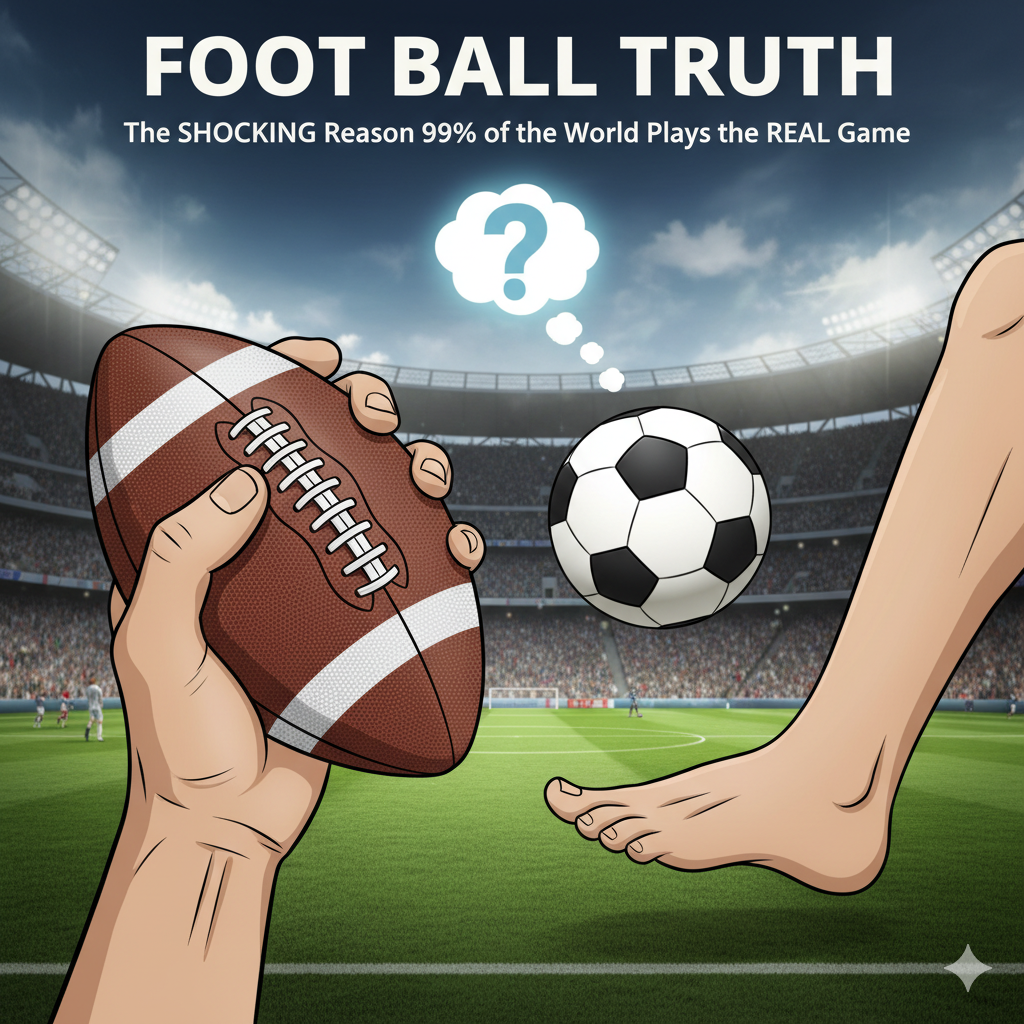
Have you ever stopped to truly think about it? I mean, really, foot ball? It’s right there in the name! Yet, somehow, a whole continent—and many passionate fans beyond—have decided that “football” means a game primarily played with hands. It’s a linguistic travesty, a semantic scandal, and frankly, I think it’s time we talk about this great deception that has led to mass confusion at an international level. This isn’t just about semantics; it’s about honoring the very literal definition of the objects and actions involved in the world’s most popular sport.
Table of Contents
The Great Hands vs. Feet Divide: A Quantitative Analysis
Let’s break down the cold, hard, etymological, and practical facts. The game most of the world calls “soccer” (or, as it should be known, the one-true, literal foot ball), demands incredible, nuanced, balletic control of a spherical object using the lower half of the human body. The rules are clear, strict, and overwhelmingly favor the feet.
Think about the sheer statistics of involvement in the global game:
- Duration: 90 minutes of constant motion.
- Primary Contact: The ball is kicked, trapped, headed, passed, and shot. Kicking and trapping, the dominant actions, are performed with the feet.
- The Hand Exception: The only player routinely, and legally, allowed to use their hands (other than the highly specific, boundary-resetting throw-in) is the goalkeeper. That is one person, out of the 22 on the field, with hand privileges. This means that at any given moment, 95.5% of the players are legally forbidden from using their hands to play the ball.
- The Physics: To impart spin, curve, and power on a foot ball, the player must utilize the complex biomechanics of the leg, ankle, and foot. We celebrate the instep, the outside of the boot, and the heel flick.
Now, let’s look at American Football, which has co-opted the name:
- The ball is carried by hands.
- The ball is thrown by hands.
- The players catch the ball with their hands.
- The primary offensive and defensive actions—blocking, tackling, passing—are all hand and arm dominant.
- The only part of the foot that reliably touches the ball is the toe of the punter or the kicker—a small, highly specialized, and often overlooked position whose primary job is simply to change field position, not drive the core continuous flow of the game.
If American Football were named based on the dominant body part used for control and propulsion, it should be called Hand Ball. But wait… that name’s already taken by another game that also uses hands! It’s a confusing mess that requires a detailed explanation every time an international traveler asks where to watch foot ball.
A Thought-Provoking Question: What If It’s All a Typo? The Scribe’s Error
I have a theory, and it’s backed by absolutely no historical evidence, but it’s far more entertaining than the dull truth of divergent 19th-century public school rules. The original rulebook for the American sport was actually a transcription error!
Imagine a tired, bespectacled 19th-century scribe working under flickering gaslight. He’s tasked with taking notes on the rapidly evolving contact sport. He jots down the instruction: “The game involves a Hand, and a Ball.” But his handwriting is terrible. He smears the ‘H’, the ‘a’, and the ‘n’, and the person setting the type misreads the smear. The word is supposed to be “hand,” but through a comedy of errors and ink blotches, it became enshrined as foot ball.
The British, meanwhile, just stuck with the pure, unadulterated version: a game involving a foot and a ball where the foot is the primary instrument of play. They were the diligent ones, the linguistic sticklers. And for this, they had to invent the silly, secondary term “soccer” just to be understood by their transatlantic cousins.
But here is where the conspiracy deepens: Did you know the term “soccer” is actually British in origin? 🤯 It was short for “Association Football” (from the Football Association) and used by posh university students who liked to add “-er” to the end of slang words (like “rugger” for Rugby). The Americans simply held onto that old-school British slang while the Brits themselves reverted back to the far more logical foot ball for the game played with the feet. The original name was about kicking, not carrying! You can read more about Why Americans Call It ‘Soccer’ (And Why That’s British Slang) to see how the linguistic tables turned.
The undeniable takeaway: Every time you watch a goal being scored with a magnificent 40-yard free kick, a powerful volley, or an audacious bicycle kick, you are witnessing the purest, most literal, and most accurate definition of foot ball in human history. The feet are doing the work, and the name reflects the reality.
The True Meaning of “Foot ball”: On Foot, Not Horseback
Now, for those who cling to the idea that “football” is simply named because it is played on foot rather than on horseback (as in polo), let us consider the logic. Yes, it’s true that the etymology of the word originally referred to games played by commoners who couldn’t afford a horse. But this merely supports the case for the global game:
- Played on Foot: Check.
- Involves a Ball: Check.
- The PRIMARY means of propulsion is the FOOT: Checkmate.
The modern global game is the true heir to this on-foot tradition, demanding continuous athleticism and control with the foot for 90 minutes.
Compare this to the gridiron sport, which evolved through a different lineage, heavily influenced by rugby foot ball, which involved much more hand-carrying. While we love the spectacle, the current American game has drifted so far from the “foot” requirement that the original on-foot definition is the only thing keeping the name from being totally absurd. If you’re interested in this history, subscribe to our newsletter.
The Unavoidable Conclusion: A Call to Linguistic Action
Look, this isn’t about throwing shade on the NFL (I enjoy a well-executed Hail Mary as much as the next person). This is about giving the feet the respect they deserve! They are the unsung heroes of the global game. They are the instruments of art, the tools of sublime control, and the source of pure, unadulterated sporting joy. They deserve to be acknowledged in the name itself.
The global game’s popularity, its utter dominance in every corner of the planet is further evidence of its inherent truth. It is the game that delivers exactly what it promises: a ball, controlled by the foot.
So, the next time someone tells you they’re watching foot ball, do them a favor. Kindly and conspiratorially inform them that they are witnessing the most literal, accurate, globally revered, and etymologically correct interpretation of foot ball in existence. The truth is out there, and it’s being volleyed straight into the back of the net.
It’s time to reclaim the proper nomenclature, one elegant tap-in goal and perfectly placed through-ball at a time. Let’s make the name fit the game.
















Comments 1