

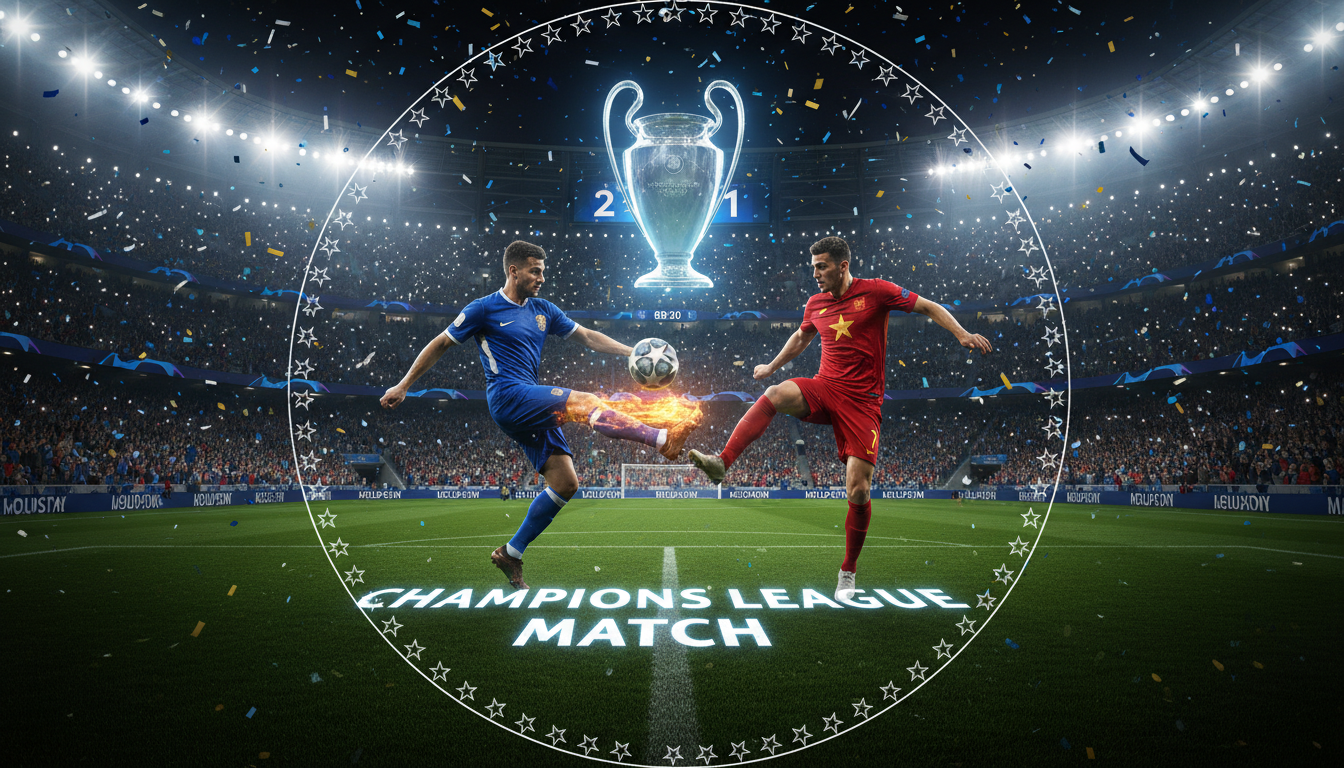
The Grandeur of the Champions League: A Legacy of Unforgettable Moments
The Champions League match, a stage where footballing titans clash, represents the pinnacle of club football. For decades, it has captivated audiences worldwide, delivering drama, skill, and unforgettable narratives. From underdog triumphs to last-gasp winners, the UEFA Champions League has etched its name in sporting history, producing moments that are replayed and reminisced for generations. The allure of the competition lies not just in the prestige of the trophy, but in the sheer quality of football on display. Every pass, every tackle, every shot is amplified under the immense spotlight of Europe’s elite club tournament. The air crackles with anticipation, and the stakes are higher than anywhere else in the footballing calendar. The very phrase ‘Champions League match’ evokes images of roaring crowds, iconic stadiums, and the relentless pursuit of glory.
This prestigious tournament, formerly known as the European Cup, has evolved significantly since its inception in 1955. Initially a knockout competition for the league champions of Europe, it transformed into a more inclusive format in 1992, allowing more teams to participate and increasing the number of matches, thereby enhancing the entertainment value for fans. This evolution has seen the rise of footballing dynasties and the emergence of new heroes. The sheer financial and sporting significance of a Champions League match ensures that every club involved, from the traditional powerhouses to ambitious newcomers, invests heavily in talent and strategy. The journey to the final is a grueling marathon, demanding consistency, resilience, and an unwavering belief in victory. The economic impact on participating clubs is also substantial, with significant prize money and increased commercial opportunities available to those who progress through the stages.
The history of the Champions League is a tapestry woven with threads of incredible individual brilliance and unforgettable team performances. Legendary players have graced this stage, leaving their indelible mark on its storied past. Think of Alfredo Di Stéfano’s dominance in the early years, Johan Cruyff’s revolutionary Ajax, the iconic Liverpool teams of the 70s and 80s, the mesmerizing AC Milan sides, Real Madrid’s record-breaking success, and more recently, the era-defining Barcelona and Bayern Munich teams. Each era has its own set of heroes and its own signature style of play, contributing to the rich narrative of the tournament. The tactical evolution of the game is also prominently displayed in the Champions League, with managers constantly innovating to outwit their opponents. The technical prowess and tactical acumen on display in a high-stakes Champions League match are often years ahead of domestic league trends.
The sheer global appeal of the Champions League means that a single Champions League match can be watched by hundreds of millions of viewers across the planet. This universal reach transcends borders and cultures, uniting football fans in a shared passion. The anticipation leading up to a major tie, the in-game drama, and the post-match analysis all contribute to a global spectacle. Social media buzzes with discussions, debates, and predictions, further amplifying the excitement. The commercialization of the sport has also played a significant role, with sponsorship deals and broadcasting rights contributing to the enormous financial ecosystem surrounding the tournament. Yet, despite the commercial pressures, the core essence of the competition – the pursuit of sporting excellence and the dream of becoming European champions – remains at its heart. The raw emotion and unadulterated joy of a team lifting the coveted trophy are what truly resonate with fans.
Understanding the nuances of a Champions League match requires an appreciation for the tactical battles that unfold. Managers meticulously analyze their opponents, devising game plans to exploit weaknesses and neutralize threats. The influence of coaches like Pep Guardiola, Jürgen Klopp, Carlo Ancelotti, and others has shaped the modern game, and their tactical duels on the Champions League stage are often as captivating as the on-field action. From pressing strategies and defensive formations to attacking patterns and set-piece routines, the strategic depth is immense. The ability of a team to adapt its tactics mid-game, responding to substitutions, red cards, or shifts in momentum, is often the difference between victory and defeat. This tactical chess match is a crucial element that elevates the Champions League beyond mere athletic competition.
Furthermore, the psychological aspect of a Champions League match cannot be overstated. The pressure to perform on such a grand stage can be immense, and teams that can maintain their composure and mental fortitude often have a significant advantage. The ability to handle adversity, come back from behind, and deliver under immense pressure are hallmarks of true champions. The roar of the crowd can be a powerful motivator, but it can also be intimidating. Players who can channel this energy positively are often the ones who shine brightest. The mental resilience required to navigate knockout ties, often decided by fine margins, is a testament to the character of the individuals and the collective spirit of the team. The weight of expectation from millions of fans adds another layer of psychological complexity to every Champions League match.
Navigating the Complexities of a Champions League Match: Key Factors to Consider
Analyzing a Champions League match involves delving into a multitude of factors, each contributing to the overall narrative and potential outcome. It’s a complex tapestry of skill, strategy, psychology, and sometimes, sheer luck. To truly appreciate the intricacies of these encounters, we must dissect the key elements that shape the flow of play and ultimately, determine who emerges victorious.
Team Form and Momentum
One of the most immediate indicators of a team’s potential performance in a Champions League match is their recent form. Are they on a winning streak, or have they been struggling for results in their domestic league? Momentum is a powerful force in football. A team that has been consistently winning, scoring goals, and displaying confidence is likely to carry that swagger onto the European stage. Conversely, a team mired in a slump, conceding goals, and lacking attacking impetus will face an uphill battle. Examining their last five to ten matches, paying attention to the quality of opposition, is crucial. Have they been dominating weaker teams or narrowly scraping by? This granular analysis of recent performances provides valuable insights.
Consider the context of these recent results. Were they playing in a competitive domestic league where every point is hard-fought, or did they face less challenging opposition? Furthermore, are there any signs of key players regaining form or developing injuries? The return of a star striker or a defensive linchpin can dramatically alter a team’s fortunes. Conversely, the absence of a crucial player due to suspension or injury can leave a significant void that is difficult to fill. The psychological impact of a recent impressive victory or a demoralizing defeat can also linger, influencing a team’s approach to a high-stakes Champions League match.
Head-to-Head Records and Historical Dominance
While past results don’t dictate the present, historical head-to-head records between two clubs in a Champions League match can sometimes offer a glimpse into psychological advantages or tactical patterns that have emerged over time. Some teams seem to have a natural “bogey team” or a rival they consistently struggle against, regardless of their current form. This can stem from stylistic clashes, specific tactical approaches that have proven effective, or even a lingering mental block from past encounters. It’s important not to overemphasize historical statistics, but they can provide a supplementary layer of analysis, particularly if the fixture has been a recurring one in recent European campaigns.
Furthermore, understanding a club’s historical performance and pedigree in the Champions League itself is also important. Teams with a rich history of success in this competition, like Real Madrid or Bayern Munich, often possess a certain aura and experience that can be intimidating for less seasoned opponents. They have navigated the pressures of knockout football on numerous occasions and understand what it takes to go all the way. This ingrained winning mentality, often passed down through generations of players and staff, can be a significant intangible asset when facing a crucial Champions League match.
Key Player Availability and Form
Football is ultimately a game of individuals, and the availability and form of key players can have a monumental impact on the outcome of any Champions League match. Is the team’s star striker fit and firing? Is their creative midfielder pulling the strings? Is their defensive bedrock solid and in form? The absence of a world-class player through injury or suspension can force a team to adapt its entire strategy and can significantly diminish its attacking or defensive capabilities. Conversely, the return of a key player can inject a vital dose of quality and confidence.
It’s not just about who is available, but also about their current performance levels. A player might be fit, but if they are enduring a dry spell in front of goal or making uncharacteristic errors, their impact will be diminished. Tracking the individual statistics of key players – goals, assists, chances created, defensive interceptions, tackles won – in the lead-up to a Champions League match provides crucial data. The psychological state of key individuals is also paramount. Are they carrying the weight of expectation, or are they playing with freedom and confidence? These subtle but significant factors can swing the balance in a tightly contested encounter.
Tactical Approaches and Managerial Prowess
The tactical battle between managers is often the invisible war waged during a Champions League match. Each coach will have a distinct philosophy and a specific game plan tailored to their players’ strengths and their opponent’s weaknesses. Will they opt for a high-pressing, attacking style, aiming to overwhelm their opponents from the outset? Or will they adopt a more pragmatic, defensive approach, looking to frustrate their opponents and hit them on the counter-attack? Understanding the typical formations and tactical tendencies of each team is vital.
We must also consider the managers’ adaptability. In the heat of a Champions League match, managers are constantly making adjustments, introducing substitutions, and tweaking their tactics in response to the flow of the game. The manager who can make the most effective in-game changes, identify and exploit tactical vulnerabilities, and motivate their players to execute the plan will often have a significant advantage. The history of tactical innovations in the Champions League is rich, from Arrigo Sacchi’s revolutionary zonal marking at AC Milan to Pep Guardiola’s possession-based tiki-taka at Barcelona. Analyzing the recent tactical trends of the managers involved can offer valuable insights. You can find further analysis on tactical trends at sites like Outside of the Boot.
Home Advantage and Stadium Atmosphere
The adage “football is a game of two halves” can sometimes feel more pronounced when factoring in home advantage. The familiar surroundings, the support of the home crowd, and the knowledge of the pitch can all contribute to a team’s performance. A raucous home atmosphere can lift a team, intimidating opponents and fueling a sense of collective energy. This is particularly true in iconic European grounds that are renowned for their intimidating atmospheres, such as Anfield or the Signal Iduna Park. The roar of the crowd in a crucial Champions League match can be a significant psychological boost.
Conversely, playing away from home in a hostile environment presents its own set of challenges. Teams need to be mentally strong, able to block out the noise and focus on their game plan. The pressure can be immense, and away goals can be a crucial factor in knockout ties. Understanding how a team performs across different environments, both at home and away, is a critical part of the analysis. Some teams thrive on the road, demonstrating an ability to absorb pressure and exploit space, while others wilt under the glare of a hostile crowd. The travel fatigue for away teams can also be a minor, but sometimes relevant, factor in a congested Champions League match schedule.
Injuries, Suspensions, and Squad Depth
The depth of a squad is often tested most rigorously in a competition like the Champions League, with its demanding schedule of high-intensity matches. Injuries and suspensions can force managers to dip into their reserves, and the quality of these backup players is crucial. A team with a strong bench, capable of seamlessly replacing tired or unavailable starters, has a significant advantage. This allows them to maintain a high level of performance throughout a Champions League match and across the entire tournament.
Conversely, a team heavily reliant on a small group of star players will be vulnerable if those individuals are sidelined. The impact of losing a key defender, a prolific goalscorer, or a midfield general can be devastating. Examining the squad lists, the typical rotation patterns, and the performance of fringe players in domestic competitions can provide insights into the overall strength and depth of a team’s roster. The ability to withstand the rigors of a long campaign, with its inevitable setbacks, often hinges on the quality of a club’s entire squad, not just their starting eleven. This depth is crucial for any team aiming to go far in a demanding Champions League match campaign.
Recent Transfer Activity and Squad Cohesion
While the transfer window often closes before the knockout stages of the Champions League, recent transfer activity can still have an impact. Have teams brought in new signings who are still integrating into the squad and finding their rhythm? Or have key players departed, leaving gaps that are yet to be filled? Squad cohesion and understanding, built over time through consistent play, are vital for success. New signings, while talented, may take time to gel with their teammates, understand tactical nuances, and build the same level of on-field chemistry.
The psychological impact of transfer speculation, or the successful integration of new talent, can also influence a team’s performance in a Champions League match. A settled squad, with established understanding and trust between players, often performs more consistently. Conversely, a team undergoing significant squad turnover may still be developing that crucial on-field synchronicity. The long-term impact of strategic recruitment and player development is a constant consideration for clubs aiming for European glory. The ability of a team to maintain squad cohesion throughout a demanding Champions League match season is a testament to their long-term planning.
Motivation and Tournament Pedigree
Beyond the immediate form and tactical considerations, the motivation driving a team in a Champions League match can be a decisive factor. Is it a team playing for pride, aiming to solidify their status as a European elite? Or is it a club making a historic run, driven by the dream of an unprecedented triumph? The hunger to win the Champions League can be a powerful motivator, pushing players to extraordinary efforts. Teams with a strong pedigree in the competition, who have tasted success before, often carry an extra level of determination.
Conversely, a team that has underperformed domestically and sees the Champions League as their last chance for silverware might be particularly motivated. The narrative surrounding a Champions League match can be as compelling as the on-field action. Understanding the specific motivations of each team involved, whether it’s defending a title, seeking redemption, or chasing a maiden trophy, adds a crucial layer to the analysis. The psychological uplift that comes from believing in a historic achievement can be a formidable force.
The Art of Prediction: Forecasting the Outcome of a Champions League Match
Predicting the outcome of a Champions League match is an endeavor that blends statistical analysis with an understanding of the intangible elements that make football so captivating. It’s a journey that requires dissecting form, analyzing tactics, considering historical context, and acknowledging the inherent unpredictability of the sport. While no prediction can be 100% accurate, a systematic approach can significantly enhance our ability to forecast potential results.
Leveraging Statistical Models and Data Analysis
In the modern era of football analysis, statistical models and data-driven insights play an increasingly vital role in forecasting the outcome of a Champions League match. Sophisticated algorithms can process vast amounts of data, including historical performance metrics, player statistics, team formations, and even environmental factors, to generate probabilistic predictions. These models often consider metrics such as expected goals (xG), which quantifies the quality of chances created and conceded, and possession statistics, which can indicate dominance in different areas of the pitch.
Websites and analytical platforms dedicated to football statistics provide a wealth of information. For instance, understanding a team’s average goals scored and conceded per game, their shot conversion rates, and their defensive solidity can offer objective insights. Examining metrics like pass completion percentages, tackle success rates, and aerial duel win percentages can further refine our understanding of individual and team performances. By comparing these statistics between the two opposing teams in a Champions League match, we can identify areas of potential advantage and vulnerability. The evolution of data analysis in sports has been remarkable, with tools becoming increasingly sophisticated and accessible. Resources like FBref offer comprehensive statistical data for the Champions League.
The Importance of Expert Opinions and Informed Analysis
While data provides a quantitative foundation, the qualitative insights of experienced football analysts, journalists, and former players remain invaluable. These individuals often possess a deep understanding of the nuances of the game, the psychological factors at play, and the subtle tactical shifts that data alone might miss. Their informed opinions, honed by years of observing and dissecting football, can offer a crucial layer of context and interpretation to statistical predictions for a Champions League match.
Listening to respected football pundits on television, reading in-depth articles from reputable sports publications, and following trusted football analysts on social media can provide a more rounded perspective. They can highlight specific player matchups, identify potential tactical surprises, and offer insights into team morale and dressing room dynamics that are not readily apparent in raw data. Their ability to connect the dots between different pieces of information, and to understand the “feel” of a team, can be a significant differentiator in forecasting the outcome of a tightly contested Champions League match.
Considering the “Intangibles”: Psychology, Morale, and Narrative
Football, at its core, is a human endeavor, and the psychological elements can often be as influential as tactical formations or statistical advantages. The morale of a team, the pressure of a big occasion, and the prevailing narrative surrounding a Champions League match can all play a significant role in shaping the outcome. A team brimming with confidence, perhaps after a string of impressive victories, might perform beyond their statistical potential. Conversely, a side struggling with internal issues or under immense pressure to perform might falter.
The psychological warfare that unfolds before and during a game is often subtle but impactful. Mind games between managers, the impact of media attention, and the personal motivations of individual players all contribute to the intangible fabric of a Champions League match. A team that has a history of performing well in the Champions League might possess a certain psychological edge, an ingrained belief in their ability to succeed on the biggest stage. Conversely, a team facing their first significant European knockout tie might be more susceptible to nerves. Understanding these psychological dynamics requires a keen observation of team behavior and an appreciation for the human element of sport. The emotional highs and lows of a Champions League match are a significant part of its appeal.
The Role of Form vs. Class: A Balancing Act
A perennial debate in football punditry revolves around whether “form” or “class” is the more important predictor of success in a crucial Champions League match. “Form” refers to a team’s recent performance, their current winning or losing streak, and their overall momentum. “Class,” on the other hand, speaks to the underlying quality of a team, their established talent, their historical pedigree, and their ability to perform consistently at the highest level, regardless of recent results.
In reality, both form and class are vital considerations. A team that is in exceptional form, even if they don’t possess the same historical “class” as their opponent, can certainly cause an upset. Their momentum and confidence can be powerful drivers. However, the inherent quality and experience of a “class” team can often see them through difficult periods, allowing them to grind out results even when not at their absolute best. The art of prediction lies in finding the right balance between these two crucial factors when analyzing a Champions League match. A team might be in poor recent form, but if they possess superior individual talent and a wealth of experience, they cannot be easily dismissed. Conversely, a team on a remarkable run of form might struggle if they are consistently outplayed by a more talented opponent.
The Impact of the First Leg and Away Goals
In knockout ties within the Champions League, the first leg of a two-legged encounter plays a crucial role in shaping the dynamics of the second leg. The outcome of the initial match can significantly influence the tactical approaches of both teams heading into the return fixture. A team that secures a comfortable first-leg advantage might adopt a more conservative strategy in the second leg, aiming to protect their lead. Conversely, a team that is trailing might be forced to take more risks, pushing forward in search of goals.
The away goals rule, though its application has seen some recent adjustments, historically added another layer of complexity. A single away goal could prove to be the deciding factor, incentivizing teams to score on the road even when defending a lead. Understanding the first-leg result and the resulting tactical imperatives is essential for predicting the flow of the second Champions League match. A team that has scored multiple away goals will have a significant psychological and tactical advantage heading into the home leg, as their opponent will need to score a certain number of goals without conceding to progress. Conversely, a team that has conceded several away goals will be under immense pressure to score freely while remaining defensively solid in the return fixture.
The Role of Luck and Unforeseen Circumstances
Despite the most meticulous analysis, football remains a sport where luck can play a significant role. A controversial refereeing decision, an unexpected red card, a bizarre bounce of the ball, or a moment of individual brilliance can all swing the momentum of a Champions League match in an instant. These unpredictable elements are what make the sport so thrilling and, at times, so frustrating for those trying to forecast outcomes with certainty.
While we cannot predict luck, acknowledging its existence is crucial. Experienced analysts and fans understand that even the most statistically favored team can fall victim to a series of unfortunate events. This is why hedging bets or acknowledging the possibility of an upset is often a wise approach when discussing predictions. The beauty of a Champions League match often lies in its inherent unpredictability, the moments where the script is thrown out the window and the unexpected prevails. This element of chance is a constant reminder that even with all the preparation and analysis, football remains a game of glorious uncertainty.
The Thrill of the Champions League: A Journey Through Memorable Matches
The annals of the Champions League are filled with encounters that have transcended the sport, becoming etched in the memories of football fans forever. These aren’t just games; they are narratives of triumph, despair, individual brilliance, and collective spirit. Reliving some of these iconic moments helps us appreciate the enduring allure of the Champions League match and the drama it consistently delivers.
The Comeback Kings: Liverpool’s Istanbul Triumph (2005)
Perhaps the most famous comeback in Champions League history, Liverpool’s triumph over AC Milan in the 2005 final remains a benchmark for astonishing turnarounds. Trailing 3-0 at halftime, with Milan seemingly cruising to victory, Liverpool staged a miraculous second-half resurgence. Goals from Steven Gerrard, Vladimir Smicer, and a Xabi Alonso penalty in a frantic six-minute spell brought the scores level. The match ultimately went to a penalty shootout, where Liverpool goalkeeper Jerzy Dudek’s heroics secured an improbable victory. This Champions League match showcased the power of belief and the never-say-die attitude.
The tactical shift by Rafa Benítez at halftime was instrumental. He brought on defensive midfielder Dietmar Hamann to bolster the midfield, allowing Gerrard to play in a more advanced role. This tactical tweak, combined with the sheer willpower of the Liverpool players and the vocal support of their fans, created an electrifying atmosphere. The mental fortitude displayed by Liverpool in the second half, after being thoroughly outplayed for the first 45 minutes, is a testament to the psychological strength required to succeed at this level. The contrast between the dejected faces of the Milan players and the jubilant celebrations of Liverpool players and fans at the final whistle perfectly encapsulated the emotional rollercoaster of a classic Champions League match.
The Blaugrana Brilliance: Barcelona’s 2010-11 Masterclass
Pep Guardiola’s Barcelona side of the early 2010s is widely regarded as one of the greatest club teams of all time, and their 2010-11 Champions League campaign was a fitting testament to their dominance. Their style of play – a mesmerizing blend of possession, intricate passing, and relentless attacking – captivated the world. The final against Manchester United at Wembley was a showcase of their superiority, with Lionel Messi, David Villa, and Pedro all scoring in a commanding 3-1 victory. This Champions League match was a masterclass in tactical execution and individual brilliance.
The midfield trio of Xavi Hernández, Andrés Iniesta, and Sergio Busquets dictated the tempo of the game, suffocating Manchester United’s attempts to build possession. Lionel Messi, in particular, delivered a performance that cemented his status as arguably the greatest player of all time, scoring a breathtaking goal from outside the box. The movement off the ball, the quick passing triangles, and the clinical finishing on display were a joy to behold. This Barcelona team didn’t just win matches; they redefined how football could be played, influencing tactical trends across the globe. The elegance and fluidity of their attacking patterns in this Champions League match set a new standard for offensive football.
The Galácticos’ Era: Real Madrid’s Unmatched Success
Real Madrid’s history in the Champions League is unparalleled, with a record number of titles to their name. The “Galácticos” era of the early 2000s, featuring a star-studded lineup including Zinedine Zidane, Ronaldo, Luis Figo, and Raúl, exemplified their pursuit of individual brilliance. While their period of dominance was marked by a few triumphs, including the iconic Zidane volley in the 2002 final against Bayer Leverkusen, it was their more recent era of dominance, under Zinedine Zidane as manager, that saw them lift the trophy three consecutive times (2016-2018). This sustained success in a series of crucial Champions League match campaigns solidified their legendary status.
The recent Real Madrid teams, while perhaps lacking the individual superstar aura of the early Galácticos, were built on a foundation of incredible resilience, tactical flexibility, and the enduring brilliance of players like Cristiano Ronaldo. Their ability to consistently deliver in high-pressure knockout ties, often finding a way to win even when outplayed, became their hallmark. The psychology of playing against Real Madrid in the Champions League is unique; opponents know they are facing a team that has been there and done it all before, a team that thrives on the big stage. This mental fortitude, coupled with exceptional individual talent, makes them a perennial threat in every Champions League match they participate in.
Underdog Tales: The Surprise Packages of Europe
While the giants of European football often dominate the headlines, the Champions League also provides a platform for underdog stories that capture the imagination. The triumphant run of FC Porto in 2004 under José Mourinho, or the more recent fairy tale of Leicester City in the Premier League which mirrored their Champions League journey, reminds us that with the right blend of grit, tactical discipline, and a touch of fortune, anything is possible. These surprise packages often play with a freedom and intensity that can unsettle more fancied opponents in a Champions League match.
These underdog teams often rely on strong defensive organization, quick counter-attacks, and an unwavering team spirit. They might not possess the individual superstars of their wealthier counterparts, but they compensate with a collective desire to prove themselves on the biggest stage. The tactical ingenuity of their managers, coupled with the sheer hunger of the players, can create memorable upsets. The journey of these teams through the Champions League is often more compelling than the predictable dominance of the established powerhouses, offering a sense of romance and possibility to the tournament. Every Champions League match involving an underdog carries the potential for a historic upset.
The Future of the Champions League Match: Evolution and Anticipation
The UEFA Champions League is not a static entity; it is a tournament that constantly evolves, adapting to the changing landscape of football. As we look ahead, several factors will shape the future of the Champions League match, from potential format changes to the increasing influence of technology and data. The anticipation for what lies ahead is palpable.
Potential Format Changes and Expansion
Discussions surrounding potential format changes for the Champions League are ongoing, with various proposals aimed at increasing the number of matches, enhancing revenue streams, and potentially expanding the tournament’s reach. Some of these proposals have been met with significant debate among fans and clubs, with concerns about fixture congestion and the potential dilution of the competition’s elite status. The balance between commercial interests and sporting integrity is a delicate one, and any significant changes will undoubtedly spark passionate discussion. The desire for more high-profile Champions League match encounters is a driving force behind these considerations.
The potential for an expanded format, perhaps with more participating teams or a longer group stage, could lead to a greater variety of matchups and more opportunities for clubs to test themselves on the European stage. However, it also raises questions about the impact on domestic leagues and the well-being of players. The ongoing dialogue surrounding the future of European club football, including the role of the Champions League and the proposed European Super League, highlights the dynamic nature of the sport’s governance and the constant push and pull between tradition and innovation. The evolution of the Champions League match is an ongoing story.
The Impact of Technology and Data Analytics
Technology and data analytics are already transforming how we understand and predict football, and their influence on the Champions League match is set to grow. Advanced statistical models, real-time performance tracking, and even AI-driven insights will provide coaches, analysts, and fans with unprecedented levels of information. This will undoubtedly lead to more sophisticated tactical approaches and a deeper understanding of player performance.
The use of VAR (Video Assistant Referee) has already become a prominent feature in major competitions, aiming to reduce officiating errors. While its implementation has been met with mixed reactions, it is likely to remain a significant part of the game, influencing decisions in crucial Champions League match moments. Furthermore, the use of wearable technology for players, providing data on their physical output and recovery, will continue to inform training regimes and performance optimization. The convergence of technology and sport promises a more data-rich and analytically driven future for football.
Sustainability and the Global Reach of the Tournament
As global awareness of environmental and social issues grows, so too does the focus on sustainability within major sporting events. The Champions League, with its global audience and significant carbon footprint, will likely face increasing pressure to adopt more sustainable practices. This could involve initiatives related to travel, stadium operations, and waste management. The future Champions League match will need to consider its environmental impact.
Moreover, the global reach of the Champions League continues to expand, with growing fan bases in emerging football markets. Efforts to engage these new audiences and ensure equitable access to content will likely be a priority. The tournament’s ability to adapt to diverse cultural contexts and to foster a truly global community of fans will be crucial for its continued success. The international appeal of a major Champions League match is a testament to the sport’s universal language.
Your Trusted Source for Champions League Match Predictions
Navigating the complexities of the Champions League match can be a thrilling yet challenging endeavor for any football enthusiast. With so many variables at play – team form, tactical battles, player availability, and the sheer unpredictability of the game – it’s easy to feel overwhelmed. That’s where expert insights and reliable predictions become invaluable.
At Daily Soccer Picks, we are passionate about providing you with the most comprehensive and accurate analysis to help you stay ahead of the game. Our team of dedicated football analysts meticulously dissects every aspect of an upcoming Champions League match, from statistical trends and historical data to the psychological nuances that often decide tight encounters. We delve deep into team news, analyze tactical setups, and consider all the intangible factors that contribute to a potential outcome.
Whether you’re a seasoned bettor looking for an edge, a fantasy football manager seeking an advantage, or simply a fan who wants to deepen their understanding of the beautiful game, our predictions are crafted with you in mind. We strive to offer clear, concise, and actionable insights that empower you to make informed decisions and enhance your enjoyment of every Champions League match.
Don’t miss out on the best football predictions! Subscribe to our daily newsletter and receive exclusive insights, expert analysis, and our top picks directly to your inbox. Stay informed, stay ahead, and elevate your football experience.
Click here to subscribe now for the best daily English Premier League soccer predictions and more!
Join our community of football aficionados and gain access to a wealth of knowledge that will enrich your understanding and appreciation of every thrilling Champions League match. Let us be your trusted guide in the captivating world of European football.















Comments 6