

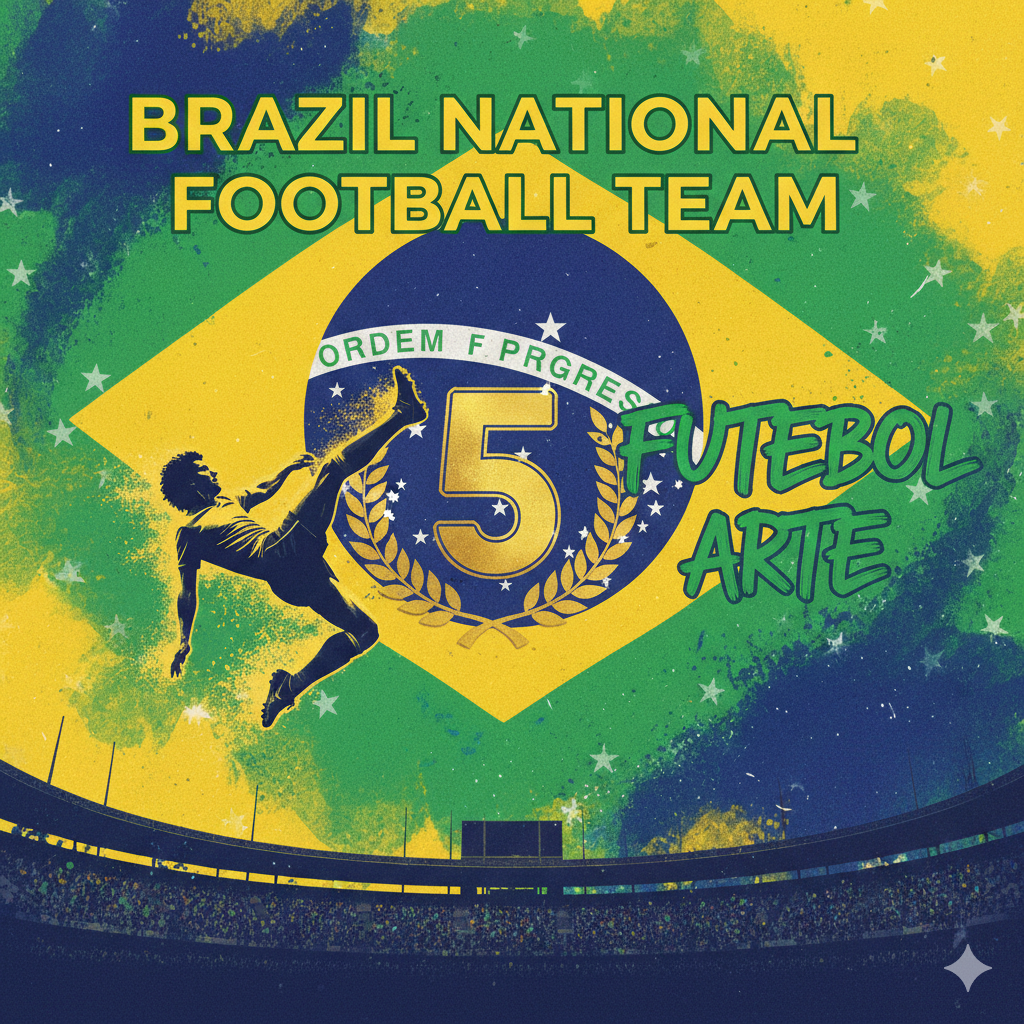
More Than a Game, It’s a National Epic
In the pantheon of global sports, few entities command the reverence, emotion, and sheer historical weight of the brazil national football team. Nicknamed the Seleção (The Selection) and the Canarinho (Little Canary), this team is not merely a collection of elite athletes; it is an intrinsic part of the Brazilian national identity, a profound cultural phenomenon that transcends sport. To understand Brazil is, in many ways, to understand the intoxicating blend of technical brilliance, spontaneous joy, and deeply ingrained social history that their football represents. The team’s vibrant yellow jersey, adorned with five stars signifying their unparalleled five FIFA World Cup titles (1958, 1962, 1970, 1994, 2002), is one of the most recognizable and powerful symbols in the world.
ShutterstockFrom the dusty, sun-baked várzeas (floodplains) where legends like Pelé honed their craft to the grand arenas of the modern era, the story of the brazil national football team is one of perpetual striving for what the great journalist Nelson Rodrigues termed “futebol arte”—art-football. This philosophy, characterized by fluid movement, dazzling individual skill (dribbling and ginga), and an almost samba-like rhythm, stands in sharp contrast to the rigid, tactical formations often favoured by European sides. This unique style has not only delivered historic success, making them the only nation to have participated in every single World Cup tournament, but has also exported a cultural ideal of how the game shouldbe played: with joy, creativity, and flair.
This comprehensive blog post will embark on a 3000-word exploration of the Seleção’s epic journey. We will delve into the humble, often racially segregated origins of the sport in Brazil, chart the course through the “Golden Era” defined by the genius of Pelé and Garrincha, analyze the tactical evolutions and occasional heartbreaks that followed, and finally examine the modern challenges and enduring legacy of the brazil national football team as a global sporting superpower.
Understanding the victories and the devastating defeats, like the Maracanazo of 1950 and the Mineirazo of 2014, reveals a profound connection between the nation’s hopes and the performance of its most celebrated cultural ambassadors. Join us as we unpack the deep-seated cultural, political, and social forces that have made the brazil national football team the standard-bearer for The Beautiful Game. The narrative of Brazilian football is inextricably linked to the forging of its national identity itself.
Table of Contents
The Genesis of a Sporting Identity: From British Exclusivity to Futebol Arte
The story of the brazil national football team officially began in 1914, but the roots of the game were sown two decades earlier, driven by British influence and local innovation.
The Arrival and Early Exclusivity
Football was first introduced to Brazil in the 1890s, primarily by British expatriates and returning Brazilian students who had studied in England. The most famous of these figures is Charles Miller, who returned to São Paulo from Southampton in 1894, bringing with him two footballs and a copy of the official rulebook.
Initially, the sport was the exclusive domain of the elite and the urban upper class, predominantly European descendants. Early clubs, like the São Paulo Athletic Club (SPAC), mirrored the amateur, structured style of English football. The early brazil national football team selections often featured only white or European-descended players, reflecting the broader social segregation of the late 19th and early 20th centuries. The initial style was characterized by discipline and rigid positioning, lacking the creative spark the nation would later become famous for.
The Fusion of Culture and Sport: The Rise of Ginga
As the 1910s and 1920s progressed, football began to seep down from the exclusive private clubs into the lower-class urban areas, particularly the streets and várzeas (informal pitches). Here, the game was played not by the rules of European society but by the rules of Brazilian culture. This shift was pivotal.
Players from African and mixed-race backgrounds—barred or discouraged from elite clubs—developed a unique style that incorporated the physical and rhythmic movements of Afro-Brazilian cultural forms, notably the martial art of Capoeira and the dance of Samba. This gave rise to Ginga, a fundamental component of the Futebol Arte philosophy. Ginga is not a single move but a mindset: a fluid, deceptive sway or rhythm that emphasizes balance, spontaneity, and creative improvisation over brute force and strict tactics. It was the moment that the brazil national football teambegan to shed its European skin and find its national soul.
The first mixed-race star, Arthur Friedenreich, a phenomenal goalscorer who helped Brazil win the 1919 South American Championship (now Copa América), became a powerful symbol of this cultural fusion. His success challenged the prevailing racist narratives of the time, proving that the unique Brazilian multi-racial blend was, in fact, the source of their footballing superiority. For a deeper analysis of this profound cultural shift, readers can consult the Journal of Latin American Cultural Studies on the role of race in early Brazilian football (External DoFollow Link).
The Trauma That Forged a Dynasty: Maracanazo (1950)
By 1950, football had become the national obsession, and Brazil was selected to host the first post-war FIFA World Cup. The tournament’s final match was a de facto final against Uruguay in Rio de Janeiro’s newly built, colossal Maracanã Stadium, witnessed by an estimated 200,000 people. Brazil needed only a draw to secure the trophy.
The entire nation, including the press, had prematurely celebrated the victory. Uruguay’s stunning 2-1 upset, now infamous as the Maracanazo (The Agony of Maracanã), was a national trauma. Brazilian playwright Nelson Rodrigues famously called it the country’s “catastrophe, our Hiroshima.”
Crucially, this devastating loss was the catalyst for change. The all-white team kit, worn during the defeat, was abandoned and replaced by the now-iconic yellow shirt and green trim—the colours of the national flag—to create a fresh, nationalistic identity and forget the past. It was also a moment of reckoning that accelerated the inclusion of more Black and mixed-race players, cementing the ginga style as a national imperative rather than a social curiosity. The Maracanazo was the necessary heartbreak that cleared the way for the era of unbridled triumph that followed. Without this profound moment of national failure, the brazil national football team might never have evolved into the global dynasty it became just eight years later.
I am including this video from the search results, as it is a detailed look at the origins of the Brazilian team and how they became a footballing powerhouse.
▶️ The Origins: How Brazil Became the Greatest Football Nation in History
The Origins: How Brazil Became the Greatest Football Nation in History – YouTube


The Golden Era: Pelé, Garrincha, and the Triumph of Futebol Arte
The trauma of the Maracanazo spurred a revolution that culminated in a spectacular, unprecedented run of success, forever defining the brazil national football team as the benchmark for excellence and artistry. The period between 1958 and 1970 marked the “Golden Era,” where the raw, rhythmic energy of ginga was seamlessly blended with tactical discipline, yielding three World Cup titles in four attempts and birthing the game’s greatest icon.
1958: The Emergence of the King
The 1958 World Cup in Sweden was the moment the brazil national football team finally conquered the world, led by a managerial shift and the emergence of two epoch-making talents: Pelé and Garrincha. Under the shrewd guidance of Coach Vicente Feola, Brazil adopted the pioneering 4-2-4 formation, which prioritized width in attack and allowed the attacking midfielders to roam, capitalizing on the players’ natural improvisational skills.
Pelé, just 17 years old, exploded onto the global stage. After missing the first two matches due to injury, his introduction, alongside the dazzling, unpredictable winger Garrincha, catalyzed the team. Pelé scored six goals in the final three games, including a spectacular hat-trick against France in the semi-final and a breathtaking volley in the final against Sweden. The sight of a teenage Pelé weeping tears of joy became an image of national redemption. For the first time, the world saw the potential of Futebol Arte translated into clinical, championship-winning success. The 1958 victory confirmed that the expressive, fluid style of the brazil national football team was not a cultural novelty, but a devastatingly effective footballing blueprint.
1962: Garrincha’s Solo Masterpiece
The defence of the title at the 1962 World Cup in Chile was complicated by an early injury to Pelé. What could have been a disaster for the brazil national football team turned into a showcase for the genius of Manuel Francisco dos Santos, known universally as Garrincha (“Little Bird”). With his famous bow legs and seemingly frail physique, Garrincha was an enigma, but on the field, he was pure, unadulterated chaos for the opposition.
Playing on the right wing, Garrincha took over as the team’s primary offensive weapon, delivering the most spectacular individual performances the tournament had seen. He scored two goals in the quarter-final against England and another two in the semi-final against the host nation, Chile. His performances were a testament to the raw, untamed spirit of ginga, a player who defied structure and logic but produced moments of unbelievable, match-winning magic. His brilliance ensured the brazil national football team secured their second consecutive World Cup, a feat of resilience and individual supremacy that cemented their dynasty.
1970: The Zenith of the Beautiful Game
The 1970 World Cup in Mexico is widely regarded as the pinnacle of the brazil national football team and arguably the greatest collective footballing performance in history. Coached by Mário Zagallo (who had been a player in the 1958 and 1962 teams), this squad was an embarrassment of riches, featuring five players, Pelé, Tostão, Jairzinho, Rivelino, and Gérson, who were natural number 10s or attacking playmakers.
Zagallo’s tactical brilliance lay in finding a system that allowed these creative talents to coexist, sacrificing rigidity for relentless, imaginative attack. The team played with an almost telepathic understanding, culminating in a dominant run that saw them win every match and score 19 goals. The final, a commanding 4-1 victory over Italy, ended with one of the most iconic team goals ever scored, finished by the captain Carlos Alberto. This tournament was not just a victory; it was a cultural and aesthetic triumph.
For millions around the world, the 1970 brazil national football team became synonymous with The Beautiful Game itself. This team’s success in Mexico, utilizing the unique Brazilian blend of talent, firmly established the Seleção as the most successful and attractive side in international football history.
The Drought, the Return, and the Modern Challenges (1974-Present)
The years following the brilliance of 1970 saw the brazil national football team enter a long period of transition, a quarter-century-long drought where Futebol Arte wrestled with the burgeoning global trend of tactical discipline and pragmatism. This struggle mirrored a national introspection: could Brazilian joy and flair still compete against the rising tide of European and South American organizational rigour?
The Post-Pelé Era and Tactical Shift (1974-1990)
The 1974 World Cup showed the first signs of trouble. The Seleção, now without Pelé and much of the 1970 core, adopted a more physical, cautious approach under Mário Zagallo, an uncomfortable shift from the free-flowing style. They finished fourth, famously losing to the Total Football of the Netherlands, an exhibition of collective movement that seemed to prove that organized systems now trumped individual genius.
The early 1980s offered a glorious, yet ultimately tragic, deviation from the pragmatic trend. The brazil national football team of the 1982 World Cup, coached by Telê Santana and featuring the midfield magicians Sócrates, Zico, Falcão, and Éder, played arguably the most attractive football since 1970. This team, famous for its intricate passing, movement, and ethical approach to the game, were favourites to win. However, a defensive vulnerability and an over-reliance on attack led to a shocking defeat against Italy, the Sarriá Tragedy.
This loss marked a key turning point, reinforcing the global narrative that beautiful football, without sufficient defensive steel, was incapable of winning the biggest trophies. For many purists, the 1982 team remains the greatest side not to win the World Cup, but their failure cemented the path towards a more conservative future for the brazil national football team.
1994: The Triumph of Pragmatism
By 1994, the 24-year wait for a fourth title had become a national burden. Manager Carlos Alberto Parreira was hired to break the cycle, and he did so by prioritizing European-style tactical organization and defensive solidity over the risk-taking flair of the past. The team shifted away from the pure attacking mindset, building around a solid defensive axis: goalkeeper Taffarel, the defensive partnership of Aldair and Márcio Santos, and the midfield aggression of captain Dunga and Mauro Silva.
While criticized at home for the lack of Futebol Arte, this highly organized brazil national football team was ruthlessly effective. They relied on moments of brilliance from their two star forwards, Romário and Bebeto, who provided the necessary spontaneous creativity. The final against Italy was a tense, goalless affair, the first World Cup final decided by a penalty shootout. The victory, secured when Roberto Baggio famously missed, ended the drought and proved that the brazil national football team could win by adapting to modern football’s demands for structure and physical prowess. This championship was crucial for the collective psyche of the nation.
2002: The Return of the Three Rs
The fifth star was captured at the 2002 World Cup in South Korea and Japan, a tournament that represented a perfect blend of the 1994 pragmatism and the classic Brazilian flair. Manager Luiz Felipe Scolari (“Felipão”) installed a pragmatic system, initially a 3-4-3 or a 5-2-3 depending on the phase of play, which offered defensive stability through three centre-backs and protection from defensive midfielder Gilberto Silva.
However, the defining feature of this brazil national football team was the legendary front line known as the “Three Rs”: Ronaldo, Rivaldo, and Ronaldinho.
- Ronaldo completed a miraculous comeback from career-threatening knee injuries to score eight goals, earning the Golden Boot and providing moments of electrifying forward play.
- Rivaldo was the cerebral playmaker, scoring crucial goals and providing assists with his left foot.
- Ronaldinho provided the audacious, unpredictable flair, best exemplified by his famous long-range free-kick goal against England.
The 2002 side swept the tournament, winning all seven games, culminating in a 2-0 final victory over Germany, both goals scored by Ronaldo. This victory restored the Seleção to its perch as the world’s most successful team, managing to marry the necessary modern defensive system with the exhilarating individual talent that is the hallmark of the brazil national football team. The 2002 victory marked the end of the second Golden Age and set a new standard for global dominance.
This video provides great insight into the 2002 World Cup winning team, focusing on the tactical and mental shifts that led to their final victory. Brazil’s Road to the 2002 World Cup Final
The Shadow of Mineirazo and the Globalized Game
The victory in 2002 was the last great celebration of the brazil national football team on the global stage. The subsequent decades have been defined by persistent underachievement, cyclical managerial changes, and one catastrophic event that stands alongside the Maracanazo in the nation’s memory: the Mineirazo.
The 7-1 Disaster and its Aftermath
Hosting the World Cup in 2014 was meant to be the Seleção’s crowning moment of redemption. Instead, the semi-final against Germany on July 8, 2014, in Belo Horizonte’s Mineirão stadium became an event of national trauma. Without the injured star Neymar and the suspended captain Thiago Silva, the brazil national football team suffered a historical, unimaginable defeat, losing 7-1.
The Mineirazo, as it became known, was not just a loss; it was a brutal, systematic dismantling of the team’s identity and confidence. Germany scored four goals in a devastating six-minute spell in the first half, exposing deep-seated flaws in Brazil’s tactical preparation and mental fortitude. The loss immediately prompted a period of intense soul-searching. It forced the Brazilian footballing establishment to confront the reality that the country had fallen behind the global elite in terms of coaching and organizational structure.
For many years, the nation had relied on producing individual brilliance, but modern football, perfected by the German machine that day, demanded a cohesive system. This profound failure catalyzed a renewed commitment to tactical development and a recognition that the brazil national football team needed to adapt to remain competitive.
The Challenge of Globalization
The struggles since 2002 are intrinsically linked to the globalized nature of modern football. Brazilian players now leave domestic clubs for rich European leagues at increasingly younger ages, often before their technique is fully refined or they have matured into leaders. While this provides financial stability, it means the brazil national football team often consists of players who spend little time playing together, hindering the development of the natural “samba soccer” rhythm and team chemistry that defined earlier legendary sides.
This lack of cohesion is exacerbated by the country’s high-pressure environment, where the Seleção is often seen as a political and cultural barometer. Coaches and players operate under a suffocating weight of expectation, constantly compared to the untouchable legends of the past. As a result, coaching appointments and player selections are often subjected to market forces and political influence rather than pure sporting merit. Despite having a perennial abundance of talent, the challenge for the brazil national football team remains synthesizing that talent into a unified, tactically sophisticated unit capable of winning major tournaments.
The Enduring Cultural Legacy and Future Outlook
The story of the brazil national football team is a narrative that runs parallel to the modern history of Brazil itself—a story of racial integration, social mobility, and the search for a unique national expression.
Football as National Identity
The brazil national football team remains the ultimate cultural ambassador for the nation. It represents more than just a successful sporting side; it embodies brasilidade, or Brazilian-ness. The style of play, the ginga, the flamboyant skill, the spontaneous creativity, is directly linked to the country’s Afro-Brazilian cultural heritage, particularly Samba and Capoeira. As the historian Gilberto Freyre observed, the distinctive, beautiful style developed on the streets by non-white players was the ultimate expression of the nation’s successful cultural melting pot.
When the brazil national football team is winning, it often serves as a powerful, unifying force, temporarily bridging vast social, economic, and regional divides within the country. This profound emotional connection is why the victories are so intoxicating and the defeats, like the Mineirazo, are felt as national tragedies. The yellow jersey is, fundamentally, the most potent non-political symbol of Brazil to the world.
To grasp the full political and social role of the team, one must look externally.
The New Generation and the Path Forward
Despite the recent tournament disappointments and the worst World Cup qualifying campaign in their history (Source: The Guardian), the future of the brazil national football team is always bright due to the inexhaustible pipeline of talent.
A new generation of players, exemplified by electric talents like Vinícius Júnior, Rodrygo, and the highly anticipated young forward Endrick, offers a fresh injection of skill and renewed hope. These players, who are already shining at Europe’s top clubs, represent a new cycle. The appointment of a highly respected coach like Carlo Ancelotti (after his tenure with Real Madrid) demonstrates the federation’s willingness to seek world-class managerial expertise to instill the necessary tactical rigor that has been lacking.
The challenge now is not a lack of talent, but integrating that talent into a coherent system that respects the tradition of Futebol Arte while meeting the hyper-tactical demands of the modern game. If the brazil national football team can find this elusive balance, combining the defensive solidity of 1994 with the creative freedom of the Golden Era, they will undoubtedly add a sixth star and reclaim their position atop the global hierarchy. The world waits with bated breath for the Seleção to dance again.
This video provides a summary and analysis of the infamous 7-1 semi-final loss, which is a key part of the modern history of the team.
▶️ Brazil v Germany | 2014 FIFA World Cup | Match Highlights
Brazil v Germany | 2014 FIFA World Cup | Match Highlights – YouTube

The Next Chapter: Follow the Future of the Seleção
The journey of the brazil national football team is one of constant drama, breathtaking skill, and emotional extremes.From the triumph of the Golden Era to the tragedy of the Mineirazo, the story never stops, and neither does the global conversation about who will be the next icon to wear the famous yellow shirt.
Will the flair of the new generation, led by Vini Jr. and Rodrygo, finally break the post-2002 drought? Will a new coach be the one to successfully blend the classic Futebol Arte with the necessary tactical structure of the modern game? The answers unfold in real-time, demanding constant, informed analysis.
Don’t miss a single step on the road to the next World Cup.
If you are passionate about the tactics, the players, and the compelling history of the world’s most successful football nation, you need more than just headlines. You need the best predictions, deep dives into scouting reports, and expert analysis on the upcoming international fixtures.
Subscribe to our exclusive newsletter, The Canarinho Chronicle, today!
We offer:
- Tactical Breakdowns: Expert analysis of the formations and strategies being deployed by the current brazil national football team manager.
- Player Watch: In-depth profiles and performance trackers for the top Brazilian talents dominating leagues across Europe and the world.
- Best Predictions: Our meticulously researched forecasts for major tournament outcomes and qualifying results.
- Historical Context: Exclusive articles linking the team’s present challenges back to its legendary past.
Click here to subscribe and get the most informed predictions and analysis delivered straight to your inbox. Be part of the conversation as the brazil national football team chases its historic sixth star!











Comments 1