
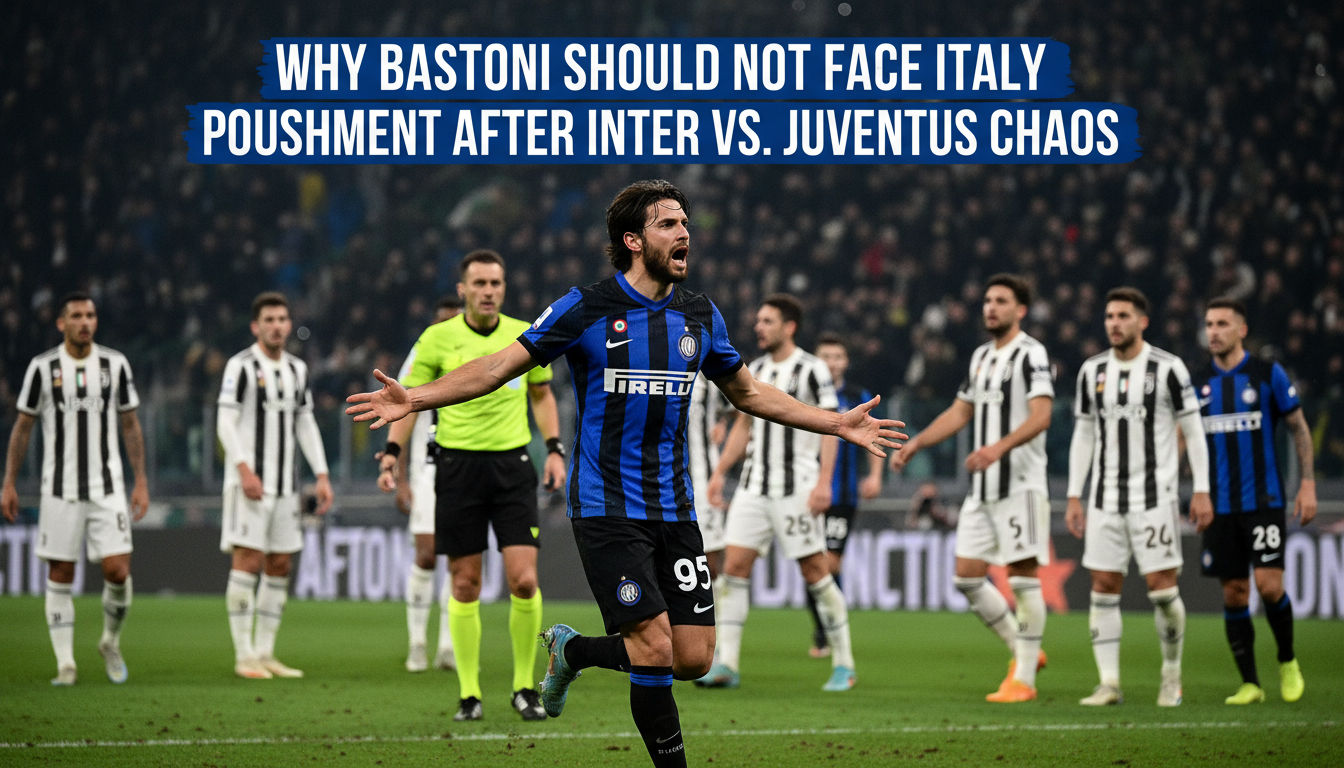
Why Bastoni should not face Italy punishment after Inter vs. Juventus chaos – the footballing world is still buzzing from the tempestuous Coppa Italia semi-final clash between Inter Milan and Juventus. The match, which ended in a 0-0 draw and saw Juventus advance on aggregate, was marred by a controversial incident involving Inter defender Alessandro Bastoni. While the debate rages on about potential disciplinary actions, a strong case can be made that Bastoni should not face further punishment from the Italian Football Federation (FIGC).
The Incident: A Moment of Frustration or Malice?
The incident in question occurred in the latter stages of the second half. Following a foul call that went against Inter, Alessandro Bastoni was seen exchanging heated words with a Juventus player, reportedly Nicolò Fagioli. Reports and replays suggest that Bastoni, in a moment of understandable frustration, may have uttered an expletive or made a gesture deemed offensive. The referee, visibly displeased, showed Bastoni a yellow card for his outburst.
However, the post-match fallout saw calls for a more severe sanction. Some pundits and sections of the media argued that Bastoni’s actions crossed a line, demanding that the FIGC review the incident and potentially impose a ban. This perspective often hinges on the idea that such displays of dissent or unsporting conduct set a bad precedent and undermine the authority of the officials and the integrity of the game.
Context is King: Understanding the Pressure Cooker Environment
To truly assess whether Bastoni deserves further punishment, it’s crucial to consider the context of the match. The Derby d’Italia is one of Italy’s most fiercely contested rivalries, carrying immense historical weight and pressure. These matches are not just about three points; they are battles for bragging rights, for league dominance, and for the very soul of the clubs. The stakes in a Coppa Italia semi-final, with a place in the final on the line, are astronomically high.
Football, at its highest level, is an emotionally charged environment. Players are under immense scrutiny, with millions watching their every move. The adrenaline is pumping, and the desire to win can be all-consuming. In such a high-stakes scenario, momentary lapses in judgment or displays of raw emotion are, unfortunately, a common occurrence. To expect players to remain completely stoic and composed in the face of relentless pressure is, frankly, unrealistic.
Furthermore, the nature of football officiating means that decisions are not always perceived as correct by both sides. Disagreements are inevitable. While players are expected to respect the referee’s decisions, the human element means that sometimes, words or gestures can slip out in the heat of the moment. This is not to condone such behaviour, but to understand it within the broader spectrum of competitive sport.
The Yellow Card: A Sufficient Deterrent?
Alessandro Bastoni was already booked for his actions on the field. The referee, who is the primary authority figure on the pitch and is tasked with managing player behaviour, deemed a yellow card to be the appropriate punishment at that moment. This disciplinary measure serves as a formal reprimand and a warning to the player. It also signals to other players that such behaviour is being monitored.
In many cases, a yellow card for dissent or unsporting conduct is considered a sufficient consequence. It impacts the player’s ability to play freely for the remainder of the match, as another yellow card would result in a sending off. It also carries the risk of accumulating yellow cards over the season, which can lead to suspensions.
The FIGC has a robust disciplinary framework, and it’s important for them to apply it consistently and fairly. Introducing additional punishments after the fact, based on post-match outcry, risks setting a dangerous precedent. It could lead to an environment where referees are pressured to make harsher calls in-game for fear of retrospective action, or where players are constantly on edge about potential future sanctions for minor infractions.
No Evidence of Intent to Harm or Serious Foul Play
Crucially, there is no concrete evidence to suggest that Alessandro Bastoni’s actions were born out of malice or an intent to seriously harm anyone, be it an opponent or the game itself. The incident, as captured on camera, appears to be an outburst of frustration directed at a perceived injustice or a heated exchange that escalated momentarily. It did not involve physical aggression or a deliberate attempt to cheat or gain an unfair advantage through deceit.
The disciplinary committees of football federations are typically tasked with reviewing incidents of serious foul play, violent conduct, or behaviour that brings the game into disrepute. For Bastoni’s action to warrant further punishment, there would need to be a clear indication that it went beyond a momentary loss of temper. This would likely involve evidence of racist remarks, homophobic slurs, or a deliberate act of aggression intended to injure an opponent. Such evidence is, by all accounts, absent in this case.
Comparing this incident to cases where players have received lengthy bans for genuinely egregious behaviour highlights the difference in severity. For instance, a player spitting at an opponent, deliberately stamping on someone, or engaging in racist abuse would undoubtedly warrant significant sanctions. Bastoni’s outburst, while not ideal, does not fall into this category.
The Role of Media and Fan Reaction
The media and fan reaction to football incidents can often be amplified, sometimes disproportionately. In the age of social media, opinions are shared instantly and can snowball, creating immense pressure on governing bodies. While feedback is valuable, it’s imperative that decisions regarding player discipline are made based on objective evidence and established rules, rather than succumbing to popular sentiment.
It’s easy for those watching from the outside to demand harsh punishments. However, they are not the ones experiencing the intense pressure, the physical exertion, or the emotional rollercoaster of a high-stakes derby. The referee on the day, with the best view of the action and the immediate authority to manage the game, made his decision. For the FIGC to overturn or augment that decision based solely on public opinion would be problematic.
We must also acknowledge the inherent subjectivity in judging emotional reactions. What one person perceives as an unacceptable outburst, another might view as a passionate, albeit regrettable, display of competitive spirit. Unless the act itself is unequivocally a violation of the sport’s core principles, a more lenient approach, especially when a yellow card has already been issued, seems more appropriate.
Precedent and Consistency in Disciplinary Actions
Consistency in applying disciplinary rules is paramount for maintaining the integrity and credibility of any sporting body. If the FIGC were to punish Bastoni further for this incident, it would raise questions about why similar outbursts from other players in other matches have not resulted in the same outcome. This could lead to accusations of bias and selective enforcement of rules.
Football history is replete with examples of players losing their temper, exchanging words, or making gestures that are later regretted. While these moments are often captured and debated, they rarely lead to significant retrospective bans unless they cross a clear line into serious misconduct. The current framework usually relies on the on-field referee’s judgment for such flashpoints.
Consider the sheer volume of yellow cards issued for dissent each season across all leagues. If every instance of verbal dissent or a minor offensive gesture was subject to a review for potential suspension, the disciplinary calendars of football federations would become unmanageable, and the focus would shift from the game itself to endless disciplinary proceedings. For a balanced approach, the FIGC should adhere to established precedents and prioritize clear violations of sporting conduct.
The Impact on Player Morale and Freedom of Expression
Punishing Bastoni further could have a chilling effect on player morale and their ability to express themselves within the confines of the game. Players are human beings, and they are expected to show passion and commitment on the pitch. While professionalism is key, stifling all emotional expression could lead to a sterile and less engaging product.
The goal of football is to entertain and to showcase athletic excellence. Part of that entertainment comes from the raw emotion and the competitive fire that players display. Bastoni’s action, while a lapse, was a manifestation of that competitive fire. To punish it severely would be to discourage players from showing such passion, which ironically, is something fans often clamour for.
It’s a delicate balance. The FIGC needs to ensure fair play and respect for officials, but also acknowledge the emotional realities of professional sport. A retrospective ban for an incident where a yellow card was deemed sufficient by the referee could be seen as overreach and an unnecessary crackdown on passionate displays.
Bastoni’s Track Record: A History of Misconduct?
A crucial aspect in assessing potential punishment is a player’s disciplinary record. Is Alessandro Bastoni a repeat offender when it comes to unsporting behaviour or dissent? If he has a clean record or a history of minor infractions that have been dealt with appropriately, then a harsher punishment for this single incident would seem disproportionate.
Alessandro Bastoni, while a fierce competitor, is not widely known for being a consistently disruptive or ill-behaved player. He is respected for his defensive prowess and his leadership qualities within the Inter squad. While he, like any player, may have had moments of frustration on the pitch, there isn’t a discernible pattern of behaviour that suggests he is a habitual offender deserving of severe retrospective sanctions.
The FIGC’s disciplinary process often takes into account a player’s past behaviour when determining the severity of a punishment. If Bastoni has a clean slate, or if his previous infractions have been minor and adequately addressed, then further punishment for this particular incident would be inconsistent with a principle of progressive discipline.
The Importance of Professionalism vs. Suppressing Emotion
There’s a fine line between professionalism and suppressing genuine emotion. Professionalism in football means respecting opponents, officials, and the rules of the game. It also means controlling one’s temper to a degree that doesn’t harm the team or the sport’s reputation. Alessandro Bastoni’s action, while a yellow card offence, didn’t necessarily breach the fundamental tenets of professionalism in a way that demands further sanction.
The argument for not punishing Bastoni further is strengthened by the fact that his action did not involve any physical confrontation, any racist or discriminatory language, or any attempt to deceive the referee. It was an emotional outburst, a common occurrence in the heat of a passionate derby. To penalize him with a ban would be to essentially say that any visible display of frustration, no matter how minor, is unacceptable and carries the risk of suspension.
This would create an environment where players are encouraged to internalize all their emotions, potentially leading to greater psychological stress and a less dynamic on-field presence. Football thrives on passion, and while it must be channelled constructively, entirely suppressing it would be detrimental.
The “Spirit of the Game” Argument
Football’s “spirit of the game” is often invoked in discussions about fair play and sportsmanship. The spirit of the game emphasizes fair competition, respect for opponents, and adherence to the rules. Does Bastoni’s action, as described, violate this spirit to the extent that it warrants a ban?
Arguably, it does not. The spirit of the game also acknowledges the human element of sport, the passion, and the competitive drive. A momentary lapse in judgment, especially one that is immediately and appropriately dealt with by the on-field referee, does not necessarily signify a disregard for the spirit of the game.
The “spirit” also implies that players are not perfect robots but individuals who can make mistakes. The aim is to learn from these mistakes and to ensure they don’t happen again, rather than to mete out excessively harsh punishments for single incidents that are already penalized on the field. If the FIGC were to intervene here, it would be seen as an overreach, potentially damaging the spirit of the game by creating an overly punitive environment.
Learning from the Incident: The Best Outcome
Perhaps the most constructive outcome for Alessandro Bastoni and for Inter Milan would be for the player to learn from this incident. He has already received a yellow card, which serves as a formal acknowledgment of his transgression. The real “punishment” should be the introspection and the commitment to avoid such outbursts in the future. This internal learning process is often far more effective than external sanctions.
Bastoni, as a young and developing leader at Inter, has an opportunity to mature from this experience. He can use it as a moment to reflect on his emotional control and how he handles pressure. This personal growth is invaluable for his career and for his development as a player and a personality within the sport.
The focus for the FIGC should be on maintaining a consistent and fair disciplinary system. Intervening with further punishment for Bastoni, when the on-field referee has already made a judgment, would create more questions than it answers and potentially set a problematic precedent. Therefore, allowing the yellow card to stand as the sole disciplinary action for this incident is the most logical and equitable approach.
Conclusion: A Case for No Further Punishment
In conclusion, while the heat of the moment in the Inter vs. Juventus derby led to Alessandro Bastoni’s yellow card for dissent or unsporting conduct, a compelling case can be made that he should not face further punishment from the Italian Football Federation (FIGC).
The context of the high-stakes Derby d’Italia, the fact that a yellow card was already issued by the on-field referee, the absence of any malicious intent or serious misconduct, and the importance of maintaining consistency and fairness in disciplinary actions all point towards leniency. Punishing Bastoni further risks setting a problematic precedent, potentially stifling player emotion and creating an overly punitive environment.
The focus should remain on the officiating of the match and the natural ebb and flow of competitive football. Alessandro Bastoni’s momentary lapse, while regrettable, is best addressed through learning and introspection, rather than through further retrospective sanctions. The integrity of the game is best served by consistent application of rules and a nuanced understanding of the human element within the intense theatre of professional sport.
For more insights into footballing controversies and predictions, stay tuned to our platform. We aim to provide you with the most comprehensive analysis and the sharpest predictions in the world of soccer.
Subscribe for the Best Predictions!
Want to stay ahead of the game with expert analysis and top-tier predictions? Don’t miss out on our daily English Premier League soccer picks. Subscribe today to get the best predictions delivered straight to your inbox!