
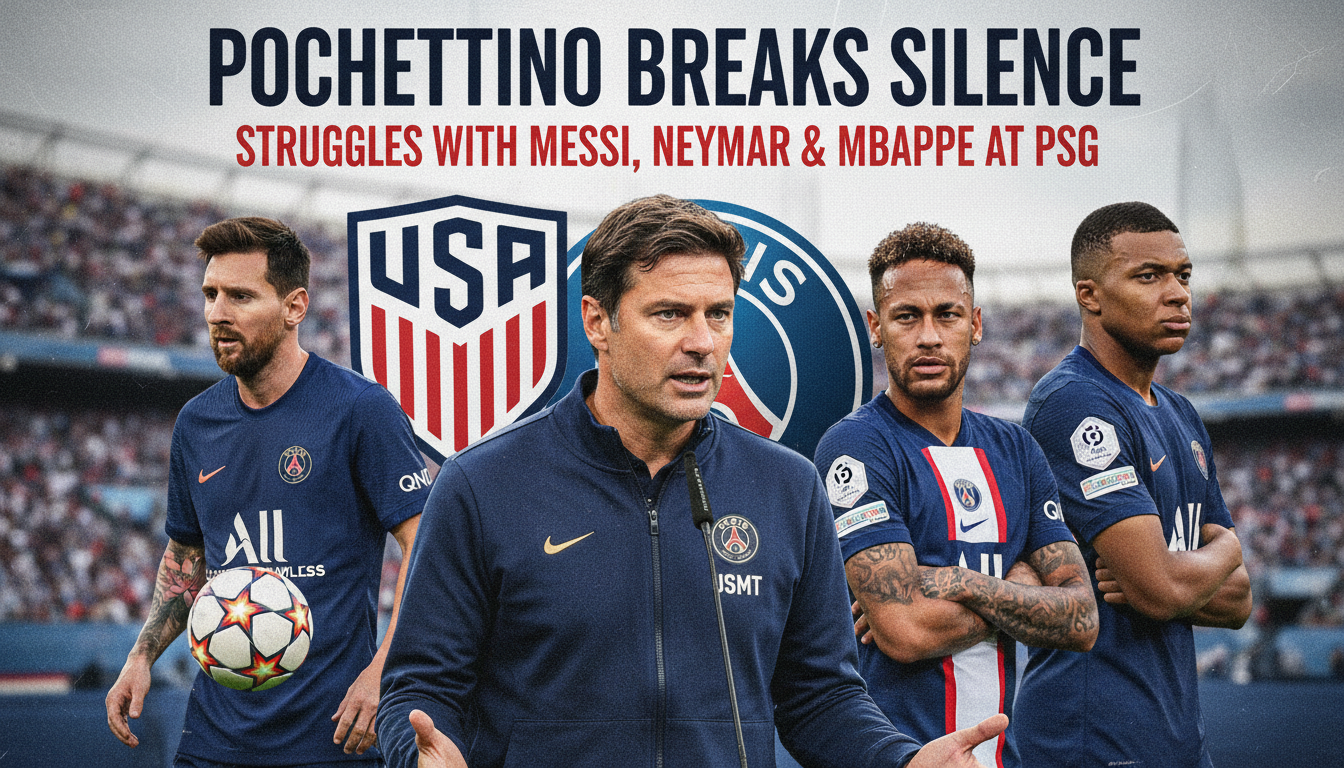
USMNT coach Pochettino breaks silence on struggles to coach lethal trio Messi, Neymar, and Mbappe at PSG. The football world is abuzz with the recent revelations from Mauricio Pochettino, the former Paris Saint-Germain manager, who has finally broken his silence on the immense challenges he faced during his tenure at the helm of the French powerhouse. While PSG, with its star-studded roster, was expected to dominate European football, Pochettino’s time at the club was marked by a curious inability to consistently unlock the full potential of their three iconic forwards: Lionel Messi, Neymar Jr., and Kylian Mbappé. This blog post delves deep into the complexities of coaching such an unparalleled attacking force, exploring the tactical dilemmas, the personality dynamics, and the sheer pressure that comes with managing a team where individual brilliance often overshadows collective cohesion.
The Genesis of the PSG Superteam
The formation of the PSG front three was, in many ways, a watershed moment in modern football transfer history. The acquisition of Lionel Messi from Barcelona in the summer of 2021, after a storied career at Camp Nou, sent shockwaves across the globe. This was followed by the continued presence of Neymar Jr., a player already synonymous with the club’s ambition, and the explosive talent of Kylian Mbappé, widely considered the heir apparent to the throne of football’s greatest players. The theoretical synergy of these three superstars was a tantalizing prospect for any manager. Imagine the offensive firepower, the individual magic, the sheer unpredictability! It was a lineup designed to overwhelm opponents, to create highlight reels week after week, and to finally conquer the elusive Champions League trophy that had become PSG’s white whale.
However, as Pochettino’s revelations suggest, the reality on the training ground and on match days proved to be far more intricate and, ultimately, more frustrating. The dream of a seamless, dominant attacking unit was a vision that, for various reasons, never fully materialized under his guidance. This isn’t to say that the players themselves weren’t capable; their individual brilliance is undeniable. The struggle lay in forging them into a cohesive, efficient, and ultimately successful collective unit, a task that even a manager of Pochettino’s caliber found to be an arduous undertaking. The pressure to deliver immediate results, coupled with the astronomical expectations, cast a long shadow over his efforts.
Pochettino’s Tactical Tightrope: Balancing Brilliance and Balance
The primary challenge for any coach tasked with managing a team featuring Messi, Neymar, and Mbappé is the delicate balancing act between maximizing individual strengths and ensuring overall team balance. Each of these players operates with a unique style and possesses distinct defensive responsibilities, or often, a lack thereof.
The Messi Enigma: Creator, Scorer, and Navigator
Lionel Messi, arguably the greatest player of all time, operates as a deep-lying playmaker, a master dribbler, and a clinical finisher. His vision and passing range are unparalleled, capable of unlocking defenses with a single pass. However, his defensive contributions are often minimal, and his positioning can leave gaps that opposition teams are eager to exploit. Pochettino would have grappled with how to best utilize Messi’s creative genius without sacrificing defensive solidity. Should Messi be given the freedom to roam and dictate play, even if it meant disrupting the team’s defensive shape? Or should he be tasked with more structured roles, potentially stifling his natural game?
External research into tactical approaches for managing playmaking superstars like Messi often highlights the importance of having mobile and defensively astute midfielders to cover the spaces left behind. Managers often consider a high pressing system to win the ball back quickly in advanced areas, reducing the need for the playmaker to track back extensively. Understanding these nuances is critical for any coach hoping to succeed with such talent. For further insight into tactical flexibility in football, one can explore resources on advanced football analytics and strategic play.
Neymar Jr.: The Dribbling Dynamo and Flair Player
Neymar Jr. brings an electrifying brand of football, characterized by mesmerizing dribbling, audacious flair, and a knack for scoring crucial goals. He thrives in possession, capable of taking on multiple defenders and creating scoring opportunities out of nothing. However, like Messi, his defensive work rate has often been a subject of debate. Pochettino would have had to consider how to integrate Neymar’s individualistic style into a team structure that demanded collective effort. Could PSG afford to have two forwards with limited defensive duties on the pitch simultaneously, especially against top European opposition?
The debate surrounding Neymar’s role often touches upon the concept of “player-centric” tactics versus “system-centric” tactics. While a player-centric approach might allow Neymar to express himself fully, a system-centric approach prioritizes the team’s overall structure and defensive organization. Finding the sweet spot between these two philosophies is a perpetual challenge in football management. Examining the tactical evolution of teams with similar star players can offer valuable perspectives.
Kylian Mbappé: The Speedster and Finishing Machine
Kylian Mbappé represents a different breed of attacking threat. His blistering pace, intelligent movement off the ball, and clinical finishing make him a nightmare for any defense. He is adept at playing on the counter-attack and can be a devastating force when given space to run into. However, Mbappé’s effectiveness is often amplified when he has support and is not isolated. Pochettino would have faced the challenge of ensuring Mbappé received the ball in dangerous areas and had teammates making supporting runs, rather than simply relying on his individual brilliance to break through.
The tactical deployment of a player like Mbappé often involves exploiting their pace in transition. This requires the midfield and defense to be able to quickly transition from defense to attack, feeding the ball to the forward line with precision. The tactical intricacies of counter-attacking football and the role of speedy forwards are well-documented in coaching manuals and football strategy discussions. Learning from the strategies of teams that excel in transition play can be incredibly insightful.
The Interplay and Incompatibility: When Stars Don’t Align
The core of Pochettino’s struggle, as he has indicated, likely stemmed from the difficulty in creating a seamless interplay between these three titans. Instead of a harmonious symphony of attacking prowess, there were often moments where their individual agendas, or simply the limitations of fitting three dominant personalities into one tactical framework, led to friction or inefficiency.
Finding the Right Formation: A Constant Puzzle
Choosing the right formation was likely a significant headache for Pochettino. A traditional 4-3-3, often favored by attacking teams, could theoretically accommodate all three. However, the specific roles within that formation would be critical. Who plays centrally? Who drifts wide? How do the midfielders support the attack without leaving the defense exposed? Pochettino would have been constantly experimenting, searching for a setup that not only allowed Messi, Neymar, and Mbappé to thrive individually but also enabled them to complement each other effectively.
For instance, a 4-2-3-1 could offer more midfield support, but might squeeze the space for all three forwards. A 3-4-3 or 3-5-2 could provide extra defensive solidity in midfield but might limit the attacking freedom of the front three. The constant tactical adjustments and the search for the “perfect” formation underscored the complexity of the situation. Exploring different successful formations used by top clubs can reveal adaptable strategies. You can find great examples of tactical formations and their effectiveness on dedicated football analysis websites.
Defensive Responsibilities: The Uncomfortable Truth
Perhaps the most significant hurdle was the issue of defensive responsibilities. In modern football, even the most attacking teams require players to contribute defensively. Messi, Neymar, and Mbappé, by their very nature, are not known for their tireless tracking back. Pochettino would have had to rely heavily on his midfielders and defenders to cover the ground and maintain a solid defensive shape, a task that can be incredibly demanding, especially against teams that are adept at exploiting space.
This is where the concept of “defensive transition” becomes paramount. When PSG lost possession, how quickly could they recover their shape? Did the front three actively participate in the initial press? Or were they often caught out of position, leaving their teammates vulnerable? The inability to consistently execute effective defensive transitions would have been a major contributing factor to their struggles, despite their offensive brilliance.
Ego, Personality, and Team Chemistry
Beyond the tactical considerations, managing a dressing room filled with three of the biggest egos in world football presents its own unique set of challenges. While all three are professionals, the dynamics of managing players of such stature, each with their own ambitions and expectations, can be incredibly delicate. Pochettino would have been tasked with fostering a sense of unity and shared purpose, ensuring that no single player felt like they were being prioritized over the collective.
The pressure from media and fans to see these superstars shine individually could also create internal tensions. If one player was perceived to be underperforming, or if another was receiving more attention, it could breed resentment. Pochettino’s role as a mediator and motivator would have been as crucial as his tactical acumen. The psychological aspect of team management, especially with global icons, is a fascinating area of study. Books and documentaries on high-pressure sports environments often delve into these complex human dynamics.
The “Lethal Trio”: A Misnomer or a Missed Opportunity?
The term “lethal trio” implies a seamless, devastating attacking unit. While individually, Messi, Neymar, and Mbappé are undoubtedly lethal, their collective impact at PSG under Pochettino often felt less than the sum of its parts. This leads to the question: was it a case of a missed opportunity, or was the very concept of fitting these three together a flawed premise from the outset?
The Individual Brilliance vs. Collective Cohesion Debate
Football purists often debate whether individual brilliance can truly compensate for a lack of collective cohesion. In the case of PSG, while they boasted undeniable individual talent, they often struggled to implement a consistent and effective team strategy, particularly in crucial European encounters. Pochettino’s challenge was to weave these individual threads into a strong, cohesive fabric.
The historical examples of football dynasties often showcase teams where individual stars thrived within a well-defined and effective team system. Think of the Barcelona of the tiki-taka era, where Messi was the focal point but operated within a meticulously structured system that maximized the contributions of every player. Or the Real Madrid of the recent Champions League dominance, where individual brilliance was present but always within a framework of tactical discipline and collective effort.
The Shadow of the Champions League
The ultimate benchmark for PSG, and indeed for any team managed by Pochettino, was the Champions League. The consistent underperformance in this competition, despite the presence of such talent, was a constant source of scrutiny. Pochettino would have felt immense pressure to deliver European glory, and the inability to do so with such a roster is a testament to the deep-seated challenges he faced. Were the struggles a direct result of his coaching limitations, or were they inherent in the construction of the squad itself?
The analysis of PSG’s Champions League campaigns during Pochettino’s tenure often points to defensive frailties and a lack of tactical adaptability in crucial moments. While their attacking flair was undeniable, they often lacked the resilience and strategic nous to overcome top European opponents consistently. Understanding the tactical nuances of knockout football is key to grasping these challenges.
Pochettino’s Perspective: The Weight of Expectation
When a manager of Pochettino’s standing speaks out about their struggles, it carries significant weight. His experience at PSG, a club operating under immense scrutiny and with astronomical expectations, provided him with a unique and challenging learning curve. His “silence broken” suggests a desire to shed light on the complexities that often go unnoticed by the casual observer.
The Pressure Cooker Environment of Paris
Paris Saint-Germain is not just another football club; it’s a global brand, a symbol of ambition and opulence. The pressure to perform, to entertain, and to win, particularly the Champions League, is immense. Pochettino, as the man in charge, bore the brunt of this pressure. Every dropped point, every disappointing performance, was magnified. The constant media attention and the high expectations from ownership would have created a relentless pressure cooker environment.
The psychological impact of managing such a high-profile club cannot be overstated. Coaches are under constant observation, with every decision dissected and debated. This can lead to a lack of clarity and can hinder the ability to implement long-term strategies. For a deeper understanding of the psychological demands of elite sports coaching, one can explore sports psychology resources and biographies of successful coaches.
The Lessons Learned: A Manager’s Evolution
While Pochettino’s time at PSG may not be remembered as a period of unqualified success, it undoubtedly provided him with invaluable lessons. The experience of managing such unique talents, grappling with complex tactical puzzles, and navigating a high-pressure environment would have shaped his managerial approach going forward. Every setback, every challenge, is an opportunity for growth.
Pochettino’s ability to adapt and learn from these experiences will be crucial in his future endeavors. The insights gained from coaching Messi, Neymar, and Mbappé, even amidst the struggles, offer a unique perspective on the intricacies of modern football management. Understanding the lessons learned by top managers from challenging situations can offer profound insights into leadership and strategy. Many reputable sports journals and coaching forums discuss these very topics.
USMNT Coach Pochettino: A New Chapter, Different Challenges
Following his departure from PSG, Mauricio Pochettino has been linked with numerous high-profile roles. The speculation surrounding his next move is a testament to his reputation as a respected manager. Now, with the possibility of him taking on a coaching role with the USMNT, the question arises: will the lessons learned from his PSG struggles inform his approach with the national team?
The challenges of coaching a national team are distinct from those of club management. Instead of building a cohesive unit from scratch over a season, a national team coach has limited time with players, often only during international breaks. The focus shifts to maximizing the potential of a diverse pool of talent, implementing a clear tactical identity, and fostering a strong team spirit within a compressed timeframe. Pochettino’s experience with PSG’s individualistic stars might offer him a unique perspective on managing players with strong personalities and ensuring they play for a common goal. The ability to adapt to different player pools and varying team dynamics is a hallmark of elite coaching. For more on the strategies of national team coaching, consider looking at the approaches of successful national team managers.
The USMNT’s Potential and Pochettino’s Vision
The USMNT has been on an upward trajectory in recent years, with a burgeoning generation of talented players emerging from both domestic and international leagues. The vision for the future of US Soccer is one of sustained competitiveness on the global stage. Pochettino, with his proven track record of developing young talent and implementing effective tactical systems, could be a transformative figure for the USMNT.
His experience at PSG, while challenging, exposed him to the highest level of the game and the demands of managing superstars. This knowledge, coupled with his innate understanding of team dynamics and tactical innovation, could be invaluable in shaping the USMNT’s identity and guiding them towards future successes. The strategic planning involved in national team development is a complex but crucial aspect of international football.
External Resources for Deeper Insight
To truly understand the complexities discussed in this blog post, it’s beneficial to explore external resources that delve deeper into football tactics, player management, and the psychology of elite sports. Here are a few valuable links:
- For in-depth tactical analysis of formations and strategies, consider visiting websites dedicated to football analytics such as The Analyst.
- To understand the psychological aspects of managing high-profile athletes, explore resources on sports psychology. Books and articles from organizations like the American Psychological Association (APA) on sport and exercise psychology can offer valuable insights.
- For historical context and case studies of successful teams and managers, reputable sports news outlets and archives often provide extensive retrospectives. For example, exploring the archives of ESPN or BBC Sport can be very illuminating.
- Discussions on managerial philosophies and the challenges of building team cohesion can be found on numerous coaching forums and in interviews with top football managers.
The Takeaway: A Masterclass in Managing Ambition
The saga of Mauricio Pochettino at Paris Saint-Germain, particularly his struggles to effectively coach the lethal trio of Messi, Neymar, and Mbappé, serves as a compelling case study in the intricate world of elite football management. It underscores that even with the most prodigious talent, the absence of a cohesive strategy, effective communication, and a strong team ethic can hinder ultimate success. Pochettino’s willingness to break his silence offers a rare glimpse into the immense pressures and complex decision-making involved at the pinnacle of the sport.
While PSG’s ambitions for European glory may have been temporarily stalled, the lessons learned from this era will undoubtedly shape the future approaches of both the club and the managers involved. The football world eagerly awaits to see how these experiences will influence Pochettino’s subsequent career moves, particularly if he takes on the helm of the USMNT, a team with its own unique aspirations and a growing pool of talent eager for guidance.
The journey of managing superstars is a perpetual learning curve, a testament to the fact that football, at its highest level, is as much about human dynamics and strategic brilliance as it is about individual skill. The **USMNT coach Pochettino breaks silence on struggles to coach lethal trio Messi, Neymar, and Mbappe at PSG** narrative is far from over, as the echoes of these challenges continue to resonate, offering valuable insights for aspiring coaches and football enthusiasts alike.
Subscribe for the Best Predictions
Stay ahead of the game and elevate your football knowledge with unparalleled insights and expert analysis. Don’t miss out on our meticulously crafted predictions designed to inform and excite. Subscribe today to receive the best daily English Premier League soccer predictions directly to your inbox!
Click here to Subscribe for Daily English Premier League Soccer Predictions!