

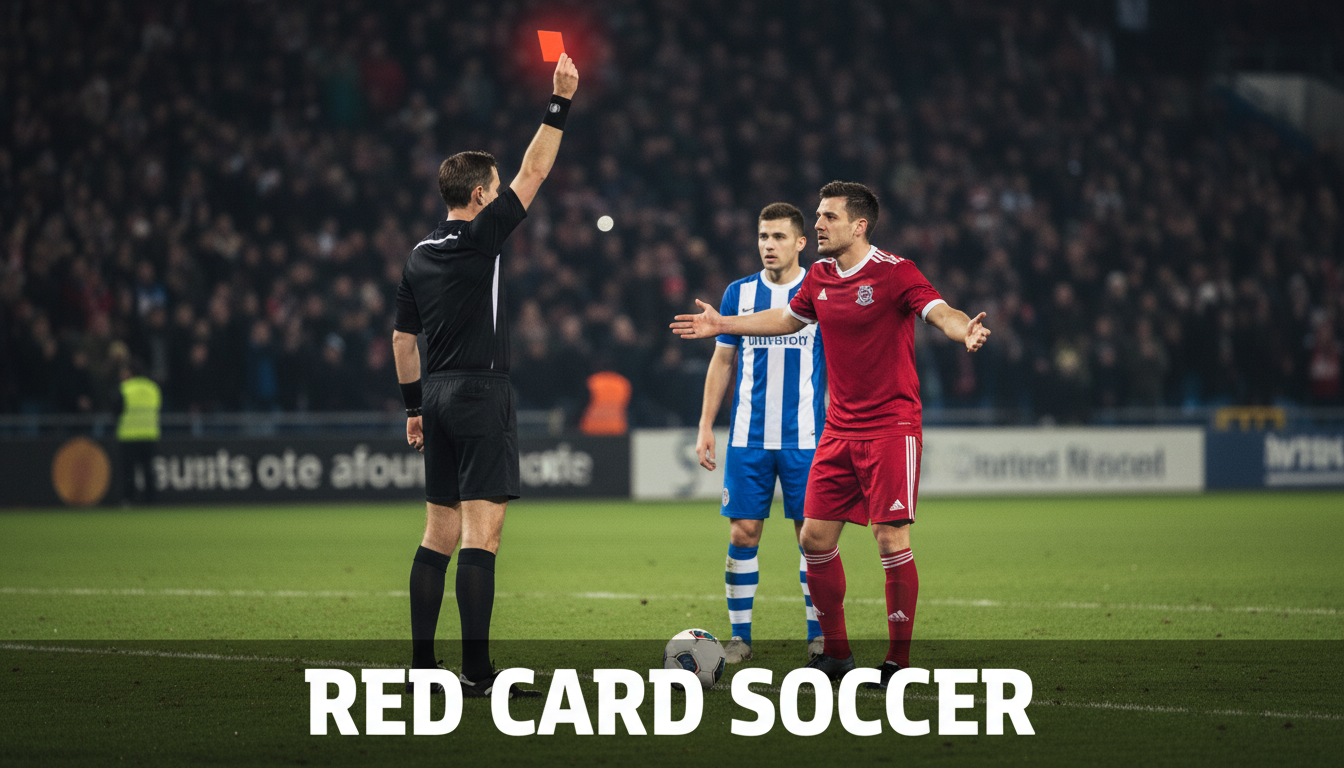
Red card soccer. The phrase itself conjures images of dramatic moments, controversial decisions, and shifts in the very fabric of a football match. It’s the ultimate sanction, a stark declaration that a player has crossed a line, fundamentally altering the dynamics of the game for both teams. But what exactly constitutes a red card in soccer? What are the nuances, the interpretations, and the profound impact these ejections have?
This comprehensive guide will delve deep into the world of red card soccer, exploring everything from the letter of the law to the psychological toll on players and teams. We’ll examine historic red card incidents, the role of technology in decision-making, and the strategic implications of playing with a man down. Whether you’re a seasoned football aficionado or a newcomer to the beautiful game, understanding the red card is crucial to appreciating its full complexity and drama.
Understanding the Laws of the Game: What Triggers a Red Card?
At the heart of any disciplinary action in soccer lies the Laws of the Game, meticulously maintained by the International Football Association Board (IFAB). These laws provide the framework for referees to manage matches and ensure fair play. When it comes to dismissals, or red cards, Law 12: Fouls and Misconduct is the definitive reference. It outlines a range of offenses that warrant a player being sent off. It’s crucial to understand that a red card is not just for a single egregious act; it can also be the culmination of accumulated offenses.
Direct Red Card Offenses
A direct red card is issued for the most serious infringements. These are offenses that are deemed to be so severe that they warrant immediate expulsion from the game, without the need for a prior caution (yellow card). These offenses are designed to protect player safety and uphold the integrity of the sport. The IFAB Law 12 clearly defines these:
- Serious Foul Play: This is arguably the most common reason for a direct red card. It involves using excessive force or brutality against an opponent. The key here is “excessive force.” A strong tackle, while potentially dangerous, isn’t necessarily serious foul play if it’s aimed at the ball and executed with a degree of control. However, a lunge with studs up, a dangerous tackle from behind with excessive force, or a deliberately violent challenge falls squarely into this category. The referee must assess the intent and the degree of danger involved.
- Violent Conduct: This offense goes beyond tactical fouls. It includes any act of aggression that is not aimed at challenging for the ball. This could be striking an opponent with a fist, headbutting them, spitting at them, or engaging in any form of physical altercation that is not part of the normal play of the game. The intent is purely malicious and not related to the objective of winning possession.
- Spitting at an Opponent or Any Other Person: Spitting is universally considered unsportsmanlike and disgusting. Whether it’s directed at an opponent, a teammate, a match official, or even a spectator, it is a red card offense. There is no justification for this behavior, and the sanction is absolute.
- Denying an Obvious Goal-Scoring Opportunity by Deliberately Handling the Ball: This is a specific scenario that often causes debate. If a player intentionally uses their hand or arm to stop a shot or prevent an opponent from scoring a clear goal, they will be sent off. This applies even if the handball is not a foul in itself (e.g., the ball hits an outstretched arm that is in a natural playing position but deflects a shot). The crucial elements are the *deliberate* nature of the handball and the *obvious goal-scoring opportunity*. Goalkeepers are exempt from this rule within their own penalty area.
- Denying an Obvious Goal-Scoring Opportunity to an Opponent Moving Towards the Player’s Goal by an Offence Punishable by a Free Kick: This is a more complex scenario that replaced the old “last man” rule. It’s not just about being the last defender. The referee must assess if the opponent had a clear path to goal, if there was a realistic chance of scoring, and if the foul committed was one that would ordinarily result in a free kick or penalty kick. Factors like the attacker’s speed, the proximity of other defenders, and the angle of the attack are all considered. It’s a nuanced judgment call.
- Using Offensive, Insulting or Abusive Language and/or Gestures: This category covers verbal abuse and offensive gestures directed at anyone – opponents, teammates, officials, or spectators. It’s about maintaining respect and decorum on the field. Profanity, derogatory remarks, or provocative gestures can all lead to a red card.
- Receiving a Second Caution (Yellow Card) in the Same Match: This is the most common way a player is dismissed. A player is shown a yellow card for a cautionable offense. If they commit another cautionable offense later in the same match, they receive a second yellow card, which automatically results in a red card. This means accumulating two less severe offenses can still lead to an ejection.
It’s important to note that referees are trained to apply these laws consistently, but interpretation can sometimes lead to controversy. The speed of the game, the proximity of the incident, and the referee’s viewpoint all play a role.
Cautionable Offenses (Yellow Cards) Leading to a Red Card
As mentioned above, accumulating two yellow cards in a single match is a guaranteed route to a red card. These yellow card offenses, while not as severe as those warranting a direct red, are still deemed to be misconduct that warrants a caution. They are often seen as preventing the game from flowing freely, showing a lack of respect, or jeopardizing fair play. IFAB Law 12 also lists these:
- Unsporting behaviour: This is a broad category and can encompass a wide range of actions. It includes things like simulation (diving to try and win a penalty or free kick), persistent infringement of the Laws of the Game, delaying the restart of play, or showing disrespect to the game.
- Dissent by word or action: Arguing with the referee, gesturing aggressively towards them, or using disrespectful language are all forms of dissent that will be punished with a yellow card. This is about maintaining the authority of the match officials.
- Persistent infringement of the Laws of the Game: This applies to a player who repeatedly commits fouls, even if each individual foul isn’t severe enough for a yellow card on its own. The referee might warn the player first, but if the infringements continue, a caution is given.
- Delaying the restart of play: This is often seen when a player intentionally kicks the ball away after a foul has been awarded, takes too long to take a throw-in, or feigns injury to waste time. The aim is to disrupt the flow of the game.
- Failure to respect the required distance when play is restarted with a corner kick, free kick or throw-in: When play is restarted, opponents must be a specified distance away (e.g., 10 yards for a free kick). Players who deliberately encroach or refuse to move back will be cautioned.
- Entering, re-entering or deliberately leaving the field of play without the referee’s permission: Players must remain within the boundaries of the field of play unless they have been substituted or have received permission from the referee to leave temporarily (e.g., for an injury). Entering the field without permission after being off it, or leaving without permission, will result in a caution.
It’s this dual pathway to a red card – a single severe offense or the accumulation of less severe ones – that adds layers of tactical consideration for managers and players alike. A player on a yellow card must tread carefully for the remainder of the match, knowing that another indiscretion means an early exit.
The Referee’s Role and the Impact of Technology
The referee is the ultimate arbiter on the field, responsible for enforcing the Laws of the Game. Their decisions, especially regarding red cards, are often under intense scrutiny from players, managers, fans, and the media. The responsibility placed upon referees is immense, requiring not only a deep understanding of the laws but also excellent judgment, communication skills, and the ability to remain calm under pressure.
Interpreting the Laws in Real-Time
While the laws provide a clear framework, their application in the fast-paced environment of a soccer match is inherently subjective. Referees must make split-second decisions based on what they see. Key factors they consider when awarding a red card include:
- Intent: Was the foul deliberate, reckless, or accidental? While accidental fouls rarely result in red cards, recklessness and intent are crucial considerations for serious foul play.
- Force: How much force was used? A strong tackle aimed at the ball is different from a brutal, studs-first challenge.
- Danger: How dangerous was the foul to the opponent’s safety? Tackles from behind, tackles with excessive force, or tackles that endanger the opponent’s ankle or knee are particularly scrutinized.
- Positioning: Was the player in an obvious goal-scoring position? Was the foul committed in a location that presented a clear goal-scoring opportunity?
- Consequences: Did the foul result in injury? While not the sole determinant, a serious injury can sometimes highlight the severity of a foul.
The introduction of the Video Assistant Referee (VAR) system has significantly altered the landscape of officiating in professional soccer. VAR aims to reduce clear and obvious errors by referees, and red card decisions are a major focus of its review.
The Role of VAR
VAR involves a team of video officials who monitor the match from a television studio. They have access to multiple camera angles and can review incidents that lead to goals, penalties, direct red cards, and mistaken identity. For red card incidents, VAR will typically review:
- Direct Red Card Offenses: VAR can recommend a review for potential serious foul play, violent conduct, spitting, or denying an obvious goal-scoring opportunity. The referee will then be alerted and can choose to review the incident on a pitchside monitor.
- Second Yellow Cards: VAR can also intervene if a referee misses a second yellow card offense, or if a player receives a second yellow card for an offense that should have been a direct red.
The impact of VAR on red card decisions has been profound. It has led to more consistent application of the laws, particularly in clear-cut cases of foul play or handball denying a goal. However, it has also introduced its own set of debates, particularly around the subjective nature of “serious foul play” and the interpretation of “obvious goal-scoring opportunity.” The speed of review and the decision to “show, don’t tell” the referee have also been points of discussion. For more on how technology is changing soccer, you can explore resources on FIFA’s technological advancements.
The Multifaceted Impact of a Red Card on a Soccer Match
A red card is not just a disciplinary measure; it’s a game-changer. Its impact resonates through every facet of the match, from tactical setups to player psychology and the overall spectator experience.
Tactical Implications
The most immediate and obvious impact of a red card is the numerical disadvantage. When a team is reduced to ten players (or fewer), their entire tactical approach must adapt. This forces managers into difficult decisions:
- Defensive Adjustments: The primary concern is usually shoring up the defense. This might involve dropping a midfielder deep to form a more compact defensive block, essentially playing a 4-4-1 or even a 4-5-0 formation. Wingers might be asked to track back more diligently, and full-backs might become more conservative.
- Attacking Sacrifices: With one less player, attacking impetus is often sacrificed. The team might abandon their usual pressing game and focus on counter-attacks, looking to exploit any space left by an emboldened opposition. Long balls and direct play can become more prevalent.
- Substitution Strategies: Managers might be forced to bring on a defensive-minded player to replace the sent-off player, or even sacrifice a more attacking player to maintain midfield control. This can disrupt any pre-planned substitution strategy.
- Maintaining Possession: Ironically, a team with ten men might try to hold onto the ball more, to limit the opposition’s opportunities to attack. This requires intelligent passing and movement to retain possession, which can be incredibly tiring.
The opposing team, now with a numerical advantage, will typically try to exploit the space. They might push their full-backs higher, overload wide areas, or try to create overloads in central midfield. The game often becomes a test of patience and discipline for the team with ten men, and a test of attacking verve and efficiency for the team with eleven.
Psychological Effects on Players
The psychological impact of a red card is immense for all involved. For the player who is sent off, there’s often a mix of frustration, regret, anger, and a profound sense of letting their teammates down. They are forced to watch the remainder of the game from the sidelines, often in agony as their team struggles.
For the remaining players on the pitch, the psychological burden increases. They have to work harder, cover more ground, and maintain focus while knowing they are at a disadvantage. This can lead to:
- Increased Pressure: The players might feel a heightened sense of responsibility to compensate for the missing teammate.
- Fatigue: The physical exertion required to play with ten men is significantly higher, leading to quicker fatigue.
- Frustration: Constantly chasing the ball and defending can be demoralizing, leading to frustration and potentially more ill-discipline.
- Determination: Conversely, a red card can sometimes galvanize a team, fostering a “backs against the wall” mentality and a fierce determination to fight for a result.
The impact on the opposing team is also psychological. While they have a clear advantage, they can also become complacent, or conversely, frustrated if they cannot break down a resolute defense. The knowledge that a single mistake could still lead to a goal can maintain pressure.
The Spectator Experience
Red cards add a significant layer of drama and unpredictability to a soccer match. They often lead to:
- Increased Tension: The game becomes more nail-biting as the disadvantaged team fights valiantly and the advantaged team strives to capitalize.
- Controversy: Red card decisions are often hotly debated, both in the stadium and online, fueling passionate discussions among fans.
- Unpredictability: A red card can swing the momentum of a game entirely, leading to unexpected outcomes and exciting comebacks.
While the drama can be engaging, some argue that too many red cards can detract from the quality of the football, especially if the game becomes overly defensive. The balance between maintaining discipline and allowing the game to flow is a constant challenge for referees and rule-makers.
Historic Red Card Incidents and Their Significance
Throughout the history of football, certain red card incidents have etched themselves into the annals of the sport, becoming legendary for their controversy, impact, or sheer notoriety. These moments often serve as case studies for understanding the nuances of the laws and the pressure on referees.
The Infamous Zinedine Zidane Headbutt (2006 World Cup Final)
Perhaps one of the most iconic and talked-about red cards in history, Zinedine Zidane’s headbutt on Marco Materazzi in the 2006 World Cup Final remains a defining moment. Zidane, playing in his final professional match, was sent off in extra time for a moment of uncharacteristic violence.
The incident, which saw him ejected from the game and Italy go on to win the World Cup on penalties, highlighted the immense pressure and emotional toll that elite football can exert on players. It was a stark reminder that even the most disciplined athletes can succumb to provocation. The reasons behind Zidane’s actions continue to be debated, adding to the legend of the event. For a deeper dive into this and other iconic World Cup moments, explore ESPN’s ranking of World Cup moments.
Eric Cantona’s Kung-Fu Kick (1995)
Another unforgettable red card incident involved Manchester United’s talismanic striker, Eric Cantona. During a match against Crystal Palace, Cantona was sent off for kicking out at Richard Shaw. As he was leaving the field, a spectator, John Magovce, ran down the stands shouting abuse at Cantona. In a moment of incredible impulsiveness, Cantona launched himself into the air, delivering a “kung-fu” style kick to the spectator.
This incident resulted in a lengthy ban for Cantona, a criminal conviction, and cemented his reputation as a player who lived on the edge. It raised questions about player conduct off the field and the responsibility of clubs to manage their stars’ behavior. This falls into the realm of discussions about clubs like Manchester United Soccer.
Diego Maradona’s Two Red Cards (1982 & 1986 World Cups)
Diego Maradona, arguably one of the greatest players of all time, was no stranger to controversy. In the 1982 World Cup, he received a red card for a vicious kick on Brazil’s Batista. In the 1986 World Cup, a tournament he dominated, he was fortunate to only receive a yellow card for a blatant handball that disallowed a goal, but his aggressive style and passion often teetered on the brink of indiscipline. While not directly red cards in every instance, his disciplinary record in major tournaments illustrates the fine line he often walked between genius and recklessness.
The Impact of These Incidents
These infamous red cards, and countless others, serve multiple purposes in football lore:
- Illustrating the Laws: They provide real-world examples of what constitutes serious misconduct and the consequences thereof.
- Highlighting Player Psychology: They offer insights into the immense pressure and emotional volatility that can affect professional athletes.
- Fueling Debate: They spark endless discussions among fans, pundits, and analysts about refereeing decisions, player responsibility, and the spirit of the game.
- Shaping Legacies: For better or worse, these moments become indelible parts of a player’s career narrative.
Understanding these historical events helps to contextualize the importance of red cards in shaping the narrative and evolution of the sport.
Red Card Soccer: Beyond the Pitch – Rules, Statistics, and Common Misconceptions
The impact of a red card extends beyond the 90 minutes of a match. It carries consequences for players, teams, and the league as a whole. Examining statistics and addressing common misconceptions can provide a clearer picture of this crucial aspect of soccer.
Sanctions and Suspensions
A red card doesn’t just mean an immediate exit from the game. Players who are sent off typically face:
- Automatic One-Match Ban: For most red card offenses, including two yellow cards, the player will automatically miss the next match.
- Extended Bans: For more serious offenses like violent conduct, serious foul play, or spitting, the Football Association (or the relevant governing body) will often impose longer bans. These can range from three matches to a significant portion of the season, depending on the severity of the offense and the player’s disciplinary record.
- Fines: Clubs and players can also face financial penalties for red card offenses.
These sanctions are designed to deter misconduct and ensure player safety. For teams, losing a key player for multiple games due to suspension can have a significant impact on their season’s aspirations. This is relevant when considering teams like Man United or Man City Games.
Statistical Trends in Red Cards
Analyzing statistics can reveal interesting trends in red card incidents:
- League Variations: Some leagues tend to have more red cards than others, possibly due to differences in playing styles, refereeing interpretations, or the physical nature of the game. For instance, historically, leagues with a more aggressive style of play might see a higher incidence of red cards. This could include leagues like the English Premier League.
- Referee Influence: While referees strive for consistency, subtle differences in their interpretation of the laws can lead to variations in the number of red cards awarded.
- Match Importance: High-stakes matches, such as cup finals or derby games, can sometimes see an increase in red cards due to heightened emotions and pressure. Consider a World Cup Final or a Man U and Man City rivalry.
- Positional Trends: Defenders and defensive midfielders are often more likely to receive red cards due to their role in tackling and breaking up play, putting them in more situations where fouls are committed.
It’s worth noting that with the introduction of VAR, there has been a general trend towards fewer “soft” red cards and more consistent application in clear-cut cases. However, the number of incidents requiring review can still vary.
Common Misconceptions about Red Cards
Several myths and misunderstandings surround red cards in soccer:
- “It was just a tackle”: While many tackles are fair, the line between a firm tackle and serious foul play can be subjective. If a tackle is reckless, excessive in force, or from behind with excessive force, it can warrant a red card even if the intent wasn’t malicious. This is a key consideration in any Soccer Match.
- “The referee is biased”: While bias is a serious accusation, it’s more common for referees to make genuine errors in judgment under immense pressure. The speed of the game and limited viewing angles can contribute to incorrect decisions. VAR aims to mitigate this, but human interpretation is still involved.
- “The player deserved it because he was provoked”: While provocation can be a factor in a player’s reaction, it does not excuse violent conduct or serious foul play. The laws of the game are clear that players must maintain control, regardless of provocation.
- “Only outfield players get red cards”: Goalkeepers can also receive red cards, most commonly for denying an obvious goal-scoring opportunity outside their penalty area or for violent conduct.
Understanding these nuances is key to appreciating the complexity of soccer officiating and the importance of red cards in maintaining the integrity of the sport.
Preparing for the Next Prediction: Subscription for the Best Soccer Picks
The world of soccer is full of unpredictable moments, and while red cards add drama, accurate predictions can enhance your enjoyment and understanding of the game. If you’re looking to gain an edge and make more informed decisions, subscribing to a service that provides expert analysis and predictions is a wise move. For those interested in upcoming events, check out the FIFA World Cup 2025 Schedule or the World Cup Schedule 2026.
We understand the passion and dedication that goes into following soccer. Our team of experienced analysts and data scientists works tirelessly to provide you with the most insightful and accurate predictions available. From tactical breakdowns to player form analysis and statistical modeling, we cover every angle to bring you the best possible picks. You can find daily picks such as Soccer Predictions: Unlocking Today’s Crucial Cup Clashes – Feb 4, 2026.
Whether you’re a casual fan looking to spice up your matchday experience or a serious bettor seeking a reliable source of information, our subscription service is designed to meet your needs. Imagine knowing the potential impact of key fixtures, understanding the form of in-form players, and anticipating tactical shifts – all thanks to our in-depth research.
Don’t miss out on another crucial match or a game-changing prediction. Elevate your soccer experience and join our community of informed fans. For the best daily English Premier League soccer predictions and more, we invite you to subscribe today!
Subscribe now for unparalleled soccer predictions!
Conclusion: The Enduring Significance of the Red Card in Soccer
The red card in soccer is far more than just a disciplinary tool; it’s a potent symbol of the game’s inherent drama, its adherence to rules, and the fine line between brilliance and indiscipline. From the thunderous roar of the crowd to the hushed tension of a player walking the plank, a red card instantly escalates the stakes and reshapes the narrative of a match. We’ve explored the intricacies of the Laws of the Game, the critical role of referees, and the transformative impact of technology like VAR in ensuring fairness and consistency. The tactical shifts, psychological battles, and unpredictable outcomes that follow an ejection underscore its profound significance. This is all part of the Soccer World.
Whether it’s a moment of impulsive aggression, a calculated act of desperation, or the culmination of persistent infringements, the red card serves as a stark reminder of the responsibilities players have on the field. Historical incidents, from Zidane’s iconic headbutt to Cantona’s infamous kick, continue to be dissected and debated, illustrating the lasting legacy these moments leave. Furthermore, understanding the sanctions and statistical trends associated with red cards provides a broader perspective on their impact beyond the 90 minutes. We encourage you to continue exploring the beautiful game with a deeper appreciation for the rules and moments that make it so compelling. Remember to stay informed with the best predictions to enhance your enjoyment of every match.















I always found it interesting how VAR has influenced red card decisions. It’s a game-changer, but I sometimes wonder if it adds to the pressure on referees during high-stakes moments.