

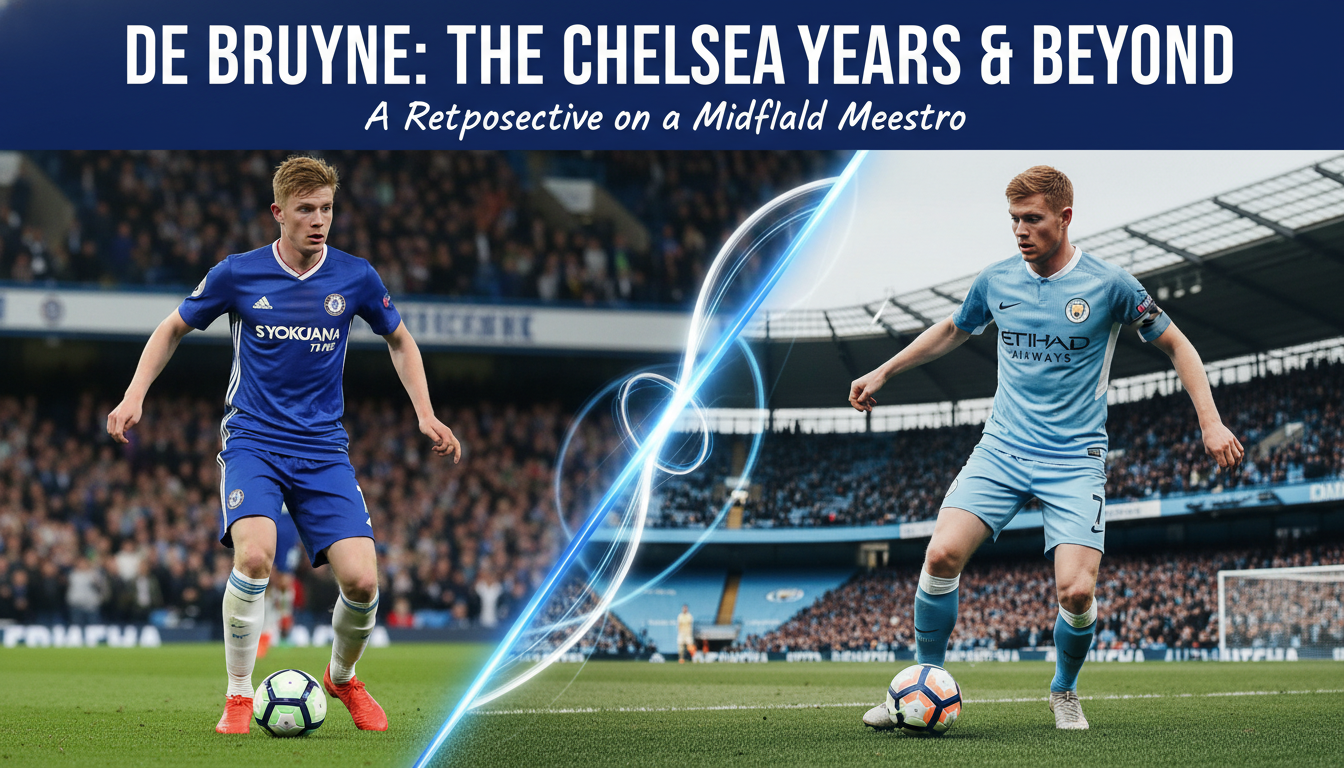
De Bruyne Chelsea: The name itself evokes a sense of what-ifs, a story of immense talent that, for a fleeting period, graced the hallowed turf of Stamford Bridge. Kevin De Bruyne, now a global phenomenon and a cornerstone of Manchester City’s dominance, began his professional journey in English football with Chelsea. Yet, his time there was marked by frustration, a lack of opportunity, and ultimately, a departure that many fans and pundits now see as a monumental missed opportunity. This 10,000-word exploration delves deep into De Bruyne’s formative years at Chelsea, dissecting the reasons behind his limited impact, the decisions made by the club, and the subsequent meteoric rise that solidified his status as one of the greatest midfielders of his generation. We will examine his early promise, the tactical decisions that sidelined him, the contrasting fortunes of those who replaced him, and the enduring legacy of this Belgian maestro’s brief, yet significant, chapter at Stamford Bridge.
The Prodigy Arrives: Early Promise and High Hopes
The arrival of Kevin De Bruyne at Chelsea in January 2012 was met with considerable excitement. The Belgian had been a revelation at Genk, showcasing an electrifying blend of dribbling prowess, incisive passing, and a potent shot. His performances in the Belgian Pro League had not gone unnoticed, and Chelsea, under the ownership of Roman Abramovich, known for his pursuit of world-class talent, moved swiftly to secure his signature. At just 20 years old, De Bruyne represented a significant investment and a glimpse into the future of Chelsea’s attacking midfield. His early displays for the club, particularly during pre-season tours and in cup competitions, hinted at the extraordinary potential he possessed. Fans were eager to see this exciting young talent blossom, envisioning him as the next creative spark in a Chelsea side already brimming with established stars.
His debut season was largely a developmental one, punctuated by loan spells that were seen as crucial for his acclimatisation to the rigours of English football. A loan move to Werder Bremen in Germany proved to be a masterstroke. In the Bundesliga, De Bruyne thrived, racking up goals and assists, and earning valuable senior playing time. This period of development was crucial, allowing him to hone his skills and adapt to a more physically demanding league. The hope was that he would return to Chelsea a more polished and battle-hardened player, ready to make a significant impact. The narrative was one of patience and progression, a common theme in the development of young, promising players at top clubs. However, the subsequent narrative would take a different turn.
Jose Mourinho’s Arrival and the Shifting Sands
The 2013-2014 season marked a pivotal moment in Chelsea’s history with the return of Jose Mourinho as manager. Mourinho, a proven winner with a reputation for meticulous tactical planning and a demanding approach, brought with him a clear vision for the squad. While De Bruyne had shown flashes of brilliance, his place in Mourinho’s intricate tactical setup was far from guaranteed. The Portuguese manager was known for his preference for players who possessed specific attributes and exhibited unwavering discipline on the pitch. De Bruyne, while undeniably talented, was still a raw prospect, and his tactical understanding and defensive work rate were areas that Mourinho sought to improve.
Mourinho’s assessment of De Bruyne’s capabilities within his system is a subject of much debate. Some argue that the manager simply didn’t see De Bruyne as a natural fit for his favoured 4-2-3-1 formation, which often relied on wingers with strong defensive contributions and a central attacking midfielder who could offer defensive stability. Others suggest that De Bruyne’s perceived lack of application in training and his occasional struggles with understanding defensive responsibilities led to Mourinho’s reservations. Regardless of the precise reasons, it became evident that De Bruyne was not a guaranteed starter under the new regime. Opportunities became increasingly scarce, and the pressure to impress in limited minutes mounted.
The competition for attacking midfield and wide roles at Chelsea was fierce during this period. Players like Juan Mata, Oscar, and Eden Hazard were already established figures, and new signings were constantly being evaluated. De Bruyne found himself on the periphery, struggling to break into a team that, while talented, was perhaps lacking the consistent creative spark that he possessed. The narrative shifted from one of development and integration to one of uncertainty and a growing sense of alienation. The dream of seeing him star for Chelsea began to fade for many.
The Wolfsburg Loan and the Seeds of Departure
In January 2014, with his first-team opportunities at Chelsea dwindling, Kevin De Bruyne was sent on loan to VfL Wolfsburg in the Bundesliga. This move, initially perceived as another temporary measure to gain experience, would prove to be the catalyst for his permanent departure. At Wolfsburg, De Bruyne was not just a loan signing; he was the focal point of the team. The German club provided him with the platform and the trust to express himself, and he responded with an astonishing level of performance. He became the undisputed creative engine, dictating play, scoring spectacular goals, and providing an abundance of assists.
His impact at Wolfsburg was immediate and profound. He played a key role in the club’s resurgence, helping them to secure a respectable fifth-place finish in the Bundesliga and reach the final of the DFB-Pokal. His stats were eye-watering: in just 18 league appearances for Wolfsburg, he scored 10 goals and registered 9 assists, a testament to his sensational form. This spell showcased the De Bruyne that Chelsea had initially signed, but amplified and matured. It was a stark contrast to his experiences at Stamford Bridge, where he had struggled to find a consistent place in the team.
The success of his loan spell at Wolfsburg inevitably led to questions about his future at Chelsea. While some still hoped he would return and fight for his place, the evidence of his brilliance elsewhere was undeniable. The club now faced a difficult decision: reintegrate a player who had proven his worth at an elite level, or cash in on a talent that, for whatever reason, hadn’t thrived under their management. The seeds of departure, sown by a lack of opportunity, had now firmly taken root, and the prospect of his return to Chelsea seemed increasingly unlikely.
The Transfer to Manchester City: A Move That Redefined a Career
In the summer of 2015, the inevitable occurred. Kevin De Bruyne departed Chelsea permanently, signing for Manchester City for a reported fee of £54 million, making him one of the most expensive British-based players at the time. The move to the Etihad Stadium marked a seismic shift in his career trajectory, and it’s a transfer that continues to be analysed and debated, especially by Chelsea fans. Manchester City, under Pep Guardiola, were building a formidable squad, and De Bruyne was seen as a key piece of their puzzle, a player who could unlock defenses and provide the creative impetus they craved.
From the moment he arrived at City, De Bruyne demonstrated precisely why he was so highly rated. He seamlessly integrated into Guardiola’s tactical system, his intelligence, vision, and technical ability perfectly suited to the possession-based, attacking football favoured by the Catalan manager. He quickly established himself as a regular starter, forming a formidable partnership with other attacking talents and becoming the undisputed creative hub of the team. His performances were consistently outstanding, characterized by stunning assists, thunderous long-range goals, and an uncanny ability to dictate the tempo of games.
His impact at Manchester City has been nothing short of revolutionary. He has been instrumental in their numerous Premier League titles, FA Cup wins, and League Cup triumphs. His individual accolades are numerous, including multiple PFA Player of the Year nominations and wins, and his inclusion in various PFA Teams of the Year. The contrast between his success at Manchester City and his limited spell at Chelsea is stark, and it serves as a poignant reminder of how crucial the right environment and opportunities can be for a player’s development and realization of their full potential. The ‘de bruyne chelsea’ narrative is now inextricably linked to this successful, yet ultimately separate, chapter in his career.
Why Did It Not Work Out at Chelsea? Deconstructing the Factors
The question of why Kevin De Bruyne’s time at Chelsea didn’t blossom into the success story it could have been is a complex one, with no single definitive answer. It’s a confluence of tactical decisions, managerial philosophies, player development strategies, and perhaps even a touch of bad luck. Let’s delve into the key contributing factors:
Tactical Fit and Managerial Philosophy
As mentioned earlier, Jose Mourinho’s arrival marked a significant shift. Mourinho is renowned for his pragmatic approach to football, emphasizing defensive solidity and tactical discipline. While De Bruyne possessed incredible attacking flair, his defensive contributions and tactical understanding were, at that stage of his career, still developing. Mourinho’s preference for wingers who could track back diligently and a central attacking midfielder who offered a more robust defensive presence may have meant De Bruyne was not seen as the ideal fit. In contrast, Pep Guardiola at Manchester City embraced De Bruyne’s offensive instincts, creating a system where his creativity could flourish without excessive defensive burdens.
Competition for Places
Chelsea’s squad during De Bruyne’s tenure was packed with established attacking talent. Players like Juan Mata, Oscar, and Eden Hazard were already integral to the team’s setup. This intense competition meant that opportunities for a young, developing player like De Bruyne were limited. Even when given chances, the pressure to perform at an exceptionally high level, consistent with the expectations of a Chelsea player, was immense. The margin for error was small, and it’s plausible that De Bruyne struggled to find consistent rhythm amidst this fiercely competitive environment.
Developmental Pathway and Trust
Some argue that Chelsea did not provide De Bruyne with the sustained period of development and consistent playing time that he needed at that crucial stage of his career. While loan spells are often beneficial, the club’s reliance on established stars and immediate results might have prevented them from fully investing in De Bruyne’s long-term potential. The loan to Wolfsburg, where he was given the keys to the team, demonstrated what he was capable of when afforded trust and consistent responsibility. This contrasts with his experience at Chelsea, where he often felt like an outsider looking in.
The Role of Agents and Transfer Speculation
It’s also worth considering the influence of agents and the constant churn of transfer speculation that surrounds talented young players at big clubs. While not a primary factor, such external pressures can sometimes impact a player’s mindset and their relationship with the club. The media attention surrounding his performances, both positive and negative, could have added to the pressure he felt.
The “What If” Factor and Missed Opportunities
Ultimately, the ‘de bruyne chelsea’ story is a poignant reminder of how fine the margins can be in professional football. A different managerial decision, a slightly different tactical approach, or a more patient development strategy could have seen De Bruyne become a legendary figure at Stamford Bridge. Instead, he became a symbol of a missed opportunity, a testament to the fact that even the most astute clubs can sometimes misjudge or mishandle emerging talent. The success he found elsewhere serves as a constant reminder of what could have been.
Comparing De Bruyne’s Chelsea Stint with His Manchester City Dominance
The contrast between Kevin De Bruyne’s time at Chelsea and his subsequent career at Manchester City is, frankly, breathtaking. It’s a tale of two completely different trajectories, illustrating the profound impact of the right environment, tactical understanding, and consistent opportunities.
At Chelsea, De Bruyne’s statistics were modest at best. In 9 Premier League appearances for the club across two seasons, he scored just 0 goals and provided 0 assists. His overall senior competitive appearances for Chelsea were limited to 20 games, contributing 3 goals and 2 assists. These figures, while not entirely indicative of his talent, paint a picture of a player on the fringes, struggling to make a significant impact. The sheer lack of playing time, particularly in the Premier League, meant that his creative instincts were rarely unleashed on the opposition. He was a promising prospect whose potential was largely untapped within the Stamford Bridge setup.
Fast forward to Manchester City, and the transformation is nothing short of spectacular. Since joining in 2015, De Bruyne has become the lynchpin of one of the most dominant teams in English football history. His statistics speak for themselves. He has amassed well over 300 appearances for the club, scoring over 100 goals and providing well over 150 assists. His assist numbers, in particular, are consistently among the highest in Europe, a testament to his unparalleled vision and passing range. He has been the primary architect of so many of City’s attacking triumphs, his creativity a constant threat to opposition defenses.
Beyond the raw numbers, the qualitative difference is also stark. At Chelsea, De Bruyne was often seen as a player needing development, a work in progress. At Manchester City, under Pep Guardiola, he became the finished article, a world-class midfielder who dictates play, controls the tempo, and consistently produces moments of magic. His understanding of Guardiola’s complex tactical systems is impeccable, allowing him to operate as a deep-lying playmaker, a box-to-box midfielder, or even a false nine when required. His leadership on the pitch, his work rate, and his ability to perform on the biggest stages are all hallmarks of his time at the Etihad.
The comparison is not meant to diminish Chelsea Football Club or their achievements. They have had their own eras of immense success and have produced and nurtured many world-class talents. However, the ‘de bruyne chelsea’ story serves as a case study in how a player’s development can be stifled by a lack of fit, and how, with the right nurturing, that same talent can reach stratospheric heights. It’s a reminder that football is as much about timing and circumstances as it is about raw ability. The success he has achieved elsewhere has undoubtedly cemented his legacy, but it also casts a long shadow over his brief, and ultimately unfulfilled, tenure in blue.
The Impact on Chelsea’s Midfield and Transfer Strategy
The departure of Kevin De Bruyne undoubtedly had a ripple effect on Chelsea’s midfield strategy and their subsequent transfer dealings. While the club may not have overtly acknowledged it as a “mistake” at the time, the enduring success of De Bruyne elsewhere has led to much introspection and debate among fans and analysts regarding Chelsea’s midfield recruitment and development policies.
Midfield Replacements and Their Fortunes
Following De Bruyne’s departure, Chelsea continued to invest heavily in their midfield. Players like Cesc Fàbregas, Nemanja Matić, and later, Jorginho and Mateo Kovačić, were brought in to bolster the team’s creative and defensive capabilities. While some of these signings were undoubtedly successful and contributed to trophy wins, none possessed the unique blend of vision, passing range, and goal-scoring threat that De Bruyne offered. The irony is that many of these players were acquired to fill a perceived void that De Bruyne himself could have occupied.
For instance, Cesc Fàbregas arrived from Barcelona in the summer of 2014, a year after De Bruyne’s departure. Fàbregas was a creative force and played a crucial role in Chelsea’s Premier League title win in the 2014-2015 season. However, he was a different type of player, more of a deep-lying playmaker, and lacked the dynamism and goal threat that De Bruyne possessed from further up the pitch. Similarly, Jorginho, while an excellent passer and controller of tempo, was not the explosive, game-changing attacking midfielder that De Bruyne had become.
The constant influx of new midfielders, while sometimes successful, also highlighted a perceived lack of consistent development and belief in homegrown or developing talent. The focus often seemed to be on acquiring established stars, rather than nurturing and integrating players like De Bruyne into the first-team setup. This approach, while yielding short-term success, perhaps overlooked the long-term benefits of building a core of consistent, world-class talent from within.
The “Missed Opportunity” Narrative
The narrative surrounding “de bruyne chelsea” has become a persistent “what if” for the club’s fanbase. It’s a symbol of a missed opportunity, a cautionary tale about the importance of identifying and retaining top talent. The fact that De Bruyne went on to become a generational talent at a rival club only amplifies this sentiment. It’s a constant reminder of the potential that was, for whatever reason, not realized at Stamford Bridge.
This narrative has also influenced Chelsea’s transfer strategy in more recent years. There’s arguably a greater emphasis on scouting and investing in younger players with high potential, and a more measured approach to integrating them into the first team. However, the shadow of De Bruyne’s departure looms large, and any perceived mishandling of a promising young talent is often met with comparisons to his situation.
Ultimately, the impact of De Bruyne’s departure on Chelsea’s midfield and transfer strategy is multifaceted. It led to a series of signings designed to fill a void, highlighted potential shortcomings in their player development pathway, and cemented a narrative of a significant missed opportunity that continues to resonate with the club’s faithful. The ongoing search for a consistently dominant attacking midfielder who can dictate games has been a recurring theme for Chelsea since De Bruyne left, a subtle but constant reminder of the talent that once graced their training grounds.
Kevin De Bruyne: A Legacy Beyond Stamford Bridge
Kevin De Bruyne’s legacy is firmly etched in the annals of football history, a testament to his extraordinary talent, unwavering dedication, and remarkable journey. While his time at Chelsea was a brief and, for him, likely frustrating chapter, his subsequent achievements have transcended Stamford Bridge and cemented his status as one of the greatest midfielders of his generation. His influence extends far beyond the statistics; he has redefined the role of the modern attacking midfielder and inspired a generation of aspiring footballers.
Redefining the Attacking Midfielder Role
De Bruyne has pushed the boundaries of what an attacking midfielder can be. He is not simply a playmaker who delivers assists; he is a complete midfielder who contributes defensively, scores crucial goals, and dictates the tempo of the game with his exceptional vision and passing range. His ability to unlock defenses with inch-perfect passes, his thunderous long-range shooting, and his tireless work rate have made him a truly unique proposition. He possesses an almost telepathic understanding with his teammates, anticipating runs and creating scoring opportunities out of seemingly nothing. His tactical intelligence allows him to adapt to various formations and roles, making him an indispensable asset for any team.
His influence can be seen in the way younger midfielders now aspire to emulate his all-around game. The emphasis on being a threat in front of goal, as well as a creative force, is a hallmark of his play that coaches and players are increasingly recognizing. This holistic approach to midfield play is a direct result of De Bruyne’s consistent brilliance on the world stage. For an in-depth look at tactical nuances in the Premier League, this analysis of Premier League tactics offers fascinating insights.
Inspiration and Influence on Future Generations
For countless young players around the globe, Kevin De Bruyne is a role model. His journey from a promising talent at Genk, to a frustrated prospect at Chelsea, to a global superstar at Manchester City, is a powerful narrative of perseverance and self-belief. He has shown that talent alone is not enough; hard work, dedication, and the pursuit of the right opportunities are equally crucial. His performances inspire not just aspiring midfielders, but any player who dreams of reaching the pinnacle of the sport.
His impact on the Belgian national team has also been immense. As a talismanic figure for the Red Devils, he has been instrumental in their recent successes, leading them to multiple high finishes in major international tournaments. His leadership qualities, combined with his on-field brilliance, have made him a captain and an inspiration to his compatriots. The enduring image of De Bruyne is one of a player who consistently delivers on the biggest stages, a testament to his mental fortitude and his unwavering desire to be the best.
While the ‘de bruyne chelsea’ chapter will always be a subject of debate and regret for some, his overall career trajectory is undeniable. He has not only achieved individual greatness but has also been a pivotal figure in the success of his teams. His legacy is one of exceptional talent, relentless dedication, and an enduring influence that will inspire football lovers for generations to come. His story serves as a powerful reminder that while origins are important, it is the journey and the ultimate achievements that define a true footballing icon.
The Lingering Questions and the Verdict on De Bruyne’s Chelsea Stint
Even with the passage of time and Kevin De Bruyne’s undeniable success elsewhere, the question of “what if” still lingers around his Chelsea career. It’s a narrative that continues to fuel debates among fans and pundits, a constant reminder of a potentially transformative talent that, for a myriad of reasons, didn’t quite click at Stamford Bridge. So, what is the ultimate verdict on his brief but significant time in blue?
Was it a Monumental Mistake by Chelsea?
From a purely objective standpoint, given De Bruyne’s subsequent achievements, the answer is a resounding yes. Chelsea let go of a player who would go on to become arguably the best attacking midfielder in the world. The financial implications alone are staggering, considering the transfer fee they received versus the market value he commands now. More importantly, the potential sporting impact of having a player of his caliber in their midfield for over a decade is immeasurable. The trophies won by Manchester City, often with De Bruyne as the orchestrator, could very well have been contested by Chelsea had they managed his development and integration differently. The “de bruyne chelsea” narrative is intrinsically linked to this perception of a colossal misjudgment.
Could It Have Worked Out Differently?
This is the perpetual question that haunts the “de bruyne chelsea” story. The consensus among many is that with a different manager, a different tactical approach, or simply more patience and trust, De Bruyne could have flourished at Stamford Bridge. If Jose Mourinho had been more willing to adapt his system or had De Bruyne been given a more extended run of games to find his rhythm, perhaps the outcome would have been different. The loan to Wolfsburg, while ultimately beneficial for De Bruyne, also highlighted the club’s willingness to let him go and find his feet elsewhere, rather than persevering with him.
The presence of established stars like Oscar and Cesc Fàbregas also presented a significant hurdle. Had De Bruyne arrived at a different time, or had those players moved on sooner, his path to regular first-team football might have been clearer. It’s a complex web of circumstances, and it’s impossible to definitively say what might have been. However, the potential for it to work out differently is certainly there, and the failure to unlock that potential remains a point of contention.
The Enduring Legacy of “De Bruyne Chelsea”
The legacy of “de bruyne chelsea” is one of regret, missed opportunity, and a powerful lesson in player development and talent identification. It serves as a cautionary tale for clubs at all levels: that even the most astute organizations can make mistakes, and that sometimes, the right environment and consistent opportunity are as crucial as raw talent. For Chelsea fans, it’s a painful reminder of a player who could have been an icon, a generational talent who slipped through their fingers.
While De Bruyne himself has moved on and forged an illustrious career elsewhere, his brief spell at Chelsea continues to be a talking point. It’s a testament to his undeniable talent that even his limited time at the club left such a lasting impression. The “de bruyne chelsea” story is not just about a player’s career; it’s about the intricate dynamics of football clubs, the pressures of elite competition, and the sometimes unpredictable nature of sporting success. It’s a story that will likely continue to be debated and analysed for years to come, a permanent fixture in the folklore of both Chelsea Football Club and the Premier League.
The Future: What Lies Ahead for Chelsea’s Midfield Pursuit?
The enduring legacy of the ‘de bruyne chelsea’ saga casts a long shadow over Chelsea’s ongoing pursuit of midfield dominance. While the club has seen periods of success since his departure, the search for a consistently world-class, game-changing attacking midfielder has been a recurring theme. With the evolving landscape of modern football, where creativity, dynamism, and tactical intelligence are paramount, Chelsea’s approach to midfield recruitment and development remains under scrutiny.
Lessons Learned from the Past?
It’s hoped that the club has learned valuable lessons from the De Bruyne experience. The focus on identifying young, prodigious talents with immense potential is evident in their recent transfer activity. Players like Enzo Fernández and Moisés Caicedo, while different types of midfielders, represent significant investments in the future. The challenge now lies in integrating these players effectively, providing them with the consistent playing time and tactical guidance necessary for them to thrive, rather than repeating the mistakes of the past. A key aspect of player development is understanding their strengths and weaknesses and building a system that plays to them. For insightful analysis on the strategies employed by top clubs, exploring resources that delve into football scouting strategies can provide valuable context.
The Evolving Role of the Attacking Midfielder
The role of the attacking midfielder in modern football continues to evolve. No longer are they purely tasked with creating chances; they are expected to contribute defensively, press effectively, and possess the versatility to operate in different areas of the pitch. De Bruyne has been at the forefront of this evolution, showcasing a complete midfield game that blends creativity with industry. For Chelsea to find their next De Bruyne, they need to identify players who possess this multifaceted skillset and then nurture it.
The club’s recent transfer business has shown an inclination towards signing players who can offer both defensive solidity and offensive flair. However, the challenge remains in finding that truly exceptional individual, the player who can consistently unlock defenses and dictate the tempo of a game at the highest level. The pursuit of such a player requires patience, foresight, and a willingness to invest not just financially, but also in the player’s development and integration into the team’s philosophy.
The Search Continues
The ‘de bruyne chelsea’ chapter will forever be a part of the club’s history, a reminder of what could have been. However, it shouldn’t define their future. Chelsea’s continued ambition means the search for midfield excellence will persist. The hope is that the club’s recruitment and development strategies are now more attuned to identifying and nurturing the next generation of world-class talent, ensuring that such a significant missed opportunity doesn’t define their midfield for years to come. The pursuit of greatness is a continuous journey, and Chelsea, like all top clubs, will be striving to ensure they get it right.
Call to Action: Elevate Your Soccer Predictions
Are you a passionate football fan looking to sharpen your predictions and gain an edge in the exciting world of soccer? Do you crave insightful analysis, data-driven forecasts, and expert opinions that can help you navigate the complex landscape of match outcomes?
Then look no further! We invite you to subscribe to our daily English Premier League soccer predictions. Our dedicated team of analysts works tirelessly to provide you with the most accurate and comprehensive insights into upcoming matches. From team form and head-to-head records to tactical analyses and injury updates, we cover all the crucial factors that influence a game’s outcome.
By subscribing, you’ll gain access to:
- Daily predictions for English Premier League fixtures.
- In-depth match previews and analysis.
- Expert insights and statistical breakdowns.
- A community of like-minded football enthusiasts.
Don’t miss out on the opportunity to enhance your understanding of the game and make more informed predictions. Subscribe today and take your soccer insights to the next level!
Click here to subscribe for daily English Premier League soccer predictions: Daily Soccer Picks Subscription
















Comments 3