

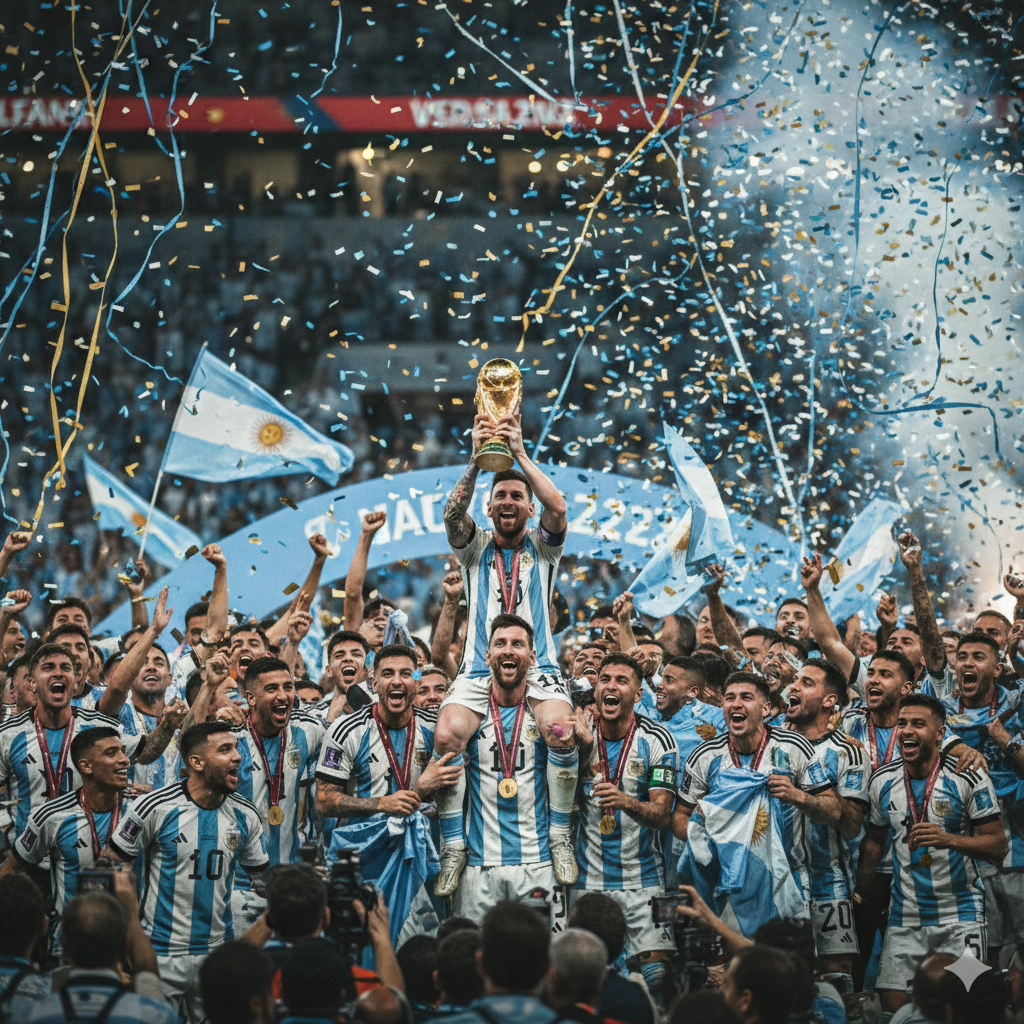
The roar of the crowd, the vibrant blue and white, and the unmistakable sense of both glorious possibility and heart-wrenching drama—this is the tapestry of the Argentina soccer team. For over a century, La Albiceleste has been more than just a collection of players; they have been the fiery, passionate standard-bearers of a unique footballing culture that prioritizes artistic flair, individual brilliance, and a palpable emotional connection with the game. They represent a global footballing institution built on a history that has seen the highest peaks of triumph and the deepest valleys of despair, always playing with a style so distinct it can be recognized anywhere in the world.
The Argentina soccer team has generated heroes whose names transcend the sport, figures whose very presence defines an era. From the early legends who established Argentina as a South American powerhouse to the transcendent genius of Diego Maradona, and now, to the completed legend of Lionel Messi, this nation has produced a disproportionate share of football’s most iconic talents.
Their journey is one of relentless pursuit, a quest for the ultimate glory that has captured the imagination of billions. Their story is a dramatic narrative written not just in goals, but in the collective passion of a nation that breathes football. It is this combination of artistic mastery and sheer emotional intensity that makes the Argentina soccer team a perpetual point of fascination and relevance in the global game.
Table of Contents
The Genesis of a Footballing Giant
The foundations of Argentinian football were laid in the late 19th century, influenced heavily by British immigrants who introduced the sport. However, the game quickly evolved to adopt a distinct, home-grown identity. By the 1920s and 30s, the Argentina soccer team was already a formidable force, participating in the first World Cup final in 1930 and establishing a legendary rivalry with neighbors Uruguay. The Argentinian style, often described as La Nuestra(“The Ours”), emphasized short, intricate passing, dribbling skills, and a more physical approach than its European counterparts. This commitment to an artistic, technical game ensured that even when the major trophies eluded them, the Albiceleste were always recognized for their captivating play.
The first definitive global triumph came on home soil in 1978, a complex, emotionally charged victory that cemented the team’s standing. While domestically crucial, it was the 1986 World Cup in Mexico that truly elevated the Argentina soccer team to legendary status worldwide. Led by Diego Maradona, a figure who embodied both the brilliance and the chaotic drama of Argentinian football, they delivered one of the most memorable World Cup campaigns in history. The 1986 tournament showcased the perfect blend of individual genius and strategic team play.
The Divine and the Drama: Diego Maradona
There is no separating the history of the Argentina soccer team from the legend of Diego Armando Maradona. His influence was so profound that for a generation of fans, the blue and white stripes represented his singular, unmatched brilliance. The 1986 quarter-final against England became the defining moment of his career and arguably the most analyzed five minutes in football history.
First, the controversial goal, famously dubbed the “Hand of God,” a moment of audacious trickery that spoke to the cunning and desperation often found in football folklore. But four minutes later, Maradona delivered a moment of pure, undeniable genius. Dribbling past five English players from his own half, he scored the “Goal of the Century,” a breathtaking display of skill, balance, and pace that remains a benchmark for individual goalscoring.
Maradona did not just lead the argentina soccer team to the World Cup trophy; he carried them on his back with a force of will that was almost spiritual. His performances were a complete expression of the national footballing soul: talented, passionate, defiant, and dramatic. The cultural significance of this victory cannot be overstated; it was a moment of national redemption and pride, forever linking the nation’s identity with the footballing success of the Argentina soccer team.
His enduring impact is such that decades later, every player who pulls on the shirt carries the weight of his legacy. If you want to dive deeper into the tactics and historical context of that famous tournament, you can find an excellent analysis of the 1986 World Cup Final on FIFA’s official website. https://www.fifa.com/tournaments/mens/worldcup/mexico1986/match-reports/1986-world-cup-final-argentina-v-west-germany
The Modern Era: The Age of Lionel Messi
If the 1980s belonged definitively to Maradona, the modern era of the Argentina soccer team has been defined by the extraordinary, often burdened, genius of Lionel Messi. Since his debut in 2005, Messi has carried the mantle of Argentine footballing hope, a silent, sublime force tasked with delivering the ultimate glory that had eluded the nation since 1986. For years, this pressure created a fascinating, and sometimes tragic, narrative of near-misses that only amplified the emotional drama surrounding the team.
The Weight of a Nation and the Near-Misses
The first phase of Messi’s international career was a string of heartbreaking final losses that seemed to haunt the Argentina soccer team. Three major finals were lost in three successive years: the 2014 World Cup Final in Brazil, followed by back-to-back Copa América final defeats in 2015 and 2016. These moments were characterized by a collective feeling that while the team possessed the most gifted player in the world, the final, decisive piece of fortune, or tactical cohesion, was missing.
This emotional turmoil even led to Messi briefly retiring from international football in 2016, a move that sent shockwaves across the country and the football world, underscoring the immense burden he faced. The public outcry for his return was immediate and profound, a clear indicator that, despite the missed trophies, the nation still saw him as their indispensable leader and brightest star.
The scrutiny placed upon the Argentina soccer team during this period was intense. They were frequently criticized for failing to replicate the club form of their superstar players, yet they consistently reached the final stages of the world’s toughest tournaments. This era solidified a core group of players—often referred to as the “Golden Generation” alongside Messi—who learned the hard lessons of defeat, forging a unity and resilience that would become crucial later on.
The Triumphant Closure: Glory Achieved
The breakthrough finally came in a manner that broke the 28-year drought for the Argentina soccer team. The 2021 Copa América victory against rivals Brazil at the Maracanã Stadium was a watershed moment. It was not just a title; it was the final, emotional hurdle cleared for Messi and his veteran teammates. The monkey was finally off their back, and the belief generated by this continental success—often dubbed the birth of “La Scaloneta” after coach Lionel Scaloni—catapulted the squad into an unprecedented run of form.
This newfound belief and tactical stability peaked at the 2022 FIFA World Cup in Qatar. Here, the Argentina soccer team played with a combination of their traditional garra (passion/grit) and a fluid, cohesive system built entirely around maximizing Messi’s influence. At 35, Messi delivered a tournament campaign of historic proportion, becoming the first player to score in the group stage, round of 16, quarter-final, semi-final, and final of a single World Cup. The final against France, widely regarded as one of the greatest matches in football history, saw Messi score twice in a dramatic 3-3 draw before the Argentina soccer team won the penalty shootout.
Statistical Zenith and Lasting Impact
Messi’s career is one defined by shattered records and unparalleled consistency. He is the most-capped player and the all-time leading goalscorer for the Argentina soccer team, holding multiple records for goal contributions in both the Copa América and the World Cup for his country. His seven goals and three assists in the 2022 tournament, earning him a record second Golden Ball, finally completed his footballing narrative.
His triumphs confirmed the current era of the Argentina soccer team as one of its most glorious. His career statistics, including a record eight Ballon d’Or awards and countless goalscoring achievements, firmly establish him not just as a national icon but as a figure whose mastery of the sport may never be repeated. For a comprehensive look at his incredible international record, including his goals and appearances, you can consult this extensive database of his statistics. https://www.transfermarkt.com/lionel-messi/nationalmannschaft/spieler/28003/verein_id/3437
The Age of Messi was a profound saga that tested the limits of a nation’s patience and the resilience of a singular talent. His ultimate success did more than just add a third star to the shirt; it provided the definitive, joyful climax to the modern history of the Argentina soccer team, ensuring his place alongside Maradona in the pantheon of footballing deities.
The Distinctive Argentinian Style and Its Fiery Rivals
The identity of the Argentina soccer team is not solely defined by the trophies in their cabinet but by the captivating manner in which they play the game—a style rooted in street football and an almost spiritual connection to the ball. This distinctive philosophy, often captured by the concept of La Nuestra, and the emotional fervor known as Garra, ensures that their matches are always an engaging spectacle, win or lose.
La Nuestra and the Cult of the Dribble
La Nuestra, which translates to “Our Way,” is the philosophical blueprint of Argentinian football, born in the narrow streets (potreros) and informal pitches of Buenos Aires in the early 20th century. In contrast to the rigid, organized, and physically direct style imported from Britain, La Nuestra champions individualism, spontaneity, and creativity. The essence of this style is the gambeta, or the slaloming dribble, where a player uses close control and cunning to bypass opponents. This focus on individual technique and improvisation means that the Argentinian game prioritizes beauty and enjoyment over the mechanical pursuit of victory.
While La Nuestra represents the idealistic, artistic side of the Argentina soccer team, their history is also marked by the perpetual debate between this idealism and pragmatism, famously termed Menottismo vs. Bilardismo—the beautiful game versus the winning game. This tension between art and efficiency is what makes Argentinian football so endlessly fascinating and dramatic.
Garra and the Emotional Component
While Argentina soccer team fans often speak of Garra, the term is more famously associated with their fierce neighbors and rivals, Uruguay. Garra (literally “claw” or “guts”) refers to a non-negotiable fighting spirit, tenacity, and courage in the face of adversity. For Argentinian players, this emotional commitment manifests as a deep, public passion, the tears of frustration, the sheer delirium of celebration, and the willingness to fight for every ball as if it were the last.
This emotionality fuels the intense atmosphere of their games and binds the players and the supporters in a collective, almost religious experience. The connection between the team and its supporters is so profound that the collective will of the nation often feels like an extra player on the pitch.
The Famous International Rivalries
The global standing of the Argentina soccer team is built on a series of historic international rivalries that consistently raise the stakes of any contest.
- Argentina vs. Brazil: Known simply as O Clássico, this is arguably the greatest international football rivalry on the planet. The clash pits the technical genius of La Albiceleste against the fluid, rhythmic beauty of Brazil’s Joga Bonito. Their competitive history, spanning major finals and World Cup encounters, represents the ultimate battle for South American footballing supremacy.
- Argentina vs. Uruguay: The rivalry with their small neighbor across the Río de la Plata is the oldest derby outside of Great Britain. Originating in the first tournaments of the 20th century, including the 1930 World Cup Final, this rivalry is a constant clash of closely related but fundamentally different football cultures, with Uruguay often embodying that pure Garra spirit.
- Argentina vs. England: The rivalry with England is one defined by historical and political significance. While sporting in nature, it was profoundly affected by the 1982 Falklands War. The 1986 World Cup quarter-final, featuring Maradona’s ‘Hand of God’ and the ‘Goal of the Century,’ elevated this fixture to a level of emotional intensity rarely seen in sport.
These clashes are not merely matches; they are cultural events that speak to history, national identity, and the very soul of South American football, cementing the Argentina soccer team‘s place as a cornerstone of the global game.
I found a video discussing the football culture of Argentina’s rivals. If you want to see how Uruguay’s national football mentality is captured, take a look at this video: La Garra Charrúa: Uruguay’s Secret to Glory.
La Garra Charrúa: Uruguay’s Secret to Glory – YouTube
Football: The Beautiful Game · 134 views


The Future: Sustaining the Argentinian Dynamo
The question that always follows a historic triumph is: what comes next? For the Argentina soccer team, the World Cup victory in 2022 was not an ending but a powerful generational transition. While the team’s narrative has long been defined by individual superstars, the current success under Lionel Scaloni has established a collective system and a culture of winning that sets the stage for a sustainable future, even as the legendary figures of the past generation step aside.
The Next Generation: Scaloneta’s Legacy
The current challenge for the Argentina soccer team is managing the inevitable departures of veterans like Lionel Messi and Ángel Di María. Fortunately, the recent successes have coincided with the emergence of a talented and dynamic core of players who are already world-class and are now stepping into leadership roles.
Midfielders like Enzo Fernández and Alexis Mac Allister are the engine room of the team, blending European tactical discipline with Argentinian technical flair. Fernández, the 2022 World Cup Young Player of the Tournament, controls the tempo with exceptional passing and spatial awareness, while Mac Allister offers versatility and drive. Up front, the goal-scoring burden is already being shared effectively by Lautaro Martínez and the relentless Julián Álvarez, two world-class strikers who represent the modern, high-pressing, and versatile Argentine forward.
Beyond this established core, the pipeline of talent remains as rich as ever. The national team coach is actively integrating a new wave of prospects, often referred to as the next generation of La Albiceleste, into the senior squad. Players like winger Alejandro Garnacho of Manchester United, known for his explosive pace and audacious skill, and playmaker Valentín Carboni, who has impressed in Serie A, are being given crucial exposure.
In defense, young talents like left-back Valentín Barco and centre-back Nicolás Valentini are being groomed to take over from the veterans, ensuring that the team remains defensively solid and technically adept at playing the ball out from the back. These young players carry the memory of the 2022 triumph, giving them a motivation and belief that was absent in previous generations.
The World Cup Effect on Youth Development
The 2022 World Cup win served as a massive cultural and psychological boost, impacting football at the grassroots level. The victory has reinvigorated the youth development system, providing an unambiguous example of what can be achieved through a combination of individual talent and collective sacrifice. Many of Argentina’s youth teams, particularly the U-20 side, have seen their performance and cohesion rise, often playing with the aggressive, talented, and tactically disciplined style of the senior squad. The country’s domestic league continues to be a powerhouse for producing gifted players, known for their garra and technical proficiency, before they make the jump to major European clubs.
The confidence and global visibility garnered by the Argentina soccer team ensures that the flow of talent will not cease. The system is designed to produce skillful, determined players ready to wear the revered blue and white shirt. The future of the Argentina soccer team is anchored not just in one player, but in a philosophy that constantly replenishes itself with passionate, world-class talent, eager to add their own chapters to the nation’s epic footballing story.
A Legacy Beyond the Trophies
The history of the Argentina soccer team is a story written in extremes: the dizzying highs of three World Cup titles, the depth of emotional passion, and the consistent production of players who redefined the boundaries of footballing genius. From the street artistry of La Nuestra to the unmatched charisma of Maradona and the systematic brilliance that delivered Messi his long-awaited World Cup, the Albiceleste has always guaranteed drama, skill, and an unforgettable spectacle.
Their legacy is cemented not just in the glittering silverware, but in the cultural significance the team holds for millions around the world. The Argentina soccer team represents tenacity, the pursuit of perfection, and the emotional power of sport to unite a nation. As the torch passes from the legendary generation to a talented new guard led by players like Enzo Fernández and Julián Álvarez, the future of the Argentina soccer team remains bright, driven by the belief that the “Argentinian Way” will always lead to moments of footballing ecstasy. Their enduring influence ensures that whenever the blue and white stripes take the pitch, the entire football world stops to watch the spectacle unfold.
Don’t Miss the Next Prediction: Join the Inner Circle!
You’ve explored the thrilling history and enduring legacy of the Argentina soccer team, from the fire of Maradona to the ultimate triumph of Messi. But the world of football never stops turning, and the next major tournament, the next shocking transfer, or the next legendary match is just around the corner.
Do you want to be ahead of the curve?
If you appreciate the in-depth analysis and historical context found in this article, you’ll love our exclusive predictions. We blend historical trends, deep statistical analysis, and expert insight to deliver the most accurate forecasts for upcoming matches and tournaments.
Subscribe Now for the Best Predictions in Football!
- Exclusive Insight: Get match previews, injury updates, and tactical breakdowns delivered directly to your inbox.
- The Edge: Receive our proprietary best predictions for major leagues, cup competitions, and international fixtures.
- Never Miss a Beat: Be the first to know about the next generation of Argentine stars and how they’ll impact the global stage.
Join thousands of informed fans! Enter your email below and tap into the future of football analysis.











Comments 2