

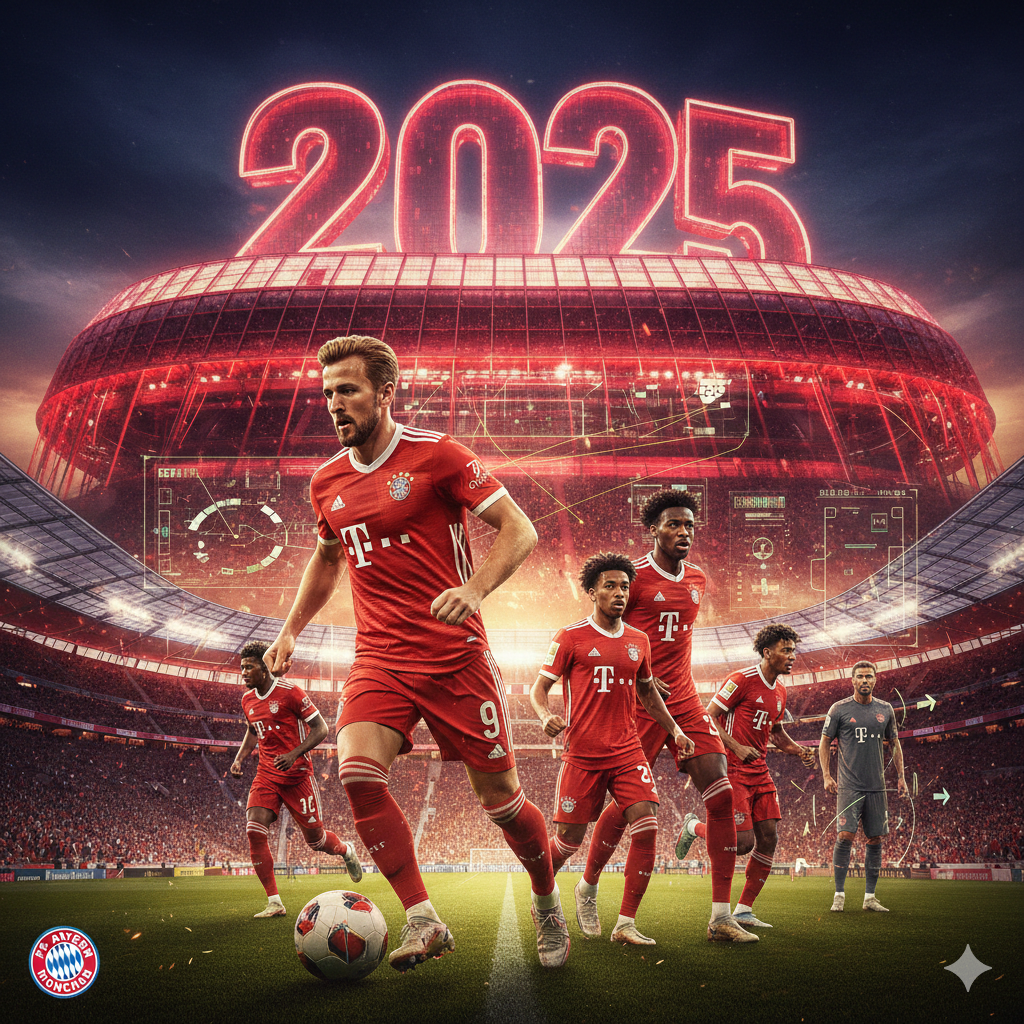
The Unstoppable Juggernaut in 2025
Bayern Munich football is not just a club; it is an institution, a dominant force whose success is measured not in cups won, but in the near-certainty of their triumph. As we navigate the 2025/2026 season, the Rekordmeister—the Record Champions—stand on the cusp of yet another era of glory, combining historic financial strength with shrewd managerial appointments and world-class squad depth. This is a club that redefined German football dominance, winning their 34th German championship in May 2025 and providing striker Harry Kane with his first major career trophy.
But what keeps this colossal machine running in 2025? It’s a complex tapestry woven with tactical innovation under new management, calculated investments in key transfer windows, and the unique culture of Bayern Munich footballthat demands nothing less than perfection. From the hallowed halls of the Säbener Straße training facility to the deafening roars of the Allianz Arena, the commitment to elite performance is absolute.
For fans, rivals, and football analysts alike, understanding Bayern Munich football in 2025 requires looking beyond the league table. It means dissecting the Vincent Kompany revolution, analyzing the new signings that have bolstered key areas, and appreciating the financial model that keeps the club competitive with Europe’s oil-rich giants. This complete guide provides an in-depth look at the structure, the stars, and the strategy powering Germany’s most formidable club.
This season promises compelling challenges, particularly in the UEFA Champions League, and continued pressure to maintain their record-breaking Bundesliga streak. The narrative of Bayern Munich football is one of perpetual ambition, where past success is merely the foundation for the next trophy.
Table of Contents
The Vincent Kompany Revolution: Tactical Shift and Managerial Philosophy
The appointment of Vincent Kompany as Head Coach marks one of the most intriguing managerial decisions in the recent history of Bayern Munich football. Succeeding Thomas Tuchel, the former Manchester City captain arrived in Munich following a tumultuous yet tactically insightful period at Burnley. His mandate is clear: maintain domestic supremacy while re-establishing the club as the undisputed leader in Europe.
1. The Kompany Blueprint: Positional Play and High Press
Kompany’s managerial style, heavily influenced by his mentor Pep Guardiola, is focused on aggressive, possession-based football with a high defensive line. The core philosophy of Bayern Munich football under Kompany can be summarized by three principles:
- Build-up from the Back: Goalkeeper Manuel Neuer and the central defenders (like Dayot Upamecano and new signing Jonathan Tah) are integral to initiating attacks, drawing opponents forward to create space higher up the pitch.
- Intense Counter-Pressing (Gegenpressing): Immediately after losing the ball, the team swarms the opponent to regain possession within seconds. This high-octane phase of play is a defining characteristic of modern Bayern Munich football and requires peak physical conditioning.
- Positional Versatility: Players like Joshua Kimmich and Jamal Musiala are granted positional freedom to exploit half-spaces, ensuring that the attacking shape is fluid and unpredictable.
Kompany has shown resilience, guiding the club to the Bundesliga title in his first season (2024-2025) and securing the Franz Beckenbauer Supercup at the start of the 2025-2026 campaign. His focus remains on the long-term, noting the early benchmarks set in the Champions League are merely preparations for the “crunch time” of 2026.
2. The Coaching Staff and Culture
The culture at the Säbener Straße is being subtly adapted. Kompany’s presence, combined with the leadership of veterans like Neuer and Thomas Müller’s celebrated career concluding at the end of the previous season, has instilled a renewed sense of resilience. The coach’s emphasis on mentality was evident in hard-fought victories, underscoring that Bayern Munich football demands not just technical quality but also unwavering psychological fortitude. This holistic approach to player development and performance is essential for long-term dominance. For a detailed look at the club’s administrative structure, you can read more here: official FC Bayern Munich club structure.
The 2025/2026 Squad: Star Power and Strategic Depth
The 2025 squad is a blend of established world-beaters and high-potential, strategically acquired talent, aimed at maintaining the superiority of Bayern Munich football across all competitions.
1. Key Signings and Departures
The summer transfer window saw several crucial movements that redefined the squad:
| Position | Player | From | Impact on Bayern Munich Football |
| DF (CB) | Jonathan Tah | Bayer Leverkusen | A free transfer acquisition, Tah adds immense physicality and experience to the center-back rotation, bolstering a key area of the defense. |
| FW (LW) | Luis Díaz | Liverpool | A significant investment (€70 million), Díaz provides blistering pace and directness on the left wing, complementing the creative forces centrally. |
| FW (CF) | Nicolas Jackson | Chelsea | Arriving on loan, Jackson offers an alternative profile to Harry Kane, bringing youthful energy and pressing ability to the attacking line. |
The club also bid farewell to veteran forward Leroy Sané and defender Eric Dier, marking a clear generational shift. The squad’s current value reflects the high calibre of players, with stars like Jamal Musiala commanding a reported market value of €140 million, cementing their status as a European elite. This consistent, aggressive approach to strengthening is a hallmark of successful bayern munich football strategy.
2. The Core Pillars of the Squad
The spine of Bayern Munich football remains incredibly strong:
- Harry Kane: The talismanic English striker, having finally lifted his first major trophy with the 2025 Bundesliga title, continues to be the central attacking focal point and one of the world’s most complete forwards.
- Jamal Musiala: The German phenom is the creative heartbeat, possessing the skill and close control to break down deep defenses, making him indispensable in Kompany’s system.
- Joshua Kimmich: Serving as vice-captain, Kimmich remains the engine room in midfield, dictating the tempo, providing defensive solidity, and executing the precision passing required for the Kompany-style attack.
- Manuel Neuer: The legendary captain, even at 39, continues to set the benchmark for the modern sweeper-keeper, his leadership and shot-stopping crucial to the team’s success.
The depth and quality across the pitch ensure that the intense demands of fighting for the Bundesliga, DFB-Pokal, and the UEFA Champions League are manageable.
Allianz Arena: The Fortress of Bayern Munich Football
The home of Bayern Munich football is as much a symbol of modern success as the trophies the club lifts. The Allianz Arena, often affectionately nicknamed the ‘Schlauchboot’ (the inflatable dinghy) due to its unique, air-cushioned façade, is a breathtaking architectural landmark in Munich’s northern district of Fröttmaning. Since its opening in 2005, it has transcended the role of a mere stadium, becoming a pulsating fortress where domestic and European dreams are forged.
In 2025, the Arena holds a capacity of 75,024 for domestic Bundesliga matches, including standing sections that provide the fervent atmosphere characteristic of German football. For international competitions, such as the UEFA Champions League, the capacity is adjusted to 70,000 seats. One of the stadium’s most famous features is its exterior, an LED lighting system capable of displaying 16 million colors, which glows an iconic, intimidating red on home matchdays, announcing to all visitors the powerful presence of Bayern Munich football.
The Arena’s location received a significant, touching update in 2025. Following the passing of the club and German football legend Franz Beckenbauer, the stadium’s address was officially renamed to Franz-Beckenbauer-Platz 5. This tribute immortalizes the “Kaiser” at the heart of the club’s modern operations, reminding every player and fan that the current era of success stands on the shoulders of giants. The atmosphere generated within this modern cathedral of sport is unparalleled, especially when the Südkurve (South Curve) ultra groups are in full voice. Their collective support turns the stadium into a kinetic force, a crucial twelfth man in the biggest European nights that have become synonymous with the recent history of Bayern Munich football.
The Allianz Arena is more than a pitch; it is the physical manifestation of the club’s identity, commitment to innovation, and respect for its legacy. For every visiting player, walking out under the glowing red lights is a reminder that they are entering the most dominant fortress in German football. This enduring legacy ensures the Allianz Arena will remain the beating heart of Bayern Munich football for years to come.
The Dominance Factor: Financial Might and The “FC Hollywood” Narrative
The supremacy of Bayern Munich football in 2025 is a two-sided coin: one side is minted with iron-clad financial stability, and the other is etched with a dramatic, often turbulent, history known as “FC Hollywood.” This unique combination of fiscal prudence and media flash sets the club apart from its rivals, both domestically and internationally.
Financial Stability: The German Model
While many European giants are propped up by billionaire owners or state funds, the financial dominance of Bayern Munich football is built on a resilient, self-sustaining model guided by the Bundesliga’s 50+1 rule. This rule mandates that the parent club (the member-owned association, FC Bayern München e.V.) must hold at least 50% plus one of the voting shares in the professional football company (FC Bayern München AG).
This fan-centric structure ensures that the club prioritizes stability over reckless spending. Despite this constraint, the club’s business model is a powerhouse:
- Record Revenue: For the 2024/2025 financial year, Bayern Munich football once again posted a record turnover of €978.3 million and a net profit of €27.1 million. This financial muscle is generated primarily through three robust streams: commercial partnerships, matchday income (at €260.7 million, a major contributor), and worldwide merchandising.
- The Commercial Juggernaut: Bayern’s commercial partnerships are the strongest in the Bundesliga, featuring long-term relationships with global brands like Deutsche Telekom, Adidas, Audi, and Allianz. Their squad value, consistently reported at over €900 million, further reflects this economic strength.
- A Global Community: The club’s stability is reinforced by its massive, engaged membership base, which grew to over 432,500 in 2025, the largest of any football club worldwide. This collective ownership reinforces the “Mia san Mia” (We are who we are) ethos of self-reliance, providing an undeniable competitive edge.
As CEO Jan-Christian Dreesen stated in late 2025, “We don’t spend more than we earn.” This fundamental, debt-averse philosophy allows the club to maintain a top-tier squad, including the highest wage bill in the Bundesliga, without the volatility seen in other major European leagues.
The “FC Hollywood” Narrative
Despite the boardroom’s strict financial control, the on-pitch and off-pitch life of Bayern Munich football has often been anything but stable. The nickname “FC Hollywood” originated in the 1990s, a period marked by high-profile internal disputes, public feuds between star players, and dramatic media coverage.
This narrative is characterized by:
- Ego and Conflict: The club was historically a stage for strong, sometimes clashing, personalities, such as the famous bust-up between Lothar Matthäus and Jürgen Klinsmann. These incidents, though disruptive, ensured the club was always headline news.
- The Uli Hoeneß Factor: Former President Uli Hoeneß and his executive colleagues were famously outspoken, often using media interviews to openly criticize players, coaches, or referees. This created a culture where the club’s drama was often as compelling as its victories.
- Maintaining the Spotlight: Even in 2025, with a more controlled environment under Kompany, the “FC Hollywood” element persists in a more subtle form. The club’s constant, relentless pursuit of domestic and European records, its significant transfer activity, and the sheer star power of players like Harry Kane and Jamal Musiala ensure that the media spotlight on Bayern Munich football remains the brightest in Germany. The drama is simply a guaranteed byproduct of their ambition and constant public scrutiny.
In essence, Bayern Munich football leverages both extremes: the rational, secure business model provides the foundation for success, while the lingering “Hollywood” flair guarantees global attention and engagement, feeding the commercial engine that keeps the dominance machine running.
This video chronicles the history of FC Bayern Munich, including the origins of the “FC Hollywood” moniker and the club’s dramatic rise to global power. FC Bayern Munich History for your pillow
FC Bayern Munich History for your pillow – YouTube


Looking Ahead: FIFA Club World Cup and European Ambitions
As a perennial powerhouse, FC Bayern Munich’s gaze is always fixed on the biggest international prizes, with the immediate future dominated by two major competitive stages: the UEFA Champions League and the inaugural expanded FIFA Club World Cup.
The Pursuit of the Seventh European Title
Reasserting dominance on the continental stage remains the club’s defining ambition. The UEFA Champions League (UCL) is the ultimate benchmark, and under coach Vincent Kompany, the long-term focus has been clearly placed on reaching the final in Budapest in 2026.
- Current European Campaign: Bayern’s performance in the 2025/26 UCL season has been strong, demonstrating a clear ability to compete against Europe’s elite. Despite a recent 3-1 defeat to Arsenal in the league phase, the team had previously secured key victories, including a 2-1 win over reigning champions Paris Saint-Germain, solidifying their status as top contenders.
- Managerial Vision: Coach Kompany views the current stage of the season as crucial preparation for the “big moments” of the knockout stages, emphasizing resilience and the need to peak when the decisive fixtures arrive in the new year.
The Expanded FIFA Club World Cup 2025
The summer of 2025 will see Bayern compete in the debut of the expanded 32-team FIFA Club World Cup, held in the United States from June 14 to July 13.
- Qualification and Pedigree: Bayern qualified for the tournament as one of the best-ranked eligible teams in the UEFA four-year ranking, cementing their consistent European presence. They will aim to maintain their perfect record in the competition, having won both of their previous Club World Cup appearances (in 2013 and 2020).
- Tournament Status: Having successfully navigated Group C against teams like Boca Juniors, Bayern has already qualified for the knockout rounds. The club is set for a high-profile Quarter-final clash against European rival Paris Saint-Germain (PSG) on July 5, 2025, in Atlanta, Georgia. This tournament provides an opportunity to become the inaugural champions of the expanded format and add another piece of global silverware to the club’s decorated history.
How to Follow Bayern Munich Football in 2025
The global dominance of Bayern Munich football is matched by the club’s robust digital presence, ensuring fans worldwide can easily stay connected to the action, from the Bundesliga’s winter break to the late stages of the UEFA Champions League.
1. The Broadcast Ecosystem: Where to Watch
Following all competitions requires access to multiple streaming and television partners, particularly across the biggest international markets:
- Bundesliga (Germany’s Domestic League): In the United States, every Bundesliga match is streamed exclusively on ESPN+ (with select marquee games sometimes appearing on ABC or ESPN). In the UK, rights are typically shared across major broadcasters and streaming services like Sky Sports or TNT Sports.
- UEFA Champions League (UCL): The exclusive home of the UCL in the US is Paramount+, which streams every match live, while in the UK, coverage is shared primarily between TNT Sports (via Discovery+) and sometimes Amazon Prime Video.
- DFB-Pokal and Supercup: Coverage for these domestic cup competitions is often bundled with the Bundesliga rights, meaning US fans can typically find these games on ESPN+.
2. The Digital Hubs: A 24/7 Connection
FC Bayern was named the Bundesliga’s social media champion for 2024/25, a testament to their dedication to digital engagement. The club communicates globally in ten languages, providing an incredible wealth of information:
- Official Website (fcbayern.com): The central source for all breaking news, match reports, and tickets.
- Social Media: Follow the club’s main accounts on Instagram, X (formerly Twitter), and YouTube for real-time updates, highlights, and behind-the-scenes access. They also have specialized accounts, such as @fcbayernpathway, which offers unique insights into the youth and talent development programs—the pipeline for future Bayern Munich football stars.
- The Club App: The official app is essential for live ticker updates, push notifications for every goal, and curated content.
3. Joining the Global Family
For many, the best way to experience Bayern Munich football is as part of the massive, thriving community. With over 4,425 officially registered fan clubs and over 328,564 members worldwide, the support system is unparalleled.
- International Presence: The club has cemented its global footprint with international offices in New York, Shanghai, Bangkok, and a new location in Seoul (opened in 2025). These offices support the fan base, coordinating large-scale events like regional fan club meetings held during the FIFA Club World Cup in the USA.
- Find a Fan Club: Joining a local official fan club is the simplest way to find organized match-watching parties and share the “Mia san Mia” spirit.
The relentless ambition of Bayern Munich football is mirrored by the club’s seamless ability to connect with its fans globally, ensuring that no matter where you are, you are part of the journey.
The Relentless Pursuit of Glory
The year 2025 finds Bayern Munich football not resting on its laurels, but accelerating its pursuit of perfection. This complete guide has dissected the machine: a blend of visionary tactics under Vincent Kompany, strategic investment in world-class talent like Harry Kane and Jamal Musiala, and the unwavering financial fortress built on the principle of self-sufficiency.
From the glowing red walls of the newly rededicated Allianz Arena (now Franz-Beckenbauer-Platz 5), to the intense, data-driven training sessions at Säbener Straße, every element of the club is optimized for victory. The Bayern Munich football narrative, a fusion of corporate stability and the dramatic flair of “FC Hollywood”, has created a global behemoth that is both envied and admired.
Looking ahead, the calendar is packed with challenges that will define this era: defending the Bundesliga title, conquering the inaugural expanded FIFA Club World Cup, and, most importantly, achieving the ultimate European prize, the UEFA Champions League. The collective strength of the club, from the leadership of the Vorstand to the passionate roar of the Südkurve, demands nothing less than absolute success.
In 2025, Bayern Munich football remains the gold standard, a testament to what is possible when history, strategy, and relentless ambition converge. The club’s relentless pursuit of glory continues, setting a benchmark for dominance that is unlikely to be matched soon.
Call to Action: Don’t Miss the Next Move!
The success of Bayern Munich football isn’t built on luck; it’s built on meticulous planning, data analysis, and forward-looking strategy. We’ve shown you the blueprint for their 2025 dominance, from Kompany’s tactics to their financial might.
Now, take the next step and stay ahead of the game with the most informed analysis available.
Get Our Elite Predictions Sent Straight to Your Inbox!
If you’ve enjoyed this deep dive into Germany’s most powerful club, imagine having our expert analysis and bold predictions for every major fixture and transfer move delivered directly to you.
Subscribe to our exclusive newsletter today and receive:
- Tactical Forecasts: Pre-match breakdowns analyzing Kompany’s predicted starting XI and opponent weaknesses.
- Transfer Rumor Insights: Early, credible analysis on who Bayern Munich football is targeting next.
- Performance Metrics: Post-match analysis of key players like Kane and Musiala using advanced statistics.
Don’t wait until the next title is won to catch up. Join the informed elite.
Subscribe Now for Exclusive Bayern Analysis!
Be the first to know the winning strategy.









Comments 3